"DELHI: A CITY UNDER A CLOUD OF POISON"
Opinion/Editorial
By Col (Dr.) Ashwani Kumar, MiD, VSM (Retd.)
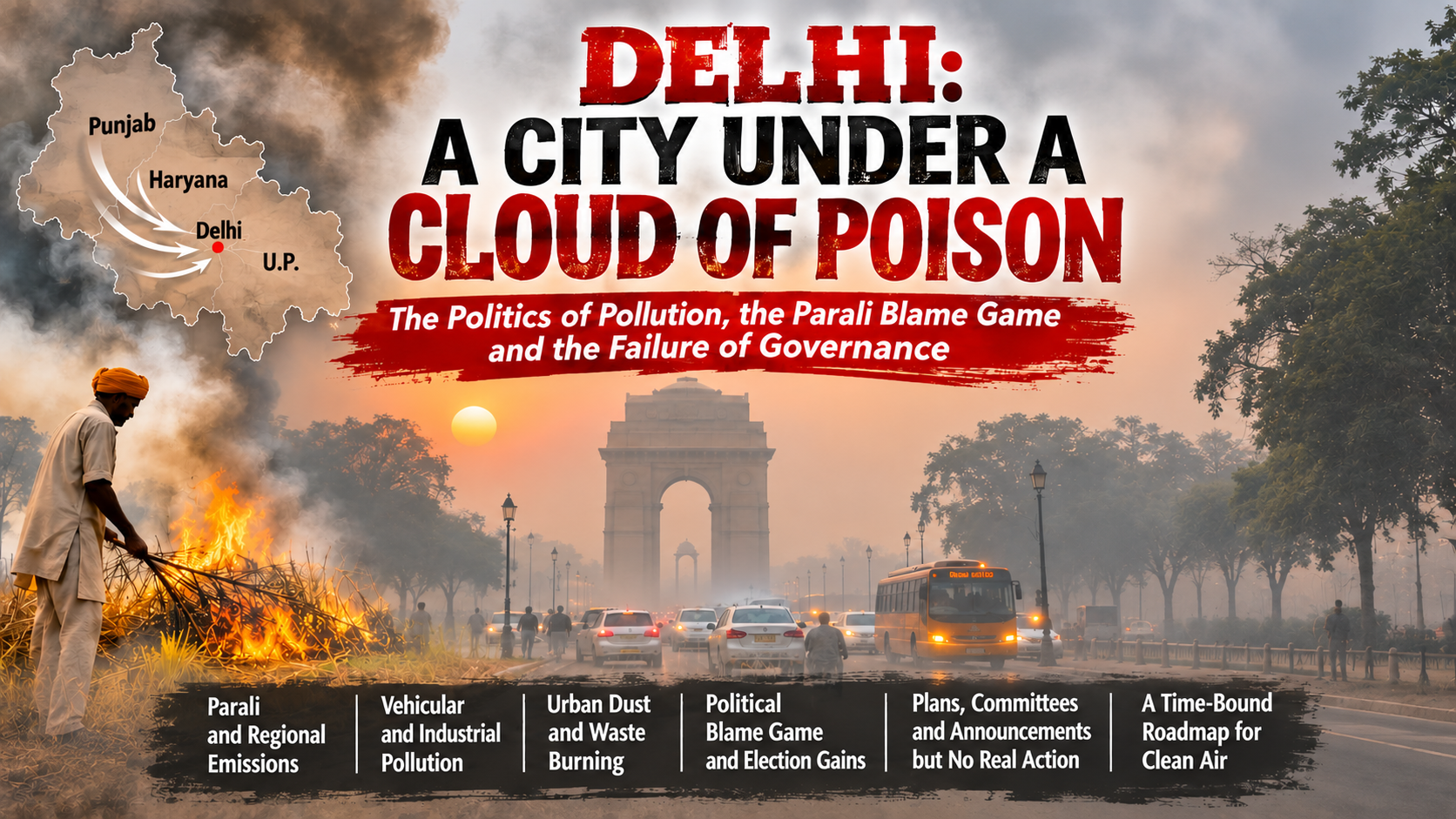
The Politics of Pollution, the Parali Blame Game and the Failure of Governance
An editorial on the environmental emergency, political accountability and the urgent need for a comprehensive clean-air strategy.
A National Capital Struggling to Breathe
Delhi, the capital of the world's largest democracy, is increasingly becoming a city where breathing clean air is no longer an ordinary expectation but a privilege. Every year, as winter approaches, a familiar environmental crisis unfolds. Smog descends upon the city, visibility deteriorates, eyes burn, breathing becomes difficult and millions of residents are exposed to highly polluted air.
Children, senior citizens, people with respiratory conditions and even otherwise healthy individuals are compelled to adjust their daily lives according to air quality. Schools face restrictions, outdoor activities are curtailed, construction work may be restricted and emergency pollution-control measures are announced.
As of November 12, 2026, Delhi's Air Quality Index (AQI) was around 313, placing it in the 'Very Poor' category, with Stage III of the Graded Response Action Plan (GRAP) in force.
The uncomfortable question is why this situation continues despite successive governments, numerous committees, public expenditure and repeated pollution-control announcements. The challenge is no longer simply a lack of awareness. It is also the difficulty of translating policies, resources and plans into sustained action.
Pollution Is Not a One-Source Problem
It is convenient to identify one culprit, but Delhi's pollution results from several interacting sources. Vehicular emissions, industrial activity, construction dust, road dust, waste burning, diesel generators, residential fuel consumption and agricultural residue burning all contribute to the problem.
The situation becomes particularly difficult during winter because of meteorological conditions. Low wind speeds, temperature inversion and a shallow atmospheric boundary layer can prevent pollutants from dispersing, allowing them to remain concentrated close to the ground.
A February 2026 assessment considered by the Commission for Air Quality Management (CAQM), based on source-apportionment studies conducted between 2015 and 2025, identified secondary particulates as an important contributor to winter PM2.5, accounting for an estimated 27 per cent. Transport contributed 23 per cent, biomass burning 20 per cent, dust 15 per cent and industry, including thermal power plants, nine per cent. These figures are broad assessment estimates and should not be treated as fixed daily contributions.
This assessment indicates that Delhi cannot address its pollution crisis by concentrating exclusively on stubble burning. Urban emissions and other regional sources also require sustained attention.
Punjab's Parali: A Genuine Problem, but Not the Entire Explanation
Every winter, Punjab's paddy stubble burning becomes a major part of the political and public debate. There is no denying that agricultural residue burning contributes to seasonal pollution.
Farmers burn paddy residue partly because they face a narrow interval between harvesting paddy and preparing fields for the next wheat crop. Removing the residue mechanically requires machinery, labour, time and money. For many small and marginal farmers, burning can appear to be the quickest and least expensive option.
However, placing the entire responsibility on farmers would overlook the wider agricultural and economic factors involved. The issue is also connected with cropping patterns, procurement incentives, water-intensive paddy cultivation and the availability of economically viable alternatives for residue disposal.
Governments have distributed machinery, announced subsidies and promoted alternative technologies. However, the gap between policy announcements and effective field-level implementation remains an important concern.
Happy Seeders, Super Seeders, mulching, in-situ residue management, biomass-based power generation and compressed biogas provide potential alternatives. Farmers need affordable technology, assured support and viable economic incentives to reduce dependence on burning.
How Does Pollution from Punjab Reach Delhi?
The movement of agricultural smoke is a scientific phenomenon rather than a political allegation. During certain post-monsoon and early-winter periods, northwesterly winds can carry smoke and particulate matter from agricultural areas of Punjab towards Haryana and the Delhi-NCR region. During this movement, pollutants can mix with emissions from vehicles, industries, construction and other local sources.
The direction and intensity of this movement depend on wind speed, atmospheric conditions and weather patterns. Therefore, it would be scientifically inaccurate to assume that every pollution episode in Delhi originates in Punjab.
Research has identified northwestern transport signatures from agricultural regions of Punjab and Haryana during several polluted periods, while also recognising the importance of local urban sources. The distinction is important: Punjab's contribution is real, but Delhi's pollution is both a regional and local problem.
What About Haryana and Uttar Pradesh?
An objective discussion must also acknowledge crop-residue burning in Haryana and Uttar Pradesh. These states have their own agricultural fires, industrial emissions, construction activity and urban pollution sources.
Haryana's proximity to Delhi makes emissions from certain districts particularly relevant. Industrial clusters, vehicular movement, construction and agricultural burning in neighbouring areas can influence the capital's air quality.
Uttar Pradesh also contributes through urban and industrial emissions, road dust, waste burning and agricultural practices.
Satellite-based monitoring covers Punjab, Haryana, Uttar Pradesh, Rajasthan and Delhi. Coordinated monitoring of crop-residue burning and other pollution sources across these jurisdictions is therefore important.
The larger question is whether the public debate should focus on one state or move towards a comprehensive regional understanding of pollution.
The Politics of Pollution and the Question of Accountability
One of the most contentious aspects of the pollution crisis has been the political debate over responsibility.
When the Aam Aadmi Party governed Delhi and Punjab, BJP leaders repeatedly criticised the AAP governments over pollution and stubble burning. During subsequent pollution crises, BJP leaders continued to raise questions about the performance of AAP governments, while AAP leaders highlighted pollution sources in BJP-governed Haryana and Uttar Pradesh.
The political landscape has since changed. The BJP governs Delhi, Haryana and Uttar Pradesh, while Punjab continues under the AAP. The BJP also leads the Central Government.
Yet Delhi continues to face serious air-quality challenges. This raises a broader question of governance: regardless of which political party is in power, how effectively are governments addressing the sources of pollution within their respective jurisdictions?
This should not be viewed merely as an accusation against one political party. It is a question of accountability across governments and institutions.
Political debates over pollution are inevitable, but they should not replace measurable action. Pollution does not recognise political boundaries, party flags or electoral calculations.
Governments are elected to provide solutions. Political leaders in power must therefore accept responsibility for their own performance while also cooperating with neighbouring governments on a problem that crosses administrative boundaries.
The people need clean air and effective action rather than competing explanations for why previous administrations failed.
Government Action: Plans Are Plentiful, Implementation Remains the Challenge
India does not suffer from a shortage of environmental policies and institutions. The National Clean Air Programme, CAQM, CPCB, DPCC, GRAP, state pollution-control boards and municipal mechanisms all have roles to play. The more important question is how effectively these systems operate on the ground.
Every winter, governments announce construction restrictions, vehicle regulations, water sprinkling, road cleaning, anti-smog measures and industrial inspections. Emergency meetings are held, committees review the situation and departments issue fresh instructions.
But the recurrence of the same problems raises important questions. Why do roads continue to generate dust? Why do construction sites continue to face compliance challenges? Why do vehicles with excessive emissions remain on the roads? Why do landfill fires and open garbage burning continue to occur? Why are industrial violations not prevented before they become part of an emergency response?
The regulatory machinery exists, but its effectiveness in preventive enforcement remains a matter of concern. Pollution control cannot begin only when AQI reaches severe levels. It requires continuous administrative attention throughout the year.
Public Responsibility: Citizens Must Also Change
It would also be unfair to place the entire responsibility on governments. Citizens contribute to the problem through unnecessary use of private vehicles, burning of household waste, poorly maintained vehicles and disregard for local environmental rules.
People can contribute by using public transport, carpooling and cleaner mobility options wherever practical. Residents' associations can discourage waste burning, report violations and participate in local environmental initiatives.
A cleaner environment cannot be created through government orders alone. It requires changes in public behaviour and civic responsibility as well.
A Practical Roadmap: From Announcements to Action
Delhi requires a comprehensive, measurable and time-bound pollution-control programme. Several areas deserve priority.
Transport and Mobility: Expand electric buses, improve Metro connectivity and last-mile transport, enforce vehicle-emission standards and reduce traffic congestion. Vehicles that fail pollution checks should face effective enforcement.
Industrial Pollution: Install continuous emission-monitoring systems in major polluting units. Habitual violators should face appropriate enforcement, while unauthorised industrial operations must remain subject to scrutiny.
Construction and Road Dust: Make dust-control arrangements compulsory at construction sites. Mechanised road sweeping, road repair, covering exposed soil and proper disposal of collected dust should be strengthened.
Agricultural Residue Management: Punjab, Haryana and Uttar Pradesh should strengthen district-level residue-management programmes. Machinery should be accessible through Custom Hiring Centres, particularly for small farmers. Residue can be utilised for biomass fuel, compressed biogas and other commercially useful applications, with timely financial and technical assistance for farmers.
Waste Management: Open garbage burning must be prevented, landfills should be scientifically managed and landfill fires should be addressed promptly. Waste segregation and proper disposal also require sustained attention.
Health Protection: Schools, hospitals and public institutions should have appropriate clean-air measures. Health advisories should be issued promptly, particularly during severe pollution episodes, and vulnerable citizens should have access to necessary healthcare.
Independent Monitoring: Pollution-control expenditure and performance should be independently assessed. Satellite imagery, ground inspections and real-time monitoring can help verify actual results rather than merely measuring the number of announcements and meetings.
One Regional Strategy, Not Multiple Competing Responses
The Delhi-NCR pollution problem requires coordinated action by the Central Government and the governments of Delhi, Punjab, Haryana, Uttar Pradesh and Rajasthan.
CAQM should be strengthened as an effective regional coordinating and enforcement institution. States should have measurable pollution-reduction targets, district-level responsibilities and publicly available performance reports.
A practical programme should have clear milestones:
- Within 30 days: Identify pollution hotspots, enforce restrictions on open burning and inspect major polluting establishments.
- Within six months: Strengthen public transport, road-dust management, industrial monitoring and agricultural residue infrastructure.
- Within one year: Conduct an independent assessment of state-level performance and publish measurable results.
Every department should have a designated responsible officer, a financial allocation and a clear deadline. Failure to implement directions should invite appropriate administrative action.
The objective should not be to produce another impressive policy document, but to demonstrate measurable improvement in the air people breathe.
The Time Has Come for a Change
Delhi is the national capital and the seat of Parliament, the Supreme Court and several major institutions of the Republic. Yet its citizens repeatedly face an environment in which clean air can become a privilege rather than an everyday expectation.
Children should not grow up considering prolonged exposure to polluted air normal. Senior citizens should not have to remain indoors because outdoor air quality is unsafe. Ordinary citizens should not have to choose between earning their livelihood and protecting their health.
The time has come to change the way pollution is governed, administered and addressed.
A government should ultimately be judged not only by the accusations it makes against its predecessors, but also by the problems it resolves during its own tenure. Political equations may change, but the pollution problem will remain unless there is a fundamental change in approach.
Punjab's farmers need practical alternatives, Delhi needs stronger urban pollution management, Haryana and Uttar Pradesh must address their regional responsibilities, and the Central Government must ensure coordination and accountability.
This issue is bigger than politics. It concerns the lives and health of millions of people.
Delhi does not need another winter dominated by promises and political arguments. It needs sustained action, measurable outcomes and cooperation across governments, institutions and communities.
Clean air is not a political favour. It is a basic necessity of life and a shared responsibility of governments, institutions and citizens.
About the Author
Col (Dr.) Ashwani Kumar, MiD, VSM (Retd.) is a former Indian Army officer with experience in military intelligence, national security, strategic affairs and public administration. During his career, he served in operational areas and held assignments in the Cabinet Secretariat and Bureau of Police Research and Development, Ministry of Home Affairs. A recipient of the Mentioned-in-Despatches and Vishisht Seva Medal, he writes on national security, governance, strategic affairs, history and contemporary public issues.
Disclaimer:
This article represents the author's independent views and opinions based on publicly available information, published assessments and personal analysis. References to political parties, governments and public institutions are made in the context of their publicly reported actions and responsibilities. The article does not intend to target or endorse any political party or individual. Pollution estimates and scientific assessments may vary according to location, season, methodology and prevailing meteorological conditions. Readers are encouraged to consult official environmental data and scientific publications for further details.