Dubai–Tel Aviv Flight Hijack Alert: Plane Diverted and Safely Landed in Saudi Arabia
Dubai–Tel Aviv Flydubai Flight Hijack Alert: Plane Diverted to Saudi Arabia After Cockpit Incident
By Ankit Kumar Mishra World Desk | September 30, 2026
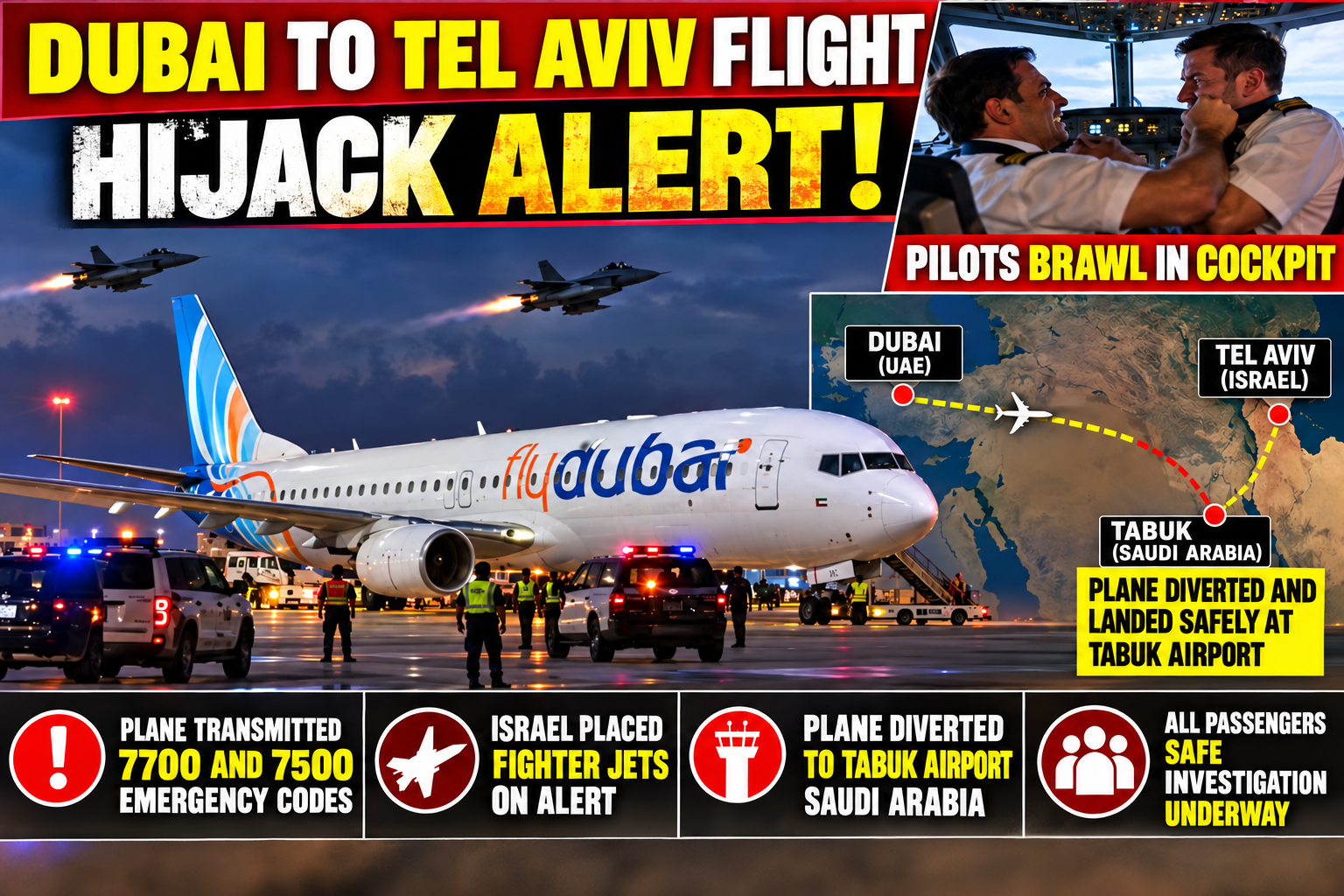
A Flydubai passenger aircraft travelling from Dubai to Tel Aviv was diverted to Saudi Arabia on Wednesday after an alarming incident on board triggered emergency signals and briefly raised fears of a possible hijacking. The aircraft, operating as Flight FZ1073, eventually landed safely at Tabuk Airport in northwestern Saudi Arabia, with passengers reported safe and accounted for.
The incident attracted immediate international attention after flight-tracking data showed the aircraft transmitting emergency transponder codes, including 7700, used internationally to indicate a general emergency, and 7500, the code associated with unlawful interference and commonly understood as a possible hijacking signal. The unusual sequence prompted a significant security response, including the reported scrambling of Israeli fighter aircraft. �
Gulf News +2
However, as more information emerged during the day, authorities and media reports indicated that the incident did not appear to be a conventional hijacking by an outside attacker. Instead, reports pointed to a serious physical confrontation between the pilots inside the cockpit. The precise circumstances, motive and sequence of events remain under investigation, and some of the more dramatic details circulating in early reports have not been independently confirmed. �
Reuters +2
Flight FZ1073 Diverted From Its Scheduled Route
Flydubai Flight FZ1073 was operating from Dubai International Airport in the United Arab Emirates to Ben Gurion International Airport near Tel Aviv, Israel. Flight-tracking information shows that the aircraft departed Dubai on the morning of September 30 and was scheduled to continue toward Israel. The flight was subsequently diverted to Tabuk in Saudi Arabia. �
Skyscanner +1
Flydubai later confirmed that the aircraft had experienced an incident while en route and had landed safely at Tabuk Airport. The airline said that its teams were working with the relevant authorities and that the safety and well-being of passengers and crew remained its highest priority. �
Gulf News
The aircraft's diversion was significant because the normal destination was Tel Aviv, while Tabuk is located in northwestern Saudi Arabia. The change in destination provided the crew with a safe airport at which to bring the situation under control and allow authorities to respond on the ground.
The incident occurred against the backdrop of a highly sensitive regional security environment, making any emergency signal from a commercial aircraft travelling toward Israel particularly significant.
Why the 7500 Code Caused Immediate Alarm
Modern commercial aircraft are equipped with transponders that communicate with air-traffic-control systems. Pilots can use specific four-digit codes, commonly called squawk codes, to communicate the nature of an emergency.
The code 7700 is widely used to indicate a general emergency. The code 7500, meanwhile, indicates unlawful interference and is strongly associated with a possible hijacking or similar security threat.
Flight-tracking information showed FZ1073 transmitting 7700 before transmitting 7500 and later returning to an emergency indication. Flightradar24 reported that the aircraft squawked 7700, then 7500, and then 7700 again during the incident. �
Flightradar24
The transmission of 7500 was therefore enough to trigger concern well beyond the aircraft itself. A hijacking code is treated extremely seriously because it can indicate that the crew is unable to communicate freely or that someone is attempting to take control of the aircraft.
In this case, the signal was especially sensitive because the aircraft was flying toward Israel. Reports said that Israeli authorities responded by placing fighter aircraft on alert and scrambling jets to assess the situation. �
MiGFlug +1
The response illustrates how quickly aviation-security systems can react when an aircraft sends an unlawful-interference signal.
Initial Fears of a Hijacking
When news of the emergency signal first emerged, the most obvious explanation was a possible hijacking.
A commercial passenger aircraft sending a 7500 code can trigger a series of procedures involving air-traffic controllers, military authorities, airport security agencies and national governments. The aircraft may be monitored closely, and military aircraft can be dispatched if authorities believe the situation represents a potential threat.
Reports indicated that Israeli fighter aircraft were scrambled after the emergency signal was detected. The development also prompted urgent security discussions in Israel. �
The Jerusalem Post +1
For passengers and people following the flight, the situation initially appeared extremely serious. A flight travelling toward Tel Aviv had suddenly sent an emergency signal associated with hijacking and was then diverted toward another country.
But the subsequent investigation began to point toward a very different explanation.
Reports Point to a Cockpit Confrontation
As the situation developed, Israeli officials and several media outlets reported that the emergency was linked to a physical confrontation between the aircraft's pilots.
According to those reports, the two pilots became involved in a serious altercation inside the cockpit. The confrontation apparently resulted in the emergency signals being transmitted and contributed to the aircraft being diverted.
Reuters reported that Israeli officials said the incident did not appear to be a conventional hijacking and that a physical altercation between the pilots was involved. Reuters also reported that there were claims that one pilot stabbed the other, although details remained under investigation. �
Reuters
Other reports also described passengers hearing shouting and seeing signs of injuries. However, allegations about a stabbing and other specific details have not been independently confirmed by all relevant authorities. Moneycontrol specifically noted that the stabbing allegation had not been independently confirmed. �
Moneycontrol
That distinction is important because information during an aviation emergency can change rapidly. Early reports often rely on passenger accounts, flight-tracking data and preliminary statements before investigators have had an opportunity to establish exactly what happened.
A Rapid Change in the Aircraft's Situation
Flight-tracking information provided another indication of the seriousness of the event.
Reports said the aircraft experienced a rapid descent during the incident before stabilising and continuing toward a safe landing. Reuters reported that the Boeing 737 descended by nearly 14,000 feet in approximately 30 seconds before stabilising. Other reports gave somewhat different figures for the altitude loss, illustrating that the precise flight profile was still being analysed. �
Reuters +1
A rapid descent can be extremely alarming for passengers. It can also trigger emergency procedures because a sudden change in altitude may indicate a serious problem involving the aircraft, its systems or the crew.
In this case, the descent was followed by the diversion toward Tabuk.
Why Tabuk Became the Emergency Destination
Once the crew and authorities determined that the flight needed to divert, the aircraft headed toward Tabuk Airport in Saudi Arabia.
Tabuk is located in northwestern Saudi Arabia and provides an airport capable of handling commercial aircraft. Its geographical position made it a practical location for the diverted flight.
The aircraft eventually landed safely, bringing the immediate danger to an end.
Flydubai confirmed that all passengers were safe and accounted for after the aircraft arrived at Tabuk. The airline also said that it was working closely with the relevant authorities and would provide further information as confirmed details became available. �
Gulf News
The safe landing was the most important development for passengers and their families.
Passengers Reported Safe
Despite the dramatic circumstances, reports indicated that passengers survived the incident and that the aircraft landed safely.
Reuters reported that approximately 150 Israeli passengers were aboard and that they were unharmed, while the pilots were reportedly injured and taken for medical treatment. �
Reuters
Other reports have given slightly different passenger numbers, with some estimating that around 150 to 180 people were aboard. Because passenger manifests and official information were still being processed, the precise number should be treated cautiously until confirmed by the airline or authorities.
The fact that the aircraft landed safely was nevertheless widely confirmed.
The successful landing also demonstrated the importance of cockpit procedures and the ability of flight crews and air-traffic authorities to respond to emergencies even when circumstances inside an aircraft become highly unstable.
Israeli Fighter Jets Were Reportedly Scrambled
The 7500 signal prompted an immediate security reaction.
Israeli fighter aircraft were reportedly scrambled after authorities received the unlawful-interference alert. The purpose of such a response is to identify the aircraft, establish communication, assess whether it presents a threat and determine what action may be necessary.
In the case of FZ1073, the aircraft ultimately diverted rather than continuing to Tel Aviv.
The fighter response highlights how aviation security operates when authorities receive a potentially serious warning. Even if the emergency eventually turns out not to be a hijacking, authorities cannot simply assume that a 7500 signal is harmless.
Every such signal must be treated seriously until officials establish what caused it.
Not a Conventional Hijacking
One of the most important developments in the story was the shift away from the initial hijacking theory.
The early alarm was understandable because of the 7500 signal. However, later reporting indicated that the incident was associated with an altercation between the pilots rather than an external hijacker taking control of the aircraft.
The Indian Express reported that authorities later ruled out hijacking as the cause and that reports pointed toward a fight between the pilots. �
The Indian Express
That does not mean that the event was minor.
A physical confrontation in a cockpit can represent an extremely serious aviation-security event. Commercial aviation depends on pilots maintaining control of the aircraft, communicating with air-traffic controllers and working together to respond to emergencies.
Any disruption inside the cockpit can therefore create significant risks for everyone on board.
Questions About What Happened Inside the Cockpit
Investigators now face several important questions.
Why did the pilots become involved in a physical confrontation?
Who initiated the confrontation?
Why was the 7500 code transmitted?
How did the aircraft experience such a rapid descent?
How was control of the aircraft maintained?
Were both pilots able to continue performing their duties?
How were the passengers and cabin crew affected?
What exactly happened before the aircraft diverted to Tabuk?
These questions will likely form part of the investigation.
Passenger accounts can help investigators reconstruct the sequence of events, but they must be compared with cockpit recordings, air-traffic-control communications, aircraft data, medical records and other evidence.
Modern commercial aircraft record enormous amounts of information. Flight-data recorders and cockpit voice recorders can provide investigators with crucial information about aircraft movements, cockpit conversations, warnings and other events.
The Importance of Flight Data
The flight-tracking information already available has helped establish a broad timeline.
The aircraft transmitted an emergency code, later sent the 7500 unlawful-interference code and subsequently returned to an emergency indication before diverting to Tabuk. �
Flightradar24
Flight-tracking data can provide valuable information about altitude, speed, location and route changes. However, such data alone cannot establish why a particular emergency code was transmitted.
That requires a formal investigation.
For example, the 7500 code indicates unlawful interference, but the code itself does not explain whether an outside person attempted to take control of the aircraft, whether there was a cockpit dispute, whether a crew member transmitted it intentionally or whether another circumstance caused the signal.
Investigators therefore need to examine the wider context.
What Passengers Experienced
Reports from passengers suggested that the situation was frightening.
Some accounts described shouting and confusion inside the aircraft. Other reports mentioned passengers becoming concerned as the aircraft changed altitude and direction.
However, passenger accounts must be treated carefully during a developing investigation.
People experiencing an unexpected aviation emergency may not know what is happening inside the cockpit. They may hear sounds, see crew members moving through the cabin or experience changes in aircraft movement without knowing their cause.
Their accounts are still valuable, but investigators normally compare them with objective evidence before drawing conclusions.
The safe landing at Tabuk provided relief to those aboard the aircraft.
The Role of the Cabin Crew
Cabin crew members are trained to respond to emergencies ranging from medical problems and turbulence to security incidents.
A cockpit emergency presents a particularly difficult challenge because access to the flight deck is tightly controlled.
Cabin crew must protect passengers, communicate with the pilots when possible and follow established procedures.
The circumstances of the FZ1073 incident will likely lead investigators to examine how the cabin crew responded and how communication was maintained between the cockpit and cabin.
Any recommendations that emerge from the investigation could have implications for aviation-security procedures more broadly.
Why Cockpit Security Is So Important
Commercial aircraft are designed around a highly controlled cockpit environment.
The pilots have responsibility for navigation, aircraft systems, communication and safe operation of the aircraft.
Because of this, aviation regulators and airlines maintain strict rules governing cockpit access and crew conduct.
A physical conflict between pilots is exceptionally serious because both individuals are essential to the safe operation of the aircraft.
The FZ1073 incident raises questions about how airlines detect and manage serious disputes between crew members before they escalate.
It may also lead to renewed discussion about pilot mental health, workplace conflict, fatigue, interpersonal dynamics and security procedures.
However, it would be premature to speculate about the personal motivations or psychological state of either pilot until investigators provide verified information.
Investigation Underway
Authorities are now expected to reconstruct the incident from multiple sources.
These may include:
Flight-data recorder information
Cockpit voice recordings
Air-traffic-control communications
Radar and flight-tracking data
Passenger statements
Cabin-crew accounts
Medical records
Airport security footage
Aircraft maintenance information
Crew records
Communications between the aircraft and ground authorities
The investigation could involve aviation authorities from more than one country because the flight originated in the United Arab Emirates, was scheduled to land in Israel and ultimately landed in Saudi Arabia.
The international nature of the incident makes coordination between authorities especially important.
Flydubai's Response
Flydubai confirmed that Flight FZ1073, operating from Dubai International Airport to Ben Gurion International Airport, experienced an incident while en route and landed safely at Tabuk Airport.
The airline said all passengers were safe and accounted for and that its teams were working closely with relevant authorities. It also said further updates would be provided when additional confirmed details became available. �
Gulf News
The airline's limited initial statement reflects a common approach during an active investigation.
Airlines generally avoid commenting on unverified details because preliminary information can change as investigators collect evidence.
The Significance of the Incident for Regional Aviation
The flight was travelling between two major Middle Eastern aviation hubs: Dubai and Tel Aviv.
Dubai is one of the world's busiest international aviation centres, while Tel Aviv's Ben Gurion Airport is a major gateway to Israel.
Flights operating through the region often cross the airspace of multiple countries. As a result, an emergency involving a commercial aircraft can quickly become an international security matter.
The FZ1073 incident demonstrated this clearly.
An event that began inside a commercial aircraft quickly involved flight-tracking systems, air-traffic controllers, military authorities and multiple national governments.
Emergency Codes Explained
For the general public, the terms "7700" and "7500" may sound similar, but they have different meanings.
7700 – General Emergency:
This code tells air-traffic controllers that an aircraft has an emergency situation requiring assistance.
7500 – Unlawful Interference:
This code is used when an aircraft is experiencing unlawful interference and is widely associated with a hijacking situation.
The use of 7500 does not by itself prove that a hijacking has taken place.
It is a signal requiring authorities to respond and investigate.
That distinction is particularly important in the FZ1073 case.
The aircraft sent the code, prompting authorities to act, but subsequent reports indicated that the cause may have been an internal cockpit confrontation rather than an outside hijacking.
Why Authorities Must Assume the Worst
When an aircraft sends a hijacking-related code, authorities cannot wait for perfect information before responding.
The potential consequences of a genuine hijacking are enormous.
A commercial passenger aircraft can carry hundreds of people and can travel rapidly across national borders. If authorities delay their response and the situation turns out to be a genuine attack, the consequences could be catastrophic.
For that reason, emergency systems are designed to produce a rapid response even when the initial information is incomplete.
The FZ1073 incident demonstrates why these systems exist.
The response was activated, fighter aircraft were reportedly placed in the air, the aircraft was diverted and emergency personnel were ready at the destination.
Eventually, the aircraft landed safely.
The Difference Between a Hijacking and an Aviation Security Incident
The words "hijacking" and "security incident" should not automatically be treated as synonyms.
A hijacking generally involves someone unlawfully taking or attempting to take control of an aircraft.
An aviation security incident can include a much wider range of situations, including threats, violence, unlawful interference, cockpit disruptions and other acts that affect aircraft safety.
The FZ1073 incident initially looked like a hijacking because of the 7500 signal.
But later information suggested that the cause was different.
Therefore, responsible reporting should distinguish between the initial hijack alert and the later assessment of what caused the alert.
This is especially important for readers because headlines can easily create the impression that a successful hijacking took place when authorities later determine that it did not.
Conflicting Reports and the Need for Caution
Several media outlets reported additional details about the incident, including claims that one pilot injured another and allegations involving a knife.
Some reports also suggested that the aircraft experienced an intentional or near-intentional descent.
However, not every detail has been independently confirmed.
Moneycontrol reported that the stabbing allegation had not been independently confirmed. �
Moneycontrol
Reuters also reported conflicting information regarding some details surrounding the pilots and the incident. �
Reuters
For that reason, NationScope is presenting those details as reports or allegations rather than established facts.
The investigation will determine which details are accurate.
What We Know With Greater Confidence
Based on information from the airline and flight-tracking sources, several elements of the story are clearer.
The aircraft was Flydubai Flight FZ1073.
It was operating from Dubai toward Tel Aviv.
It experienced an incident while airborne.
The aircraft transmitted emergency signals, including 7700 and 7500 according to flight-tracking information.
The aircraft was diverted from its planned destination.
It landed safely at Tabuk Airport in Saudi Arabia.
Flydubai said passengers were safe and accounted for.
Authorities investigated the incident and reports indicated that the initial hijacking concern was later replaced by a theory involving a cockpit confrontation. �
Gulf News +2
What Remains Unclear
Several important details remain subject to investigation.
The exact reason for the confrontation between the pilots has not been fully established.
The precise sequence of events inside the cockpit remains unclear.
The reason the 7500 code was transmitted requires official clarification.
The exact circumstances behind the rapid descent need to be established using aircraft data.
Reports about injuries and the alleged use of a knife require confirmation from authorities.
The motivations of those involved should not be speculated about without verified evidence.
The authorities will ultimately have to determine whether the incident resulted from a crew dispute, a deliberate act, a medical or security emergency, or another cause.
A Major Test for Aviation Emergency Procedures
The incident is also a reminder of how many layers of safety exist in modern aviation.
The aircraft's transponder provided an emergency signal.
Air-traffic authorities detected the unusual situation.
Security authorities responded.
Military aircraft were reportedly scrambled.
The commercial aircraft was diverted.
An airport was prepared to receive it.
Emergency services were available on the ground.
The aircraft landed safely.
Each stage was important.
Even when an emergency begins unexpectedly, aviation systems are designed to provide multiple opportunities to prevent the situation from becoming a disaster.
The Human Side of the Incident
Behind the security codes and military response were ordinary passengers who had boarded a flight expecting a routine journey from Dubai to Tel Aviv.
For them, the experience would have been deeply unsettling.
Passengers generally have little information about what is happening in the cockpit during an emergency.
A sudden descent, change of direction, unusual announcements or visible concern among crew members can create fear.
The fact that the flight eventually landed safely in Saudi Arabia would have been the most significant relief for those aboard.
The next challenge was then to determine how passengers would continue their journey and what arrangements would be made after the unexpected diversion.
Regional Diplomatic Complexity
The aircraft's landing in Saudi Arabia also created an unusual logistical situation.
The scheduled destination was Israel, while the emergency landing took place in Saudi Arabia.
The two countries do not have normal diplomatic relations, making the handling of passengers and their onward travel particularly sensitive.
Reports indicated that Israeli authorities were working on arrangements involving the passengers after the landing.
The immediate priority, however, was safety.
Only after the passengers and crew were secure could officials focus on transport, documentation, medical needs and the investigation.
What Happens to the Aircraft After an Incident?
When a commercial aircraft is involved in a serious security incident, it may be subject to detailed inspection.
Investigators can examine the cockpit, cabin and aircraft systems.
If there are allegations of violence, authorities may treat the aircraft as an important source of physical evidence.
The cockpit may be examined for signs of damage or struggle.
Medical teams may document injuries.
The aircraft's recording systems can become crucial pieces of evidence.
Depending on the investigation, the aircraft may remain on the ground for an extended period.
Why the Cockpit Voice Recorder Matters
The cockpit voice recorder could provide investigators with one of the clearest accounts of what happened.
It may contain communications between pilots, warnings, sounds associated with a struggle and conversations with air-traffic controllers.
Investigators can compare those recordings with flight-data information to establish a detailed timeline.
For example, if the aircraft began descending rapidly at a particular time, investigators can compare that moment with cockpit communications.
This can help establish whether the descent was intentional, accidental or caused by another event.
Why the Flight Data Recorder Matters
The flight-data recorder records numerous aircraft parameters.
These may include altitude, airspeed, heading, engine information, control inputs and other technical data.
Investigators can use this information to determine exactly how the aircraft responded during the incident.
This is particularly important because reports of a rapid descent need to be evaluated using objective data.
Passenger perceptions can tell investigators what people experienced, but flight-data records can show what the aircraft actually did.
Together, these sources can produce a much more reliable picture.
Lessons for Airlines
The FZ1073 incident could lead aviation experts to review procedures concerning cockpit conflict.
Airlines already have extensive crew-training programs, including communication, teamwork and emergency management.
But a serious physical confrontation between pilots raises difficult questions about how potential interpersonal problems are identified before a flight.
Airlines may review:
Crew communication procedures
Reporting mechanisms
Fatigue management
Conflict-resolution training
Security protocols
Cockpit access procedures
Medical and psychological screening requirements
Emergency response training
Any changes would depend on the findings of the official investigation.
Lessons for Passengers
For passengers, the incident is also a reminder of the importance of following crew instructions during an emergency.
Passengers should remain seated when instructed, listen carefully to cabin crew announcements and avoid interfering with emergency procedures.
During a security incident, panic can create additional risks.
The safe outcome of FZ1073 demonstrates why trained crews and established emergency procedures are essential.
The Role of Responsible Journalism
The incident also demonstrates the importance of careful reporting.
A headline stating that a plane "was hijacked" would be misleading if authorities later determine that no hijacking occurred.
A more accurate description is that the flight triggered a hijack alert after transmitting a 7500 code and was subsequently diverted to Saudi Arabia.
This distinction matters because aviation incidents can cause unnecessary fear among passengers, families and the wider public.
Responsible news reporting should clearly distinguish:
What was confirmed
from
what was initially suspected
and
what remains under investigation.
That is especially important when an incident involves international security.
Timeline of the Incident
Departure from Dubai
Flight FZ1073 departed Dubai International Airport on September 30, 2026, bound for Tel Aviv.
Emergency Situation
During the flight, the aircraft transmitted an emergency signal.
Hijack Alert
Flight-tracking data showed the aircraft transmitting the 7500 code associated with unlawful interference.
Security Response
The unusual signal prompted a major security response, including reports of Israeli fighter aircraft being scrambled.
Diversion
The aircraft changed course and headed toward Tabuk in Saudi Arabia.
Safe Landing
The aircraft landed safely at Tabuk Airport.
Investigation
Authorities began investigating the circumstances behind the emergency and reports emerged that the incident involved a confrontation between the pilots rather than a conventional hijacking. �
Flightradar24 +2
International Attention
The incident quickly became an international aviation story because it involved multiple countries and a flight travelling between major Middle Eastern destinations.
News organisations across Israel, the Gulf region, India and other countries began reporting on the emergency.
Flight-tracking websites also played an important role by allowing the public to observe the aircraft's route and diversion.
However, flight-tracking information should not be confused with an official investigation.
It can show what the aircraft did, but not necessarily why it did it.
The Bigger Aviation-Security Picture
Commercial aviation has experienced many security incidents over the decades, leading to increasingly sophisticated security systems.
Today's aircraft operate with multiple layers of monitoring.
Air-traffic controllers can track aircraft movements.
Transponders provide coded information.
Airlines maintain communication with pilots.
Military authorities can respond to threats.
Aircraft carry recording systems.
Airports have emergency response teams.
These systems are designed to work together.
The FZ1073 incident shows how quickly those systems can become active when an aircraft sends an unusual signal.
Why the Story Is Still Developing
The incident occurred only hours before many of the reports were published.
In a rapidly developing aviation story, information can change as authorities conduct interviews and examine evidence.
Initial reports may contain incomplete or conflicting information.
For example, reports have differed over the exact number of passengers and details of the pilots' injuries.
Therefore, further official statements are expected.
The airline has said that more updates will be issued as confirmed information becomes available. �
Gulf News
No Reported Passenger Fatalities
One of the most important facts at this stage is that the aircraft landed safely and passengers were reported safe and accounted for.
The incident therefore ended without the catastrophic outcome that authorities initially had to consider when the hijacking signal appeared.
The pilots were reportedly injured and received medical attention, according to Reuters and other reports. �
Reuters
A full assessment of injuries and the circumstances surrounding them will depend on official medical and investigative findings.
What Authorities Will Likely Examine Next
Investigators are expected to focus on several areas.
First will be the cockpit confrontation.
Second will be the emergency codes.
Third will be the aircraft's rapid descent.
Fourth will be communications between the pilots and ground authorities.
Fifth will be the decision-making process that led to the diversion.
Finally, investigators will seek to determine whether any security or operational procedures need to be changed.
The findings could influence airline procedures beyond Flydubai if authorities identify a broader safety concern.
A Reminder That Emergency Signals Have Multiple Contexts
The story also provides an important lesson about aviation terminology.
A 7500 signal is serious, but it is not the same thing as proof that a hijacking has been completed.
The signal tells authorities that unlawful interference may be taking place.
In the FZ1073 incident, the initial interpretation was a possible hijacking, but subsequent information pointed toward an internal cockpit confrontation.
That is why aviation authorities investigate the circumstances surrounding emergency codes rather than relying solely on the code itself.
Conclusion
The Flydubai FZ1073 incident has become one of the most closely watched aviation stories of September 30, 2026.
A flight travelling from Dubai to Tel Aviv triggered alarm after transmitting emergency signals, including the 7500 code associated with unlawful interference. The development prompted a significant security response, including reports that Israeli fighter aircraft were scrambled.
The aircraft was ultimately diverted to Tabuk Airport in Saudi Arabia, where it landed safely. Flydubai confirmed that passengers were safe and accounted for. �
Gulf News
The initial fear of a hijacking later gave way to reports that the emergency was connected to a serious confrontation between the pilots inside the cockpit. Israeli officials and multiple media reports indicated that the incident did not appear to be a conventional hijacking. �
Reuters +1
At the same time, several dramatic details circulating in early reports remain unverified. Claims concerning injuries, a possible stabbing and the precise circumstances of the aircraft's rapid descent require confirmation through the ongoing investigation.
What is clear is that the incident involved a serious in-flight emergency, triggered a major aviation-security response and resulted in the aircraft being diverted from its scheduled destination.
The safe landing of the aircraft and the protection of passengers remain the most important outcome.
Investigators will now need to establish exactly what happened inside the cockpit, why the emergency codes were transmitted, how the aircraft experienced its rapid descent and whether additional safety measures are necessary.
For passengers, families and the aviation industry, the incident is a reminder that even a routine commercial flight can quickly become an international emergency—and that well-established aviation procedures, rapid communication and coordinated responses can play a critical role in bringing such situations to a safe conclusion.
NationScope will continue to monitor official statements from Flydubai and relevant aviation authorities and update this report as verified information becomes available.