Engineering the Underwater Data Centre: From Seabed Pressure to Server Reliability
Engineering Underwater Data Centres: Pressure, Cooling, Reliability and Efficiency
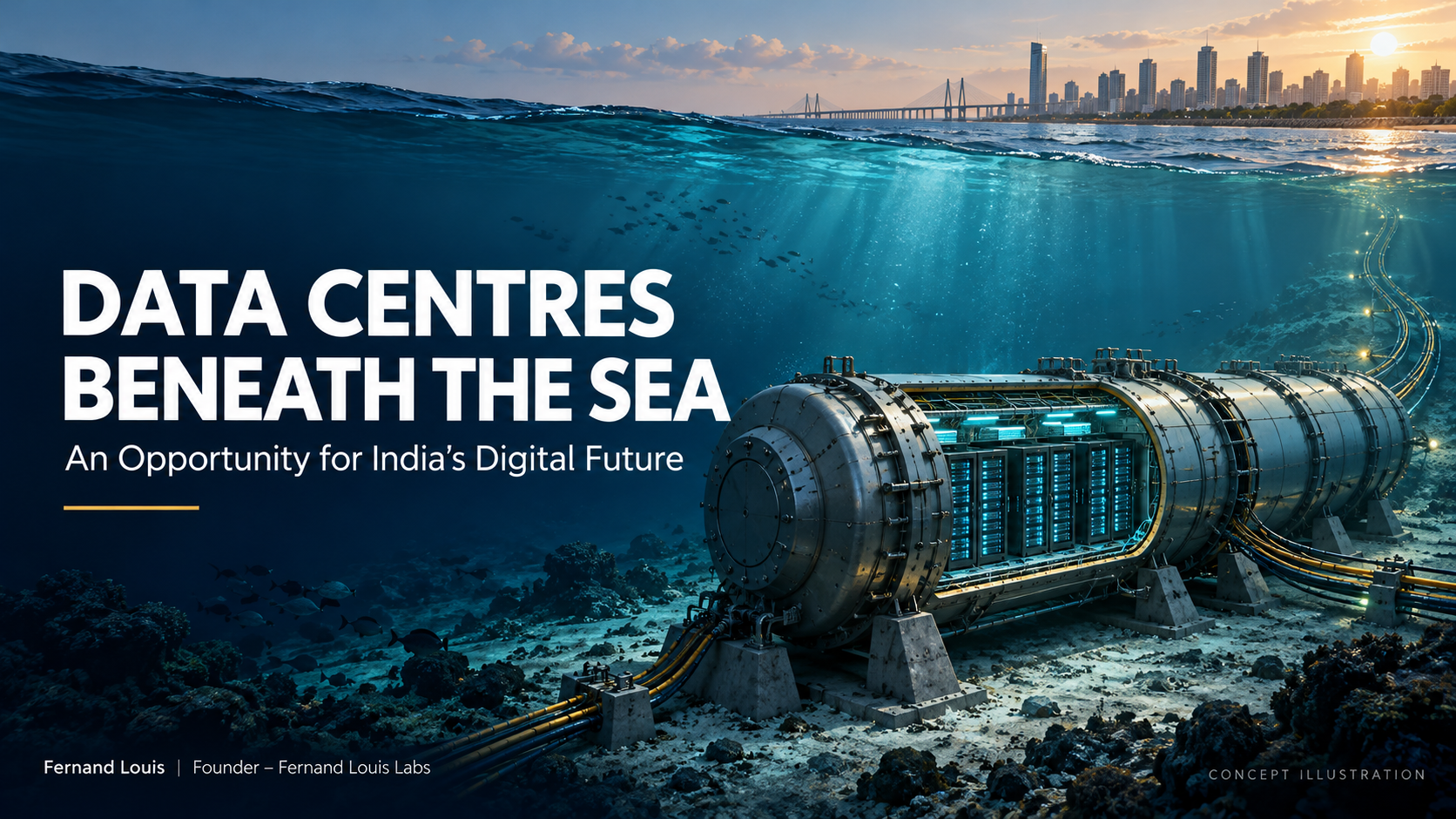
An underwater data centre combines two engineering disciplines that typically operate in different environments: high-performance computing and subsea infrastructure. Its success depends on integrating servers, cooling equipment, pressure-resistant enclosures and communication networks into a reliable system.
Microsoft’s Project Natick demonstrated that computing equipment could operate inside a sealed underwater module for two years. The experiment also reported fewer server failures than its land-based comparison installation. These findings demonstrated technical potential, but they do not eliminate the need to validate each new design under its intended operating conditions.
For a deployment in India, the central engineering challenge is maintaining computing performance across changing marine conditions while ensuring that failures can be detected, contained and managed.
Designing for External Pressure
Water pressure increases with depth. Using a seawater density of approximately 1,025 kilograms per cubic metre, the hydrostatic pressure increase at a depth of 30 metres is about 302 kilopascals, equivalent to approximately three bar above atmospheric pressure.
If an enclosure maintains near-atmospheric internal pressure, its structure must withstand the difference between internal and external pressure. One important design concern is buckling, in which a shell loses structural stability before its material reaches its nominal compressive strength limit.
Design calculations must account for shell geometry, wall thickness, stiffening rings, manufacturing tolerances, weld quality and material degradation. Cable penetrations, access closures and cooling connections also require careful engineering because they interrupt the pressure boundary.
A robust verification programme should combine structural calculations, appropriate numerical analysis, fabrication inspections and pressure testing. Independent verification of subsea equipment can provide additional assurance through design reviews, manufacturing oversight and testing.
Managing Heat from Processors to the Ocean
Almost all electricity consumed by computing equipment ultimately becomes heat. A data centre operating at one megawatt of IT load must therefore remove approximately one megawatt of heat generated by its servers, in addition to heat from supporting equipment where applicable.
The ocean can serve as the final heat sink, but heat still needs an engineered transfer path. One possible arrangement uses a closed internal coolant circuit connected to a seawater heat exchanger. Heat moves from the processors into the coolant, across the exchanger and into the surrounding seawater.
A simplified heat balance illustrates the scale involved. Removing one megawatt of heat with water experiencing a temperature rise of five degrees Celsius requires a flow rate of approximately 48 kilograms per second. This is an illustrative calculation, not a pump specification. Actual requirements depend on coolant properties, temperature limits, exchanger performance and hydraulic losses.
Warmer seawater reduces the temperature difference available for heat transfer. A tropical installation must therefore be designed around demanding seasonal conditions rather than average annual sea temperature alone.
Marine growth can also reduce heat-transfer performance or restrict flow. The cooling system must be monitored throughout its operating life, with provisions for inspection, cleaning or equipment recovery.
Measuring Energy Efficiency Accurately
Power Usage Effectiveness (PUE) compares total facility electricity consumption with the electricity consumed by IT equipment.
At a PUE of 1.20, a facility supplying one megawatt to its servers consumes 1.20 megawatts in total. If it operates continuously at full load for a year, this represents approximately 10.51 million kilowatt-hours of electricity.
An underwater data centre requires a clearly defined measurement boundary for a meaningful efficiency assessment. Shore-based power equipment, cooling pumps, transformers and subsea transmission losses should be accounted for consistently.
PUE alone does not establish whether servers perform useful work efficiently, whether the electricity supply is low-carbon, or whether marine construction and operations create additional environmental impacts. These factors require separate evaluation.
Designing for Limited Physical Access
Conventional data centres allow technicians to replace failed drives, power supplies and network components. An underwater module, by contrast, may operate for extended periods without direct physical intervention.
This changes the design philosophy. Hardware failures must be anticipated and managed through spare capacity, distributed storage, workload migration and software capable of isolating faulty components.
Redundancy must extend beyond the number of servers. Two cables sharing a vulnerable route may fail in the same incident, while multiple cooling devices connected to one unprotected electrical supply may share a common point of failure.
The complete system should therefore be assessed for common-cause failures, including shore-power loss, cable damage, water ingress, cooling-system failure and communication outages.
For critical services, an independently located facility should be capable of maintaining operations if the underwater installation becomes unavailable. Recovering the subsea module should not be the only means of restoring an essential application.
Monitoring, Control and Cybersecurity
Operators need continuous visibility into internal temperature, humidity, coolant flow, electrical conditions, leak detection and communication status. External monitoring should track seawater temperature and other relevant environmental conditions.
Monitoring systems must be linked to defined responses. Rising temperatures may trigger workload reduction, while suspected water ingress may require electrical isolation. The system must also have a clearly defined safe operating state for situations in which communication with shore is lost.
Cybersecurity is equally important. Remote-management interfaces, maintenance access and control systems must remain protected throughout the installation's operating life. Applicable CERT-In directions should be reviewed to determine the requirements relevant to the operator and facility, including incident reporting and log retention.
Proving the Design Before Scaling
For Tamil Nadu, a pilot project could evaluate a complete operating cycle, including installation, sustained computing operations, seasonal cooling performance, controlled failure scenarios and eventual retrieval.
Acceptance criteria should cover workload availability, energy consumption, thermal margins, corrosion, environmental measurements and recovery time. Results should be compared with a land-based facility serving equivalent workloads under comparable conditions.
The key engineering milestone is sustained, independently verifiable performance under realistic operating conditions. Underwater computing becomes a credible infrastructure option only when its cooling potential, reliability, environmental implications and full-life costs can be demonstrated together.