
Federal Reserve Chief Kevin Warsh Sounds Warning on AI: Technology Could Transform the Economy or Trigger Job Losses
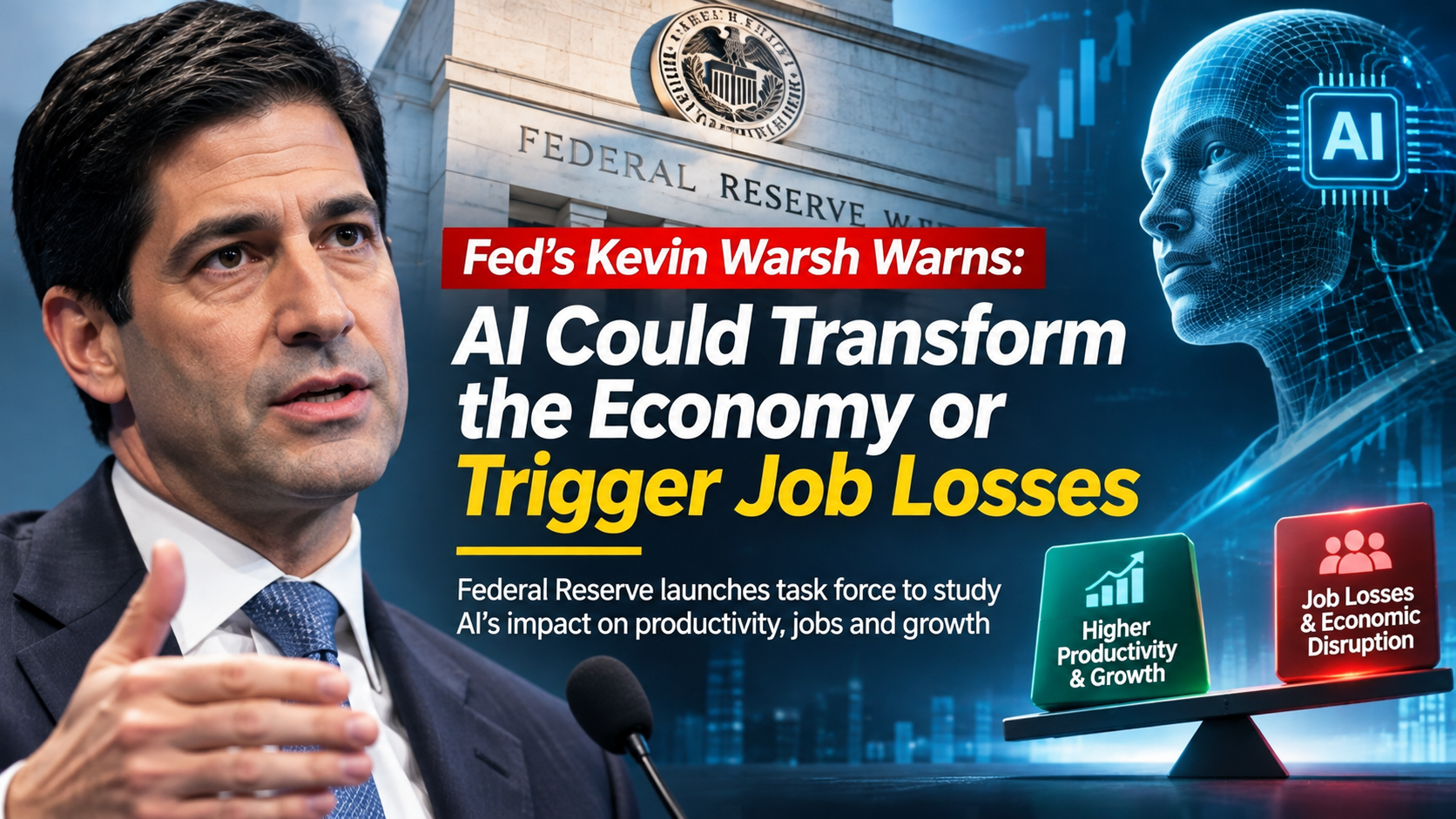
Artificial intelligence could become one of the biggest drivers of economic growth in the coming years, but its rapid adoption may also create serious challenges for employment, financial markets and economic stability. Federal Reserve Chairman Kevin Warsh has highlighted both possibilities, warning that the technology could deliver significant productivity gains or expose the economy to disruption if expectations fail to materialise.
Speaking on November 16, 2026, at the Federal Reserve's Productivity and Jobs Task Force Conference in San Francisco, Warsh outlined how artificial intelligence and what he described as super intelligence (SI) could fundamentally change the way businesses operate, workers perform their jobs and economies generate growth.
The conference reflects the Federal Reserve's efforts to understand the long-term economic consequences of AI. It also highlights the central bank's interest in examining how the technology could influence productivity, employment and future monetary policy decisions.
Why the Federal Reserve Is Studying Artificial Intelligence
The Federal Reserve traditionally focuses on inflation, employment, economic growth and financial stability when making monetary policy decisions. However, the rapid development of artificial intelligence is introducing new factors that could influence all these areas.
Warsh suggested that AI could differ from previous technological revolutions, including electricity and the internal combustion engine. While earlier innovations transformed industries and improved productivity, AI could also accelerate the process of generating new ideas.
According to Warsh, this could change the speed of innovation and potentially allow businesses to achieve productivity improvements at a much faster rate.
The Federal Reserve has established specialised task forces to examine important areas affecting monetary policy. The Productivity and Jobs Task Force is specifically responsible for studying the economic consequences of emerging technologies, including advanced AI systems.
Warsh Outlines Three Possible Futures for AI
One of the important aspects of Warsh's remarks was his assessment of three possible economic outcomes resulting from widespread AI adoption.
The first scenario is optimistic. AI could substantially improve productivity, help businesses operate more efficiently and generate economic benefits for both employees and investors. Under this scenario, the US economy could experience sustained GDP growth above its historical long-term average while maintaining relatively strong employment levels.
The second possibility is more challenging. AI adoption could accelerate automation across industries, replacing certain tasks currently performed by human employees. Although businesses may become more productive, workers could face displacement, creating pressure on employment and household incomes.
The third scenario involves disappointment. Companies and investors are committing substantial capital to AI infrastructure, data centres, computing hardware and advanced software. If these investments fail to generate the expected financial returns, valuations could decline and investment activity could slow.
Warsh warned that falling equity valuations following significant capital investment could trigger an economic slowdown and a noticeable increase in unemployment.
This scenario raises questions about whether the current enthusiasm surrounding AI investment can be sustained over the long term.
AI Could Become a Major Challenge for the Global Workforce
The potential impact of artificial intelligence on employment remains one of the significant concerns surrounding the technology.
Businesses are increasingly adopting AI to automate administrative processes, customer support, software development, research and data analysis.
While automation can improve efficiency and reduce operating costs, it may also reduce demand for certain job roles.
The impact may not be limited to entry-level positions. Professional services, financial institutions, technology companies and other sectors could also experience changes in workforce requirements as AI capabilities improve.
For countries such as India, where IT services, business process outsourcing and technology sectors employ millions of people, these developments deserve particular attention. This is a broader economic concern and should not be interpreted as a specific finding from Warsh's remarks.
The challenge will be ensuring that employees can transition towards roles requiring technical expertise, problem-solving, security oversight, strategic thinking and the ability to work alongside AI systems.
Why AI Investment Could Also Create Inflationary Pressure
Although Warsh focused heavily on productivity and employment, another major economic question concerns inflation.
The expansion of AI infrastructure requires significant investments in data centres, advanced processors, electricity, networking equipment and cooling systems.
This growing demand could increase prices across several parts of the technology supply chain.
Other Federal Reserve policymakers have raised concerns that growing infrastructure demand could contribute to inflationary pressure, particularly through higher prices for computer chips, electronic components, electricity and copper.
This creates a complicated situation for monetary policymakers. AI could eventually improve productivity and reduce certain operating costs, but the infrastructure required to support it may increase costs in the short term.
Warsh did not directly address this inflation concern during his opening remarks, leaving an important question for future Federal Reserve discussions.
What Happens Next?
The November 16 conference brought together technology executives, economists, researchers and policymakers to examine how advanced AI could reshape productivity and employment.
Participants included technology and business leaders such as Marc Andreessen, Nikesh Arora and Patrick Collison, alongside academic and economic experts.
The discussions are expected to contribute to the Federal Reserve's broader assessment of how technological transformation could influence economic conditions and future policy decisions.
For investors, businesses and employees, the findings could become increasingly important as AI investment accelerates and companies move from experimental projects towards large-scale implementation.
However, the Federal Reserve has not announced a new interest-rate policy based on these discussions. The immediate objective is to understand the scale, timing and potential consequences of the transformation.
Conclusion
Kevin Warsh's message highlights that artificial intelligence presents significant economic opportunities, but its risks cannot be ignored. Whether AI becomes a long-term engine of productivity or creates substantial disruption will depend on how effectively businesses, governments and workers adapt.
The coming years could determine whether the AI revolution delivers broadly shared economic prosperity or creates new challenges for the global economy.