Lake Ontario/Lake America: What happens when a place has two different names?
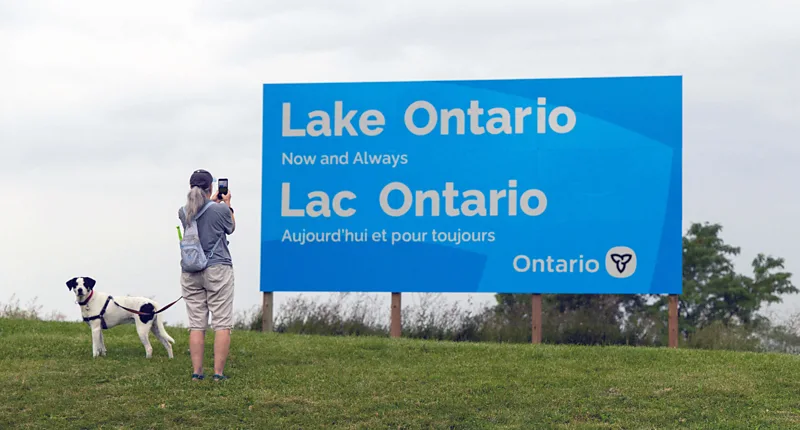
Lake Ontario or Lake America? Why the Same Lake Has Different Names on Maps
Open the same map in the US and Canada and you may see two different names for the same lake. So, who decides what a place is really called?
Open Google Maps in Toronto and you may see one name for a place, while users in New York may see another. Increasingly, the map displayed on your phone can depend on where you are located.
That is what is happening with Lake Ontario, the smallest of the Great Lakes, which lies along the US-Canadian border. After President Donald Trump ordered the US government to rename it "Lake America" following tensions between the two countries, the lake began appearing under different names on different maps.
However, changing a name in a government database does not necessarily mean the rest of the world will adopt it. From digital maps to tourism organisations and local communities, the Lake Ontario dispute highlights how complicated it can be to rename a geographical feature and determine which name is ultimately used.
Who Decides What Goes on a Map?
Canada has not adopted the proposed change. In the US, the modification began with the federal Geographic Names Information System (GNIS), the database used to standardise geographic names for federal use.
Trump's executive order directed the US government to use "Lake America" in federal references. Google Maps subsequently reflected the change for users in the United States, following its policy of using official government naming sources. Canadian users continue to see "Lake Ontario," while users elsewhere may see both names.
Apple Maps has also adopted the new name for users in the United States. However, private mapping companies are not necessarily required to follow the federal designation.
MapQuest, one of the earlier digital mapping services, has chosen to retain the name Lake Ontario. Its decision attracted considerable attention following the US name change.
"MapQuest focused on maintaining a name that people are familiar with," said Doug Berger, general manager at MapQuest. "When people need directions, they seek familiarity. It was an easy decision."
What's in a Name?
The differing responses demonstrate how a federal name change can quickly result in multiple versions of the same geography.
Oswego County in New York, which borders the lake, has chosen to retain Lake Ontario in its official and business materials, citing the historical significance of the name as well as the potential cost of rebranding for taxpayers and businesses.
The Seneca Nation has also opposed the change, citing the Indigenous roots and historical significance of the lake's name.
"In our traditional Seneca language, its name is sga:nyodai:yoh, meaning 'beautiful lake'," said J Conrad Seneca, Seneca Nation President. "To us, Lake Ontario is not a political pawn. It does not separate the countries of the United States and Canada. It is all Indigenous land, which has been occupied by Indigenous people since time immemorial."
When Two Names Coexist
Beyond the US and Canada, the impact of the name change may be more limited. "The naming of bodies of water typically falls within national jurisdictions," explained Taufiq Rahim, senior fellow at non-partisan think tank New America and author of Trump 2.5: A Primer.
He noted that international organisations such as the International Hydrographic Organization (IHO) do not generally have the authority to settle naming disputes, meaning multiple names can sometimes continue to be used.
A longstanding example is the dispute over the names "Persian Gulf" and "Arabian Gulf". Persian Gulf remains the standard name used by the UN, the IHO and many international publications, while several Arab states bordering the waterway use the term Arabian Gulf.
Lessons From the Gulf of Mexico
A more recent example followed Trump's January 2025 decision to rename the Gulf of Mexico as the "Gulf of America" for US government purposes. The new designation was subsequently reflected by some digital mapping services, while Mexico and many international users continued to use "Gulf of Mexico" or both names.
The change also created practical challenges for organisations that had already invested in branding and public materials associated with the original name.
A similar issue is now playing out on the US side of Lake Ontario. The Lake Ontario National Marine Sanctuary, a federally designated protected area covering waters and lakebed along the eastern New York shoreline, has retained its established name.
The National Oceanic and Atmospheric Administration (NOAA), which co-manages the sanctuary with New York State, has indicated that the executive order concerns federal references to the lake itself and does not automatically change the separately designated name of the sanctuary.
A Diplomatic Wedge
The organisational and financial burden of implementing the name change is likely to involve US government agencies and other organisations that use federal geographic data.
"This adds another unnecessary line to US expenses which in total can exceed hundreds of millions of dollars annually," said Usha Haley, Barton Distinguished Chair in International Business at Wichita State University. "People have to divert time, another important resource, to manage these changes for different audiences."
While the change has practical implications, its symbolic significance could have a longer-lasting effect.
"Geographic naming becomes a proxy for sovereignty and power. It's geopolitical signalling on who controls national and bi-lateral narratives," said Haley. "The downstream symbolic and diplomatic consequences of a name change such as this can be much larger than the immediate commercial calculations."
The dispute comes amid broader tensions in US-Canada relations, particularly over trade. Analysts have argued that symbolic disagreements over geographic names can add another layer to already strained relations between the two countries.
For now, the lake has effectively acquired different labels depending on the map, country and audience. In the United States, "Lake America" is increasingly appearing in official and digital references, while Canada continues to use the long-established name, Lake Ontario.