NATAJI SUBAS CHANDRA BOSE LIFE HISTORY
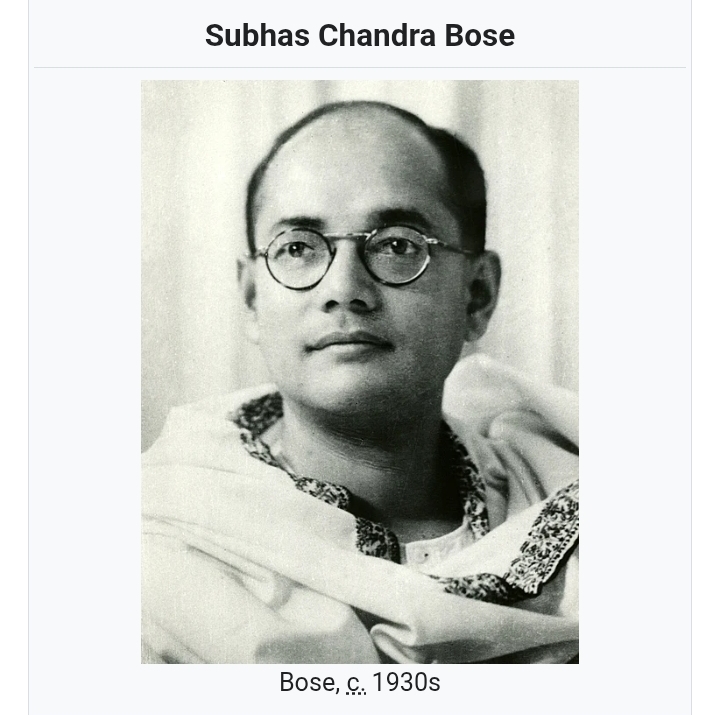
Subhas Chandra Bose (23 January 1897 – 18 August 1945), popularly known as Netaji, was a prominent Indian nationalist and revolutionary who fought for India's independence from British rule. He played a significant role in the Indian freedom struggle and is particularly remembered for his leadership of the Indian National Army (INA).
Early Life and Education
- Birth: Subhas Chandra Bose was born on 23 January 1897 in Cuttack, in present-day Odisha, to Janakinath Bose and Prabhavati Bose.
- Education: He studied at Presidency College and Scottish Church College in Calcutta (now Kolkata). He later travelled to England and studied at the University of Cambridge.
- Indian Civil Service: Bose secured the fourth position in the Indian Civil Service (ICS) examination in 1920. However, he decided not to continue with the service and formally withdrew in 1921 to dedicate himself to India's independence movement.
Political Career and Congress Leadership
- Political Influences: Chittaranjan Das played an important role in shaping Bose's political career. Bose was also deeply influenced by the teachings of Swami Vivekananda.
- Activism: Bose participated actively in the Indian independence movement and was imprisoned several times by British authorities. He became the Mayor of Calcutta in 1930.
- Congress President: He was elected President of the Indian National Congress in 1938 at the Haripura session. He was re-elected in 1939 at the Tripuri session, despite opposition from leaders supporting Mahatma Gandhi's preferred candidate.
- Resignation: Ideological and strategic differences with Mahatma Gandhi and other Congress leaders led Bose to resign from the presidency in 1939.
- Forward Bloc: In May 1939, Bose established the All India Forward Bloc to bring together progressive and radical elements within the Indian independence movement.
World War II and the Indian National Army (INA)
- Escape from India: While under house arrest by the British, Bose escaped from India in January 1941. He travelled through Afghanistan and eventually reached Germany, where he sought international support for India's independence, including from Adolf Hitler's government.
- Journey to Southeast Asia: In 1943, Bose travelled to Southeast Asia and assumed leadership of the Indian National Army (INA), also known as the Azad Hind Fauj. The army included Indian prisoners of war and expatriates who supported the independence movement. The INA had originally been formed under the leadership of Mohan Singh.
- Provisional Government of Azad Hind: In October 1943, Bose established the Provisional Government of Free India, known as the Azad Hind Government, and served as its head of state and prime minister. His famous slogans included “Give me blood, and I shall give you freedom!” and “Delhi Chalo.”
- Military Campaign: The INA fought alongside Japanese forces against the British in Burma and during campaigns in northeastern India, including the operations around Imphal and Kohima. The military campaign ultimately failed following the retreat and defeat of Japanese forces.
Death and Legacy
- Reported Death: According to the widely accepted historical account, Bose died on 18 August 1945 from severe burn injuries following an aircraft crash in Taihoku, in Japanese-occupied Taiwan, now Taipei.
- Historical Debate: Questions about the circumstances of his death have persisted for decades. Several inquiries examined the circumstances surrounding his disappearance, while alternative theories continued to circulate among some supporters. These theories should be distinguished from the widely accepted account of his death.
- Ashes and Memorial: Bose's ashes are traditionally reported to have been preserved at Renkō-ji Temple in Tokyo, Japan. The question of his death and the identification of the ashes have remained subjects of public debate.
- National Recognition: Bose's contribution to India's independence movement continues to be commemorated across the country. His birth anniversary, 23 January, is observed as Parakram Divas.
Subhas Chandra Bose remains an important figure in Indian history for his determination, leadership and efforts to secure independence from British rule. His political ideas, wartime alliances and role in the INA continue to attract historical research and public discussion.
##Latestupdate
KOUSHIK ROY
1 follower