Nepal’s First Female Helicopter Captain Flies Nearly 100 Rescue Missions Amid Devastating Floods
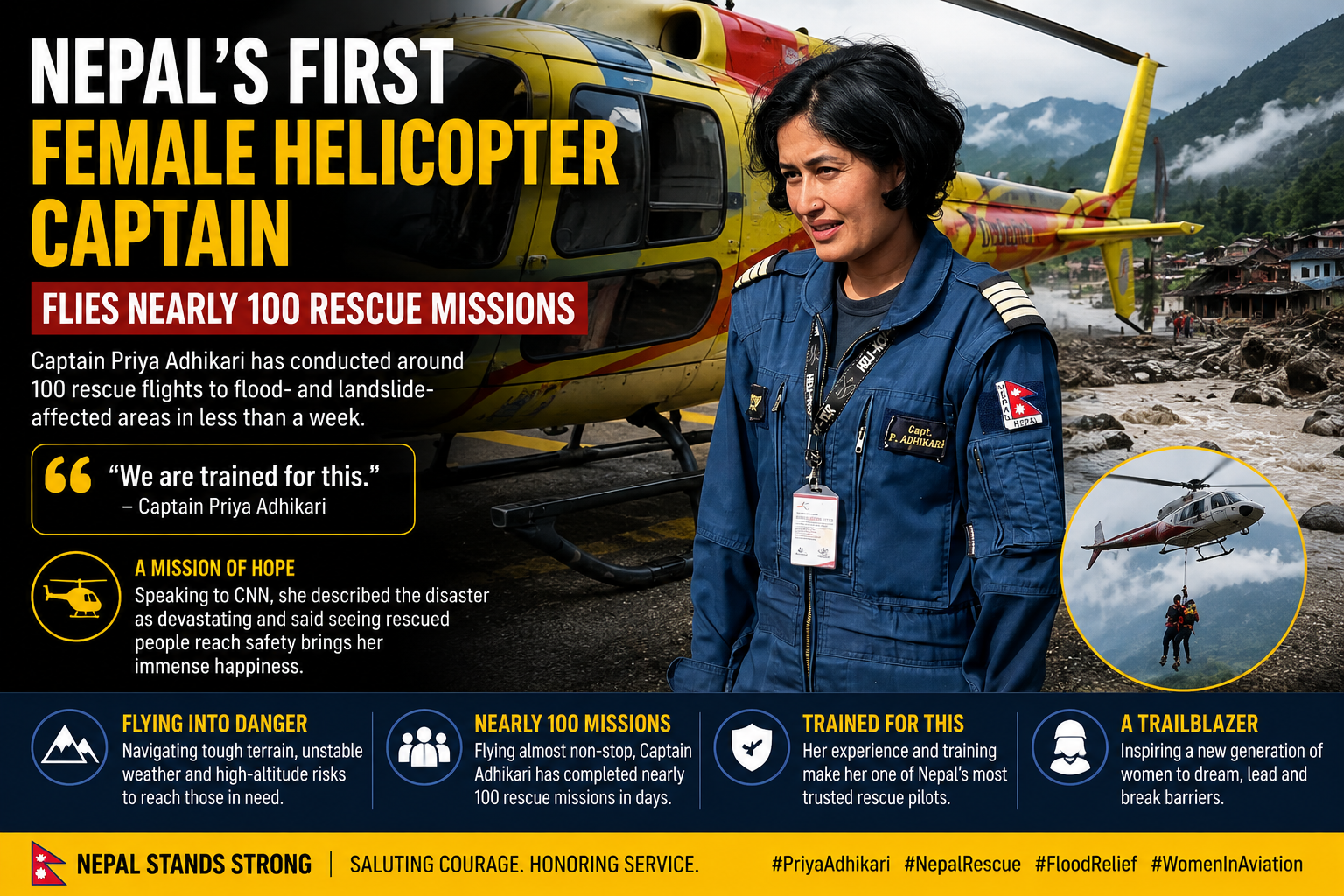
Captain Priya Adhikari Says Rescue Work Is What She Has Been Trained For as She Continues Flying Into Disaster-Hit Areas
KATHMANDU: Nepal’s first female helicopter captain, Priya Adhikari, has emerged as one of the key figures in the country’s ongoing rescue operations following devastating floods and landslides.
Captain Adhikari has flown nearly 100 rescue missions in just a few days, navigating difficult terrain and challenging conditions to reach people affected by the disaster. Her efforts have highlighted the crucial role of helicopter crews in reaching remote communities cut off by floods, landslides and damaged roads.
Flying Into Difficult and Dangerous Terrain
The rescue missions have required helicopter crews to operate in challenging conditions, including mountainous terrain, unstable ground and areas affected by severe flooding and landslides.
For communities in remote parts of Nepal, helicopters can become one of the few practical means of reaching people when roads and bridges are damaged or completely cut off.
Adhikari’s experience in high-altitude rescue operations has made her particularly suited to such missions. She has spent years conducting search-and-rescue flights in the Himalayas and has previously helped rescue injured climbers from high-altitude locations.
A Trailblazer in Nepalese Aviation
Adhikari’s role carries significance beyond the current disaster response. She became Nepal’s first female helicopter captain after entering a profession traditionally dominated by men.
Her journey into aviation began after she experienced a helicopter flight while working as a cabin crew member. The experience inspired her to pursue pilot training, eventually leading her to become a high-altitude helicopter captain.
She later specialised in high-altitude rescue missions and has been involved in search-and-rescue operations in the Himalayas, including missions involving injured climbers around Mount Everest.
“We Are Trained for This”
For Adhikari, the current rescue operation is a continuation of the work she has trained for throughout her career.
Speaking to CNN, she described the demanding nature of the ongoing rescue operations and said that the crews had been trained for such situations.
The missions involve difficult weather, mountainous terrain, limited landing areas and rapidly changing conditions. Pilots and rescue teams must make critical decisions while trying to reach people who may be stranded or in immediate danger.
An Inspiration for Women
Adhikari’s achievements have also drawn attention to the role of women in Nepal’s aviation sector.
When she began her aviation career, she faced doubts about whether a woman could succeed as a helicopter pilot. Over time, she established herself as an experienced rescue pilot and became a pioneer for women seeking careers in aviation.
Her career demonstrates the opportunities available to women in demanding professional fields, including aviation and emergency rescue operations.
Rescue Efforts Continue
As Nepal continues to deal with the aftermath of severe flooding and landslides, rescue teams remain focused on reaching isolated communities and bringing survivors to safety.
Recent reports said around 20 helicopters were operating in the Timure area, with multiple aircraft sometimes coordinating to evacuate survivors. More than 200 people were reportedly evacuated from the area during the first two days of the operation.
The scale of the rescue effort has placed enormous demands on emergency responders. Helicopter pilots like Captain Priya Adhikari are playing an important role by providing access to areas that may otherwise remain difficult to reach.
Her nearly 100 rescue missions in a matter of days highlight the scale of Nepal’s emergency and the demands placed on rescue crews. For Adhikari, the focus remains on reaching people who need help and bringing them to safety.