New Method Could Make Quantum Simulations More Reliable
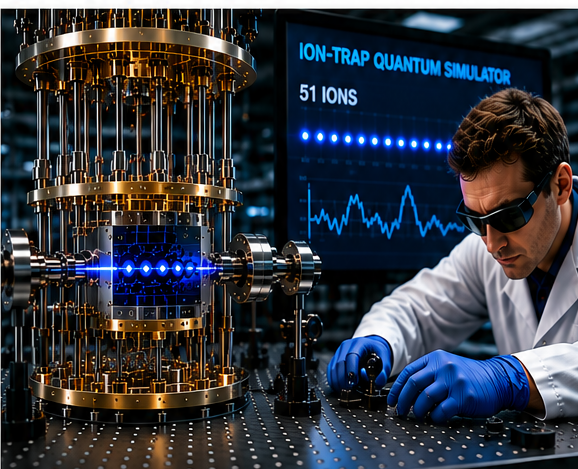
Researchers develop a way to quantify uncertainty and put numerical error limits on quantum simulation results
PUNE, MAHARASHTRA: Scientists have demonstrated a new method that could help solve a major challenge in quantum computing—determining how much confidence researchers can place in the results produced by quantum simulators.
Quantum simulators are increasingly being used to study complex many-particle systems that can be extremely difficult, or even impractical, to calculate using conventional computers. However, as these systems become more powerful, independently verifying their results becomes increasingly difficult.
When a quantum problem remains within the capabilities of classical computers, researchers can compare the two sets of results. But once quantum systems enter a regime beyond the practical reach of conventional computing, scientists need alternative methods to establish whether the results are accurate.
A research team led by Tristan Kraft of the Technical University of Munich and Peter Zoller of the University of Innsbruck and the Institute for Quantum Optics and Quantum Information at the Austrian Academy of Sciences, together with Barbara Kraus of the Technical University of Munich, has demonstrated an experimental approach to address this challenge.
The researchers developed a method to experimentally characterize how a quantum simulator actually behaves and translate uncertainties in the physical system into numerical error limits for its results.
The approach was tested by a team led by Manoj Joshi and Christian Roos using an ion-trap quantum simulator containing up to 51 ions.
According to the researchers, real quantum experiments inevitably face uncertainties. Interactions may differ from theoretical expectations, environmental influences can affect the system, and measurements are subject to noise and other limitations.
Instead of assuming that a simulator performs exactly as designed, the new approach uses experimental measurements to determine its actual behavior. Researchers can identify relevant interactions and assess fluctuations and noise before calculating how these uncertainties influence the final simulation.
“But no real experiment is perfect,” said Tristan Kraft, highlighting the importance of accounting for experimental imperfections.
The result is more than a single numerical answer. The method provides error margins that quantify the accuracy of the simulation, potentially giving scientists a clearer basis for judging the reliability of quantum results.
The development could prove increasingly valuable as quantum simulators move toward larger and more complex systems that cannot be independently checked using conventional computers.
Reported by:
Pranav Parsoon
Journalist and Reporter
Indian Press Union & Global News Press
Pune, Maharashtra
31 August 2026, Monday