PF Defaults for ₹100? What EEC 2026 Really Offers and Who It Leaves Out
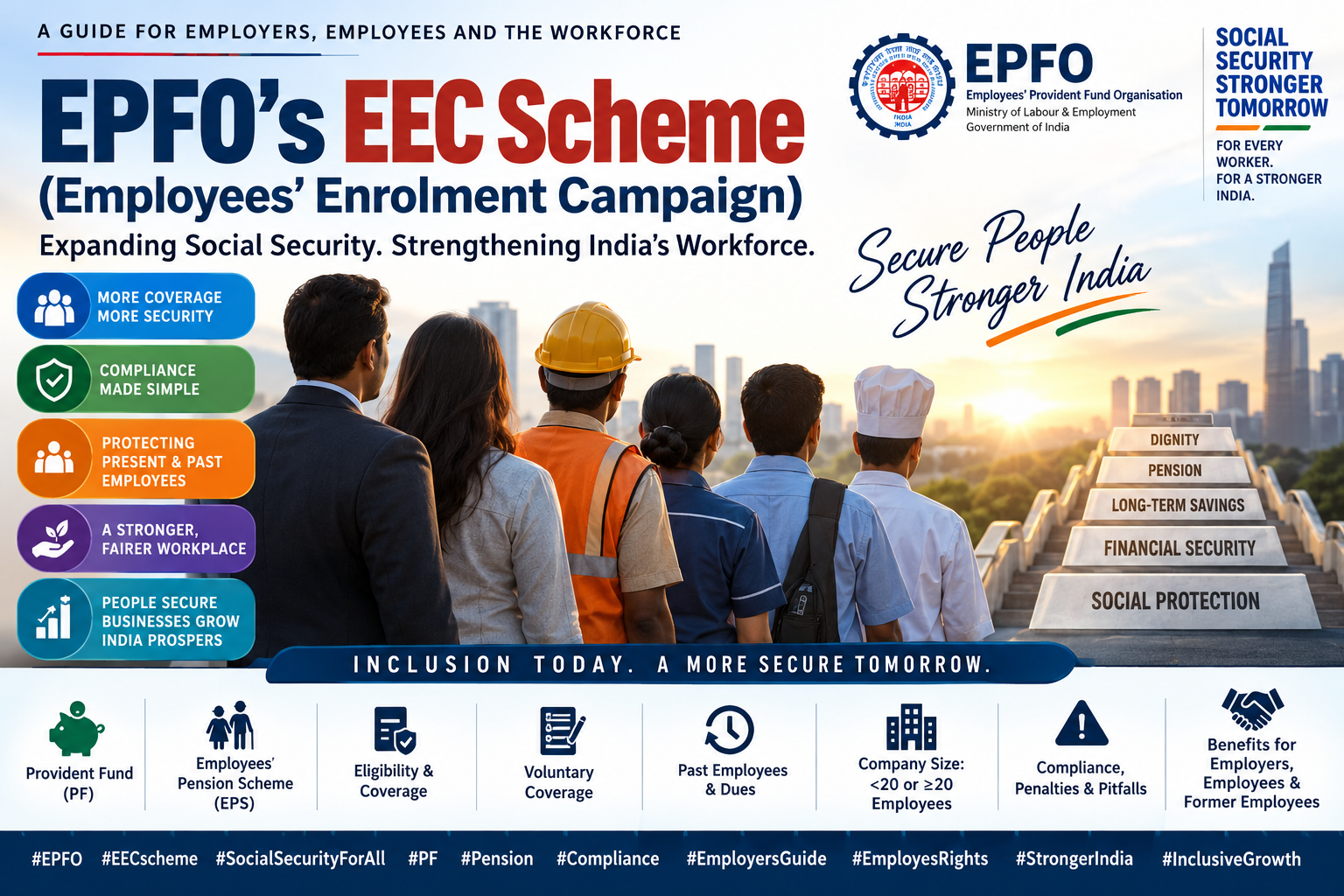
NATIONAL ARTICLE / PRACTICAL EMPLOYER REFERENCE
PF Defaults for ₹100? What EEC 2026 Really Offers—and Who It Leaves Out
By Pratik Vaidya
A national article and practical employer’s guide to missed PF enrolments, undeducted contributions, former employees, voluntary coverage, pension and the Social Security Code transition.
Position reviewed: 14 October 2026. The campaign’s notified closing date is 31 October 2026. This guide distinguishes the Gazette provisions, EPFO’s implementation instructions and issues that require a written determination. It is general guidance, not a finding on any particular establishment’s liability. [1–5]
PART I | THE ARTICLE
There is a dangerous way to describe the Employees’ Enrolment Campaign, 2026: pay ₹100 and put your provident fund problems behind you.
It makes an attractive headline. It is not what the scheme says.
EEC 2026 offers a time-bound opportunity to bring eligible employees into the PF system and regularise qualifying omissions. The ₹100 concession concerns damages. It does not replace the employer’s contribution arrears, applicable interest, insurance contributions or administrative charges. The more substantial relief is the waiver of the employee’s historical contribution where that money was never deducted, subject to the campaign’s conditions. EPFO’s operational window runs from 1 July to 31 October 2026. [2–4]
For an employer that missed enrolments, that distinction changes the calculation. For an employee whose salary already suffered a PF deduction, it changes the answer altogether.
The first question is not how much to pay
Before calculating arrears, establish what actually went wrong. Was the business legally required to have PF coverage but never registered? Was it registered, but some employees were omitted? Were the employees already members and only their monthly deposits missed? Or was the establishment genuinely outside compulsory coverage?
These are not interchangeable situations. EEC allows employers that were not previously covered to apply for coverage and then enrol qualifying employees. It is not a general settlement of every kind of PF default. The Gazette’s enrolment provision concerns employees who joined between 1 April 2009 and 31 March 2026 and remain employed on the declaration date. EPFO additionally specifies that they must be alive and still working in the same establishment. [1,2]
An unregistered company with 35 employees therefore should not mistake the absence of a PF code for the absence of a legal obligation. Equally, a business that has always employed 12 people and was never otherwise coverable should not be told that EEC automatically creates years of historical liability. Compulsory coverage, voluntary coverage and the campaign’s enrolment relief must be examined separately. Under the Code, voluntary establishment coverage requires the employer’s and a majority of employees’ agreement and the prescribed coverage process. [7]
Money never deducted is different from money retained
The central concession recognises a practical difficulty: where PF was never deducted, an employer may otherwise face both shares of historical contributions without an ordinary right to recover years of deductions from today’s salary.
For a qualifying declaration, EEC can waive the undeducted employee share for the specified historical period. The employer still pays its own share and the other applicable dues. But money already deducted from salary cannot be relabelled as “not deducted” or treated as the employer’s saving. [2,6]
The employer should reconcile wage registers, payslips, bank payments and the PF liability ledger before signing anything. A salary structure mentioning PF within cost to company does not, by itself, answer whether an employee contribution was actually recovered.
The former employee is the most easily misunderstood case
Consider an employee who joined in 2021, left in 2024 and was never enrolled. No PF was deducted. Can that person now be enrolled through EEC by the former employer? The current-employment condition says no. [5]
However, that is not the end of the employer’s position. Annexure A(15) provides a separate, conditional protection concerning employees who have already left. It requires an undertaking that all existing eligible employees have been declared and that no deducted employee contributions, together with the corresponding employer contributions, remain unpaid. EPFO’s circular describes the protection as no suo-motu action for exited employees. [1,2]
That may be valuable to a participating employer. It is not a PF deposit for the former employee. It does not, by itself, create pensionable service, fund a retirement balance or settle every possible complaint or court proceeding. The distinction deserves to be stated plainly: relief for the employer is not necessarily restoration of benefits to the former employee.
As a matter of policy, this is where closer attention is warranted. A campaign measured only by new enrolments may leave unanswered questions about people who worked, left and remain outside its direct enrolment benefit. Administrative clarity on their position would help employers and workers alike.
An inquiry changes the calculation
A pending inquiry does not automatically shut an establishment out of EEC. But the relief is narrower for the inquiry period: both contribution shares remain payable and the concession is confined to nominal damages. Completed assessments are not an invitation to reopen settled liability through a new campaign declaration. [1,2]
The practical exercise is therefore employee-wise and period-wise. A business may have an ordinary omission, a period under inquiry and an already assessed demand. Presenting one blended “amnesty saving” for all three would be unreliable.
PF is not the same thing as pension
The campaign concerns the PF, pension and deposit-linked insurance framework. Their benefits are different. EPF builds an individual savings balance. EPS provides benefits according to its membership, service and age rules. EDLI provides death assurance subject to its own conditions. A UAN is an identifier, not a guarantee of a particular pension or insurance payout. [5,9,10]
Employers should explain what has actually been credited and recognised, not merely tell employees that they are “covered now”. Where an employee’s contribution is waived, the campaign does not state that the Government will deposit that waived amount into the employee’s EPF account.
The new Code does not erase the old payroll
The labour codes became effective on 21 November 2025. The Social Security (Central) Rules followed in May 2026, and the replacement EPF, EPS and EDLI schemes were notified in June. It is no longer accurate to advise employers as though the new PF schemes are still awaited. [1,8–10,13]
Nor should the change be read as permission to recalculate every old month using today’s rules. Historical liability, applicable wages, membership status and contribution ceilings need to be mapped to the relevant period. The ₹25,000 ceiling effective from 17 September 2026 is not a retrospective ceiling for a 2022 omission. [12,14]
The sensible response to EEC is neither panic nor complacency. Establish coverage, reconstruct the employee record, separate the eligible relief from the liabilities outside it, arrange funds and complete the prescribed process before the deadline.
The ₹100 headline may get an employer’s attention. The real value of the campaign depends on getting the employment history right.
PART II | THE EMPLOYER’S FAQ
A. The scheme and establishment eligibility
1. What is EEC 2026, and what are its key dates?
It is the Employees’ Enrolment Campaign, 2026, a special route for qualifying missed enrolments. EPFO’s circular gives the operational window as 1 July–31 October 2026. The Gazette identifies the eligible joining window as 1 April 2009–31 March 2026, with continuing employment on the declaration date. The historical employee-share waiver also ends on 31 March 2026. These are three different date tests, not one. [1,2]
2. Which legal documents govern it?
The main provisions are in Annexure, Part A, to the Employees’ Provident Funds Scheme, 2026, notified through G.S.R. 525(E), dated 29 June 2026. EPFO’s implementation circular is No. EEC/2025/E-1190921/4278204, dated 8 July 2026. The related EDLI and EPS schemes were notified through G.S.R. 526(E) and 527(E). Read the Gazette and circular together; a promotional summary cannot enlarge the notified relief. [1,2,9,10]
3. Can a company with 20 or more employees that never registered participate?
Yes. The campaign expressly permits an employer not previously covered to apply for coverage and enrol qualifying employees. Exactly 20 meets the general threshold; it is not necessary to have 21. Establish the true date of applicability, rather than entering today’s date simply because the PF code is being obtained now. Statutory exclusions and exemptions must still be checked. [1,7]
4. Can an employer with fewer than 20 employees take voluntary coverage?
Yes, where compulsory coverage does not otherwise apply. Section 1(5) of the Code permits voluntary establishment coverage with agreement between the employer and a majority of employees, through the prescribed process. Coverage takes effect from the agreement date or a subsequent specified date. EEC does not dispense with that process. [7]
5. Does voluntary registration today automatically require contributions for every earlier year?
No such assumption is justified. First distinguish an establishment that was genuinely never liable from one that should have registered earlier. In a genuinely voluntary case, the approved effective date matters. Do not backdate an agreement or promise retrospective EEC benefits without reconciling the coverage order with Annexure A(13), which addresses past contributions from joining. Obtain a written position before declaring disputed pre-coverage years. [1,7]
6. We once had 25 employees but now have 11. Are we outside PF?
A later fall in headcount does not, by itself, end an establishment’s existing statutory coverage. Section 1(8) preserves applicability after the threshold has been crossed. An employer cannot present an existing compulsory-coverage case as a fresh, optional enrolment merely because the present workforce is smaller. [7]
7. Is voluntary coverage irrevocable forever under the new Code?
Not as a blanket proposition. The Code and Rule 3 of the 2026 Central Rules provide a conditional exit route for voluntarily covered establishments. It requires written agreement with the majority, at least five years’ coverage, all returns and dues cleared, and no subsequent compulsory applicability. The rule contains a 60-day decision/deemed-permission mechanism. This is a formal statutory route, not permission to stop remittances unilaterally. [7,8]
8. Who counts towards the 20-person test?
Do not count only employees whose wages fall below the contribution ceiling. The Code expressly includes higher-paid employees in establishment headcount. Its employee definition includes direct and contractor-engaged employees and excludes genuine Apprentices Act apprentices. Examine employment status and the establishment boundary; “consultant”, “trainee”, “part-time” or “management” on a spreadsheet is not a complete legal analysis. [7]
9. What about branches, contractors, group companies and exempted trusts?
Prepare a map of legal employers, locations, establishment codes, contractors and exemptions before combining data. Do not presume that each branch has its own 20-person exemption or that a group can make one declaration for unrelated establishment codes. Contractor arrangements require particular care: PF and pension responsibility cannot be decided from an invoice disclaimer alone. An exempted trust’s obligations must be read with its exemption conditions. [1,7–10]
10. Does establishment coverage mean every person must contribute?
No. Establishment applicability and individual membership are separate tests. For example, 30 employees may trigger coverage even where only some are individually liable to join at that time. Higher-paid first entrants, continuing members, statutory apprentices and special categories cannot all be treated alike. Nor does being a proprietor, partner or director automatically establish an employer–employee relationship for PF purposes. [1,7]
B. Employee eligibility and omissions
11. Which employee is the straightforward EEC candidate?
An employee who joined the establishment within 1 April 2009–31 March 2026, was eligible for enrolment but omitted, and is alive and still employed in the same establishment when declared. Joining dates, membership history and legal coverage need documentary support. Being employed today alone is insufficient. [1,2,5]
12. What about a person who joined before April 2009 or after March 2026?
The literal joining-date condition does not include them. A worker who joined in 2008 is not automatically eligible simply because the default continued after April 2009. A worker first joining in April 2026 belongs to ordinary current compliance, not the campaign’s specified joining cohort. Obtain written clarification for disputed earlier-service cases; do not change the joining date to fit the portal. [1]
13. An employee already has a UAN from another employer. Is that disqualifying?
It calls for an establishment-specific check, not an automatic yes or no. Distinguish a missed enrolment in this establishment from an already enrolled employee with unpaid months. Preserve the genuine prior membership history and use the existing UAN through the correct EPFO process; do not create a second identity to manufacture eligibility. EPFO’s member portal provides activation of existing UANs through UMANG. [1,16]
14. Can EEC settle missed ECRs for employees who were already enrolled?
Do not assume so. The campaign is framed around missed enrolments, not a universal concession for all late deposits, underreported wages or incorrect pension allocations. Already enrolled members with unpaid months require the ordinary correction/payment route unless EPFO specifically accepts the case within EEC. Damages-related relief may need separate examination under VISHWAS. [1,15]
15. What about employees paid above the old wage ceiling?
Reconstruct their status at the relevant time. A person who was lawfully excluded is different from an existing member wrongly excluded after a pay rise. The later increase to ₹25,000 does not turn a lawful 2022 exclusion into a historical default. It can, however, create a new current enrolment obligation from the relevant 2026 effective date. [1,12]
16. Can the employee refuse PF or sign a declaration waiving it?
A private declaration cannot override compulsory statutory coverage. Equally, an old statement that the employee was “not interested” does not demonstrate that the worker was legally excluded. Verify the actual membership rule, prior history and applicable wages. Keep genuine declarations as evidence; do not treat them as a general exemption. [7]
17. What about unpaid leave, maternity absence, suspension, trainees and international workers?
Continuing employment and wages payable are separate questions. Reconstruct contributory wages and non-contributory periods from records rather than multiplying today’s salary by every calendar month. Verify whether an apprentice was genuinely engaged under the statutory apprenticeship framework. International workers, social security agreements and certificates of coverage require separate analysis; the domestic wage-ceiling shortcut is unsafe. [1,7,9]
C. Deductions, arrears and the employer’s cost
18. Employee deductions never happened. What is the main relief?
For an otherwise qualifying declaration outside the inquiry restriction, the employee’s unrecovered share for the specified historical period can be waived. The employer still pays its contribution arrears, applicable interest and administrative charges, together with applicable insurance dues and nominal damages. Not deducting PF does not mean nothing is payable. [2,4,6]
19. PF was deducted but not deposited. Is the whole employer ineligible?
The employee-share waiver is unavailable for that money. Do not convert this into a blanket statement that the establishment can never participate: the appropriate treatment depends on enrolment status, proceedings and payment of the outstanding dues. Deducted money must be remitted. In particular, the former-employee undertaking cannot truthfully be given while deducted employee shares and corresponding employer contributions remain unpaid. [1,2]
20. What if deductions happened in only some months or for some employees?
Create an employee-by-month reconciliation. Separate never-deducted amounts, deductions already remitted, deductions retained and ordinary arrears outside the campaign. Do not claim an establishment-wide waiver based on a few undeducted months. Obtain EPFO’s written acceptance of the split treatment in mixed cases, especially where the portal does not reflect it clearly. [1,2]
21. How should “not deducted” be established?
Use payslips, wage registers, salary-bank files, payroll journals and the PF payable ledger together. Investigate inconsistencies: a payslip deduction may not match the actual bank payment, and a bookkeeping provision may not represent a salary recovery. A cost-to-company sheet alone is not a sufficient factual answer. This is a recommended verification exercise because the waiver turns on actual recovery and false declarations can invalidate relief. [1]
22. Can the employer recover its own arrears from employees or adjust their CTC?
The employer’s statutory contribution cannot be recovered from the member. Do not use a retrospective CTC adjustment or a “voluntary reimbursement” form to pass that liability back to staff. Prospective remuneration changes are a different issue and must not be used to disguise recovery of the employer’s historical PF obligation. EPF Scheme 2026 paragraph 21 expressly prohibits recovery of the employer share. [1]
23. Can old employee contributions be deducted from current salaries?
Not automatically. Where EEC validly waives the amount, there is no waived contribution to collect for remittance. Where both shares remain payable, the employer’s liability to EPFO does not itself authorise unrestricted deductions from later wages. Paragraph 22 contains period-specific recovery rules and limited exceptions, including false prior-membership declarations and specified clerical-error cases. Examine the exception before making a recovery. [1]
24. Is ₹100 charged per employee, month, declaration or scheme?
EPFO describes it as a lump sum per establishment across all three schemes, not ₹100 per worker or per month. It is damages, not the contribution principal or interest. Multiple declarations are permitted, but operational reconciliation of the establishment-level levy should be checked rather than multiplying—or ignoring—portal demands without confirmation. [2,3]
25. What is the proper total-cost formula?
Budget for employer EPF/EPS contribution principal + employee principal wherever not waived + applicable EDLI contributions + administrative charges + statutory interest + campaign damages. Compute month-wise using the correct wages, ceiling, contribution rate, due date and payments already made. Do not apply one current rate and salary to a 17-year spreadsheet. Separate professional assistance fees, if any, from statutory payments. [1–4,10]
26. Is interest waived, and is it the same as interest credited to employees?
No general interest waiver is promised. EPFO’s circular refers to old section 7Q or Code section 127 interest, as applicable. That liability is different from interest credited to an individual EPF account under the Scheme. Do not promise that the employer’s entire interest payment will appear in the employee’s passbook or that all missed years will automatically receive backdated account interest. [1,2]
27. Are all months from joining to October 2026 automatically covered by the waiver?
No. Annexure A(17) expressly limits the employee-share waiver to 31 March 2026. A(3) refers to compliance commencing in the declaration month, while A(13) requires past contributions. Read these together; the wording does not justify either “no historical arrears” or “every month until October is waived”. The April 2026-to-declaration interval needs explicit reconciliation and, where disputed, written EPFO clarification. [1]
28. Can already paid contributions be refunded, or can arrears be paid in instalments?
Do not budget for either without an express, applicable order. EEC is not a general refund programme, and the published workflow links a declaration to contribution payment. A draft application or proposed instalment plan is not equivalent to completed compliance. Tax deductibility, accounting recognition and treatment of damages are separate questions; EEC itself does not settle them. [1–3]
D. Former employees—the essential distinction
29. An employee joined, left and was never deducted PF. Can that person be enrolled now?
Not through the campaign’s current-employee declaration by that former employer. The person fails the still-employed condition. There may nevertheless be a separate employer protection under A(15), explained below. “Not eligible for enrolment” and “no possible benefit to the participating employer” are different answers. [1,2,5]
30. What exactly is the employer protection for former employees?
A(15) provides conditional non-initiation of EPFO action concerning employees who have left, on an undertaking that all existing eligible employees have been declared and no deducted employee contribution, with corresponding employer contribution, remains unpaid. EPFO describes this as no suo-motu action. It is not an unconditional write-off of every former-employee liability. [1,2]
31. Does the former employee receive PF money, pension service or insurance because of that protection?
No automatic credit or benefit is created by the employer’s A(15) undertaking. Former employees are outside the direct enrolment route. A payment and recognised service history require their own legal and administrative basis. Do not tell a former worker that “your PF has been settled” merely because the employer received campaign protection. [1,5]
32. What if the former employee’s PF was deducted but retained?
The unpaid deduction and matching employer liability cannot be ignored. The undertaking specifically covers existing and earlier employees. Remittance and reconciliation must precede any declaration asserting that such money is no longer pending. EEC does not authorise retaining money already taken from somebody’s wages. [1]
33. Does EEC cancel a former employee’s complaint, existing inquiry, assessment or court case?
Do not promise that. Non-initiation protection is not the same as withdrawal of an existing proceeding. The Gazette and circular do not expressly dispose of every employee-initiated claim or judicial remedy; completed assessments also face a separate exclusion. The effect in a disputed case requires examination of the proceeding, dates, statutory basis and undertaking—not a generic “amnesty obtained” letter. [1,2]
34. What about deceased workers, retirees, closed businesses, rehires and employees leaving during filing?
A deceased or already departed person cannot be described as a living current employee. A closed establishment with no eligible current employees should obtain written confirmation before claiming A(15) protection through a stand-alone declaration. Genuine re-employment does not automatically settle an earlier spell; a fictitious rejoining date is unacceptable. Where a worker leaves during processing, verify status at the legally relevant declaration date. An exit after a valid declaration does not, by itself, erase benefits lawfully credited. [1,2]
E. Inquiries and completed assessments
35. Is an establishment facing a section 7A or section 125 inquiry eligible?
Participation is expressly allowed. However, for the stipulated inquiry period, the relief is restricted to nominal damages; both employee and employer contributions remain payable. The inquiry officer must take the declaration into account. “Pending inquiry means excluded” and “pending inquiry still gives the full employee-share waiver” are both unreliable descriptions. [1,2]
36. What if only certain years, workers or wage components are under inquiry?
Map the precise scope of the proceeding. A(4) uses broad language about pending inquiries, while A(12) refers specifically to the inquiry period. Obtain a written position on any proposed separation of inquiry and non-inquiry amounts. Do not extrapolate a concession for one employee or year to the entire pending case. [1]
37. Can a completed assessment be reopened under EEC?
The Gazette excludes already concluded assessments. An appeal against a completed demand should not be treated as automatically converting it into a fresh, unassessed omission. Other eligible omissions may require separate consideration, but the assessed demand cannot simply be deleted from the working sheet. [1]
38. Is VISHWAS 2026 the same scheme? What about AMNESTY 2026?
No. EEC concerns qualifying missed enrolments. VISHWAS concerns specified damages-related disputes, including some finalised damages orders where recovery is pending or partial. AMNESTY 2026 addresses specified provident-fund trust/exemption situations. They have different conditions; one programme’s concession does not automatically attach to another’s principal contribution liability. [15]
F. Benefits to employees, pension and insurance
39. What does the current employee actually gain?
A qualifying employee can enter the formal EPFO framework, receive the contributions properly attributable to the account, and obtain pension and insurance coverage where separately eligible. The employer should provide the UAN, contribution details and corrected service record. Waiver of an undeducted employee share avoids that historical contribution becoming a fresh remittance burden, but does not mean the waived amount is deposited by Government. [5,6]
40. How are EPF, EPS and EDLI different?
EPF is the member’s provident fund balance. EPS provides pension and related benefits under its own rules; the pension contribution is generally an allocation from the employer share, not an extra employee deduction. EDLI is employer-funded death assurance, not medical insurance or another withdrawable savings account. EEC does not make each benefit unconditional. [9,10]
41. Does enrolment automatically provide ten years of pensionable service?
No. The EPS service rules refer to eligible/contributory service and contributions received or receivable. Payment and recognition of qualifying historical service can matter, but neither a new UAN nor a lump-sum challan proves ten years of pension eligibility. Obtain a reconciled service history. Ordinary superannuation pension generally requires ten years of eligible service and age 58; other benefits have different conditions. [7,9]
42. What if the employee has fewer than ten years, is over 58 or is already a pensioner?
PF and pension must be assessed separately. Short service can lead to a scheme certificate or withdrawal benefit subject to current EPS conditions, not necessarily an immediate refund. Age 58, pension already vested and the limited deferral provisions affect EPS contributions and benefits. Someone still employed after 58 is not, solely for that reason, outside all PF obligations. Do not run every such employee through the standard EPS allocation. [1,7,9]
43. Does EEC guarantee higher pension, full insurance payout or all old benefits?
No. It does not reopen every higher-pension option or guarantee a particular pension. EDLI’s maximum assurance is ₹7 lakh, subject to the governing conditions; it is not a fixed payment for each enrollee. Deceased employees cannot be newly enrolled through EEC, but that does not determine every separate claim their family may otherwise have. Benefits and claims require their own assessment. [9,10]
G. The old Act, the Code and current payroll
44. How does the old EPF Act–CoSS transition affect EEC?
Use a dated legal map. The labour codes took effect on 21 November 2025; the Social Security (Central) Rules were notified on 8 May 2026, and the replacement PF/pension/insurance schemes in June 2026. Section 164 preserves specified earlier actions, instruments and accrued legal positions through its savings framework. EEC itself expressly references both old and new inquiry provisions. Neither a legal vacuum nor a universal cancellation of old dues should be assumed. [1,7,8,13]
45. Should every old month be recomputed using CoSS wages or 50% of gross?
No. The Ministry’s clarification places the new wage definition from 21 November 2025. Historical calculations require the law applicable to each period. Even under CoSS, the test is the statutory definition, exclusions and the specified add-back mechanism—not an instruction that “basic must always equal 50% of gross”. Retrospective salary relabelling is not a substitute for checking what was actually paid. [7,14]
46. How do the ₹25,000 ceiling and September pension amendment interact with EEC?
The new ceiling applies from 17 September 2026, not retrospectively to the entire EEC history. Separately, G.S.R. 847(E), dated 25 September 2026, effective from 17 September, brings specified existing EPF members who were not EPS members within EPS when their wages satisfy the new ceiling test. Therefore, “once excluded from EPS after 2014, always excluded” is unsafe current advice. Keep historical eligibility and new 2026 membership changes separate. [11,12]
47. Does the Code’s five-year inquiry limit wipe out older EEC periods? Does EEC settle other laws?
Neither conclusion follows automatically. Section 125 contains a limitation provision, but its application to saved proceedings, accrued dues, particular defaults and voluntary declarations requires legal analysis with section 164. EEC’s historical window is not, by itself, an answer to every limitation dispute. The campaign also does not settle ESI, professional tax, labour welfare fund, minimum-wage, gratuity or tax liabilities. Those remain separate reviews. [1,7]
H. Filing, evidence and the decision to act
48. What is the filing sequence, and may declarations be made in batches?
Obtain/correct establishment coverage; verify employee identity and membership; complete the prescribed UMANG face-authentication/UAN process; prepare and pay the appropriate ECR; link the paid TRRN in the EEC module; pay campaign damages and complete the online declaration using the applicable digital-signature/e-sign process. Multiple declarations are permitted. Preserve acknowledgements and payment evidence; a saved draft, unlinked challan or successful bank debit alone does not establish full completion. [1–3,16]
49. What records and controls should management insist on?
Prepare a signed coverage chronology; an employee-wise joining/exit and UAN register; month-wise wages and deduction reconciliations; a list of current and former workers; all notices, orders and appeals; an EPF/EPS/EDLI allocation sheet; and the proposed undertaking with evidence supporting every statement. Assign payroll preparation, independent checking and authorised sign-off. Resolve Aadhaar, UAN and portal errors early, and retain dated support tickets rather than inventing data to make a file upload. [1–3]
50. What are the benefits of acting, the risks of not acting and the limits of protection?
For eligible cases, the employer may save the undeducted employee share, reduce damages and obtain the specified former-employee protection. Not joining EEC is not itself a new offence; the underlying default may still attract contribution recovery, interest, damages and, where statutory ingredients are met, prosecution. False or suppressed declarations can be void from the outset. Do not assume a deadline extension or automatic PM-VBRY subsidy: that scheme has separate eligibility conditions. [1–3,7]
PART III | WORKED EXAMPLES AND PRACTICAL SCENARIOS
Example 1. A qualifying employee, no historical deduction
Assume an establishment already legally liable to PF at the ordinary 12% rate. An eligible employee joined on 1 April 2024, remains employed on the declaration date and was never enrolled. There is no relevant inquiry. For illustration, examine only April 2024–March 2025, with contributory wages of ₹15,000 in every month. This is not the complete settlement for the person’s later service.
Employer contribution principal: ₹15,000 × 12% × 12 = ₹21,600.
Employee contribution for those months: ₹15,000 × 12% × 12 = ₹21,600, potentially waived under a valid EEC declaration because it was never deducted.
For these twelve months the employer therefore starts with ₹21,600 contribution principal, not ₹100 and not automatically ₹43,200, before insurance dues, charges, interest and the establishment-level damages. Other service months must be reconciled separately. This is an illustrative application of the campaign conditions, not a portal-generated demand. [1,2]
Example 2. Same facts, but salary deductions were retained
The employee’s ₹21,600 cannot be waived. For these months the principal remittance is ₹43,200, comprising both shares, before additional statutory dues. The payroll bank reconciliation must explain where the deducted money went. Whether campaign damages relief applies still depends on the enrolment and case conditions. [1,2]
Example 3. Same undeducted wages, but the period is under inquiry
The principal calculation is again ₹43,200, because the inquiry-period restriction requires both shares. The damages concession may remain available. Do not assume that this liability gives an unrestricted right to recover ₹21,600 from the employee’s current wages. [1,2]
Example 4. Fifty similar employees
For the same twelve-month illustration, employer contribution principal is ₹10,80,000. The potential employee-share waiver is another ₹10,80,000, assuming all 50 satisfy the conditions and none falls within the inquiry restriction. Charges, insurance and interest remain additional. The significant benefit is the contribution waiver and damages reduction—not a fictional ₹100 settlement of a ₹21.60 lakh principal exposure.
Example 5. Why the employer’s ₹21,600 is not necessarily all in EPF
In the standard historical illustration of an EPS-eligible member on ₹15,000, the monthly employer ₹1,800 is ordinarily split into ₹1,250 EPS and ₹550 EPF, using the applicable rounding. Across twelve months, that is ₹15,000 towards EPS and ₹6,600 towards EPF. Where the employee’s own ₹21,600 is waived, do not present it as an additional Government-funded EPF credit. An EPS-ineligible member requires a different allocation. [9]
Example 6. Forty employees worked over time; only twelve remain
Assume the employer was legally coverable, all twelve current employees qualify for EEC, and no PF was ever deducted for either current or former workers. The twelve may be declared. The 28 who left cannot be inserted as current employees. A valid A(15) undertaking may provide the employer the specified protection concerning those 28; it does not put money into their accounts. Existing proceedings need separate examination. [1,2]
Example 7. A genuine 12-person voluntary-coverage case
Assume the establishment has always been below the threshold, has no aggregation issue, no earlier voluntary coverage and no other compulsory-coverage basis. It may seek voluntary coverage with the required agreement. Start with its legally approved coverage date and current compliance—not an automatic demand from 2009 and not a promise of free historical pension years. [7]
Example 8. A 35-person company that never obtained a PF code
Assume the establishment was legally coverable before the campaign. It may register and examine EEC for its qualifying current omissions. The code-allotment date does not erase earlier applicability. Some employees may qualify, some may have left, some may have been lawfully excluded and some periods may already be assessed. One company can require four different treatments. [1,2,7]
Example 9. A ₹20,000 employee who was lawfully excluded in 2022
Assume a first-time entrant was genuinely excluded under the rules then applicable, with no prior continuing membership. The 2026 ceiling increase does not retrospectively make the 2022 exclusion unlawful. Review enrolment from 17 September 2026 and pension eligibility under the applicable new provisions. Another employee on the same salary who already had continuing PF membership may have a different historical liability. [1,11,12]
Example 10. A resigned worker is shown as active just to use EEC
That is not a filing solution. Altering employment facts can invalidate the declaration from the outset and expose the employer to ordinary action. Preserve the actual exit and examine the legitimate former-employee provision instead. Do not convert conditional protection into a false employment record. [1]
PART IV | QUESTIONS THAT WARRANT WRITTEN EPFO CLARIFICATION
The April–June 2009 discrepancy. The Gazette’s eligibility and waiver clauses start on 1 April 2009, but the damages table in A(18) prints 1 July 2009. The published text should not be silently “corrected” in a calculation covering those three months. Seek the applicable clarification or corrigendum. [1]
The April 2026-to-declaration interval. A(3), A(13) and A(17) must be reconciled. Obtain the precise computation and treatment of the interval rather than assuming a blanket waiver until declaration. [1]
Mixed inquiry periods and concluded orders. Record which employees, wages and dates belong to each proceeding. The campaign should not be used to imply that an existing order has disappeared. [1,2]
Voluntary retrospective coverage, pre-April 2009 joiners and re-employment spells. Do not resolve these by changing joining dates. Obtain the coverage and membership determination needed for the actual facts. [1,7]
The reach of former-employee protection. The Gazette’s non-initiation wording and EPFO’s “no suo-motu action” description should be addressed expressly where employee complaints, litigation, closure or past deductions are involved. [1,2]
Recognition of historical pension service. Obtain the accepted service record and contribution allocation before promising a pension outcome. Financial settlement and the appearance of a new UAN are not substitutes for a reconciled EPS record. [9]
A final management test
Before the authorised signatory files, ask three questions: Are the people and dates true? Are the contribution and deduction records reconciled? Can every statement in the undertaking be proved?
A defensible answer to those questions is worth more than a hurried filing built around the ₹100 headline.
SOURCE NOTES
The following are the primary legislation, official instructions and Government releases used for this guide. Where a Government Gazette or EPFO circular is reproduced by a third-party host, the reproduced official document—not that host’s commentary—is the source. Gazette English pagination is identified to assist review. Primary-source wording governs over this explanatory guide.
[1] Ministry of Labour and Employment, Employees’ Provident Funds Scheme, 2026, G.S.R. 525(E), 29 June 2026. Annexure Part A, printed pp. 97–99; also paragraphs 9–11 and 20–23. Government Gazette, reproduced copy: Read source document
[2] EPFO, Implementation of Employees’ Enrolment Campaign, 2026, No. EEC/2025/E-1190921/4278204, 8 July 2026. Official circular reproduced by Bombay Chamber: Read source document
[3] PIB/EPFO Kolkata, Employees’ Enrolment Campaign (EEC), 2026, 13 August 2026, Release 2299045: Read source document
[4] PIB/EPFO Pune, EEC 2026: Special one-time opportunity, 17 August 2026, Release 2300475: Read source document
[5] Ministry of Labour and Employment/PIB Delhi, EPFO urges establishments to utilise EEC 2026, 22 August 2026, Release 2302247: Read source document
[6] PIB/EPFO Mysuru, EEC 2026 to expand social security coverage, 14 August 2026, Release 2299439: Read source document
[7] Code on Social Security, 2020, sections 1, 2(26), 2(82), 2(88), 125, 127–133, 161 and 164; First Schedule. Ministry copy: Read source document
[8] Social Security (Central) Rules, 2026, G.S.R. 344(E), 8 May 2026; particularly Rule 3, printed pp. 137–138. Ministry copy: Read source document
[9] Employees’ Pension Scheme, 2026, G.S.R. 527(E), 29 June 2026; paragraphs 4–13 and benefit provisions. Government Gazette, reproduced copy: Read source document
[10] Employees’ Deposit Linked Insurance Scheme, 2026, G.S.R. 526(E), 29 June 2026. Government Gazette, reproduced copy: Read source document
[11] Ministry of Labour and Employment, G.S.R. 847(E), 25 September 2026, effective 17 September 2026, amendment to EPS 2026 paragraph 7(1). Government Gazette, reproduced copy: Read source document
[12] PIB/EPFO Goa, statutory wage ceiling raised to ₹25,000 from 17 September 2026, 23 September 2026, Release 2313790: Read source document
[13] Government of India/PIB, Four Labour Codes made effective from 21 November 2025, Release 2192463: Read source document
[14] Ministry of Labour and Employment, Additional FAQs on Labour Codes, 16 March 2026, especially questions 7–8: Read source document
[15] PIB/EPFO Thane, VISHWAS 2026 and AMNESTY 2026, 29 July 2026, Release 2291296: Read source document
[16] EPFO Member e-Sewa portal, notices on UAN generation and activation through UMANG: Read source document