The Global Food Security Challenge: Can the World Protect Its Food Supply?
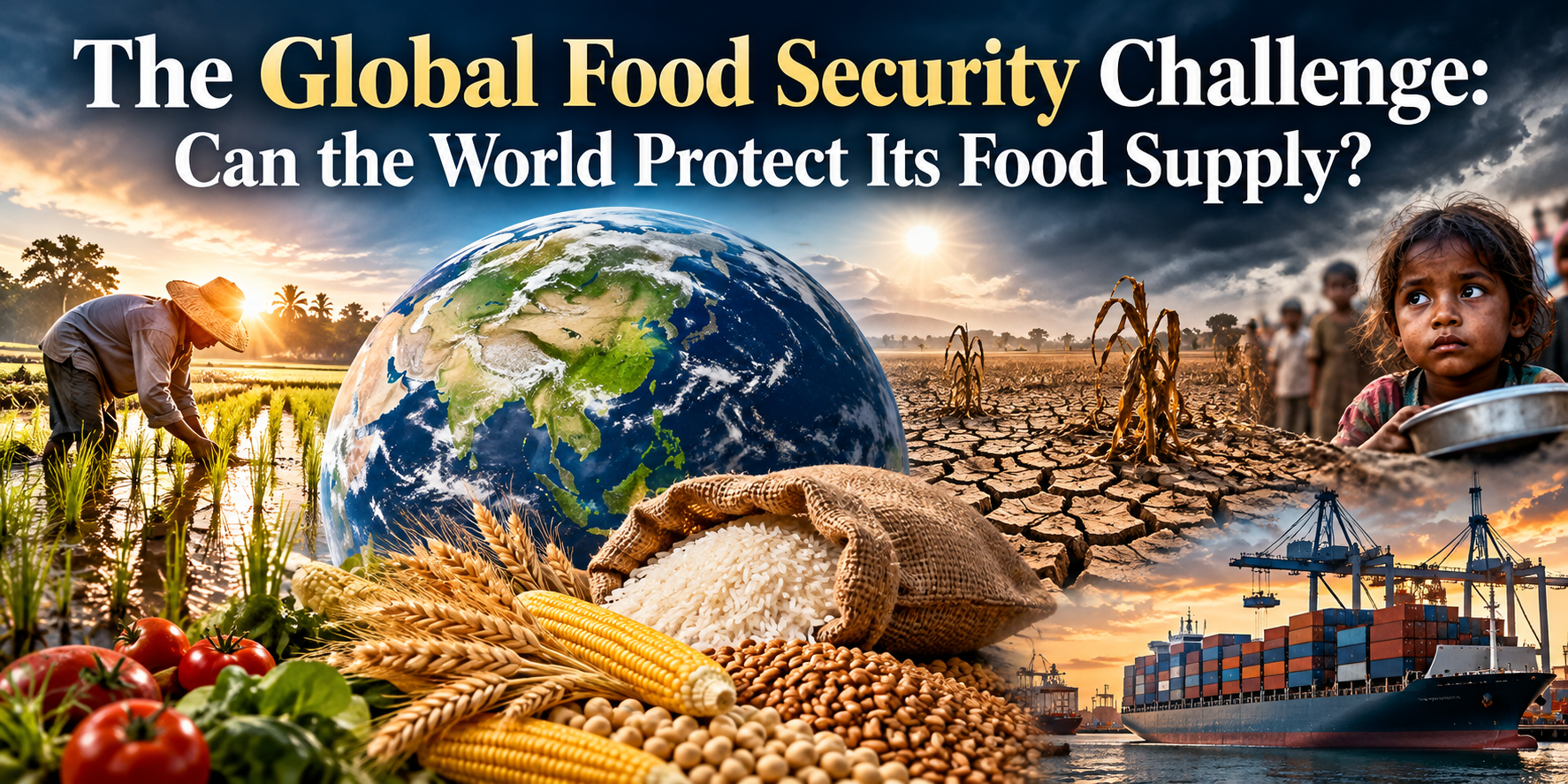
Climate shocks, conflict, disrupted trade and rising prices are putting renewed pressure on the world's food system. The challenge is no longer simply producing enough food, but ensuring that people can reliably afford and access it.
By Fernand Louis
Food security is becoming one of the defining global challenges of our time.
The world produces enormous quantities of food, supported by sophisticated agricultural technology and international trade. Yet millions of families continue to struggle to obtain sufficient and nutritious food. In 2026, the problem is being intensified by an increasingly dangerous combination of conflict, climate disruption, volatile prices and pressure on humanitarian assistance.
The World Food Programme reported in September that **266 million people across food-crisis countries are facing acute hunger**. Conflict remains a major driver, while climate shocks, displacement and economic pressures are making vulnerable communities even more fragile.
### Warning Signs in Global Food Prices
There are also renewed pressures in international food markets.
The UN Food and Agriculture Organization's Food Price Index reached **133.3 points in August 2026**, increasing 1.9 per cent from July and 2.5 per cent from a year earlier. All major commodity groups recorded increases during the month.
The causes extend far beyond ordinary market movements.
Adverse weather is affecting production expectations, while conflicts and logistical difficulties around important trading routes are adding uncertainty to global supplies.
FAO reported on September 14 that international prices for wheat, maize and rice had risen during August amid weather concerns, strong demand and trade disruption.
For wealthy households, higher food prices may mean adjusting spending. For poorer families, however, they can mean reducing the number or nutritional quality of meals.
### Climate Is Becoming a Food-Security Risk
Perhaps the greatest uncertainty comes from the climate.
On September 3, the World Meteorological Organization reported that El Niño was firmly established and expected to intensify into a very strong event. Its forecasts indicated a near-100 per cent likelihood of El Niño conditions continuing through February 2027.
This matters enormously to agriculture.
Changes in rainfall and temperature can produce drought in one region and flooding in another. Crops may fail, livestock can be affected and farmers may face higher production costs.
FAO's September assessment reduced its forecast for global cereal production in 2026 to **2.98 billion tonnes**, around 2 per cent below the previous year's level. Nevertheless, it would still represent the second-largest global cereal harvest on record, illustrating an important point: the world is not simply facing a universal shortage of food. Distribution, affordability and resilience are equally important.
### When Trade Routes Become Food Routes
Modern food security also depends heavily on international transportation.
Wheat, rice, maize, cooking oils, fertilizers and fuel routinely cross borders before reaching consumers. Disruption in the Black Sea, Red Sea and Strait of Hormuz can therefore have consequences far beyond the countries directly involved.
The World Food Programme warned on September 8 that disruption across major trade routes was affecting movements of food, fuel and fertilizer and contributing to delays and price pressures.
This demonstrates why food security can no longer be treated solely as an agricultural issue. It is simultaneously a question of energy security, international trade, logistics, climate resilience and peace.
### Building a More Resilient Food System
The solution cannot be found in one policy.
Countries need climate-resilient agriculture, improved irrigation, better storage facilities, diversified supply chains and stronger early-warning systems. Reducing food loss between farms and consumers can also strengthen supplies without requiring equivalent increases in production.
International trade must remain dependable during periods of stress, while humanitarian organisations need sufficient resources to intervene before food emergencies become catastrophes.
Technology can contribute as well. Satellite monitoring, weather forecasting, precision agriculture and data-driven crop management can help farmers anticipate risks and improve productivity.
But technology alone cannot solve hunger.
### Food Security Is Global Security
The central lesson of 2026 is increasingly clear: food security cannot be separated from global stability.
A resilient food system must ensure not merely that enough food exists somewhere in the world, but that families can obtain nutritious food consistently and affordably.
Protecting the world's food supply will therefore require cooperation among farmers, governments, scientists, businesses and international institutions.
**The question is not simply whether humanity can produce enough food. It is whether we can build a global system capable of delivering that food reliably, affordably and sustainably to the people who need it.**
That may ultimately become one of the most important tests of international cooperation in the decade ahead.
---