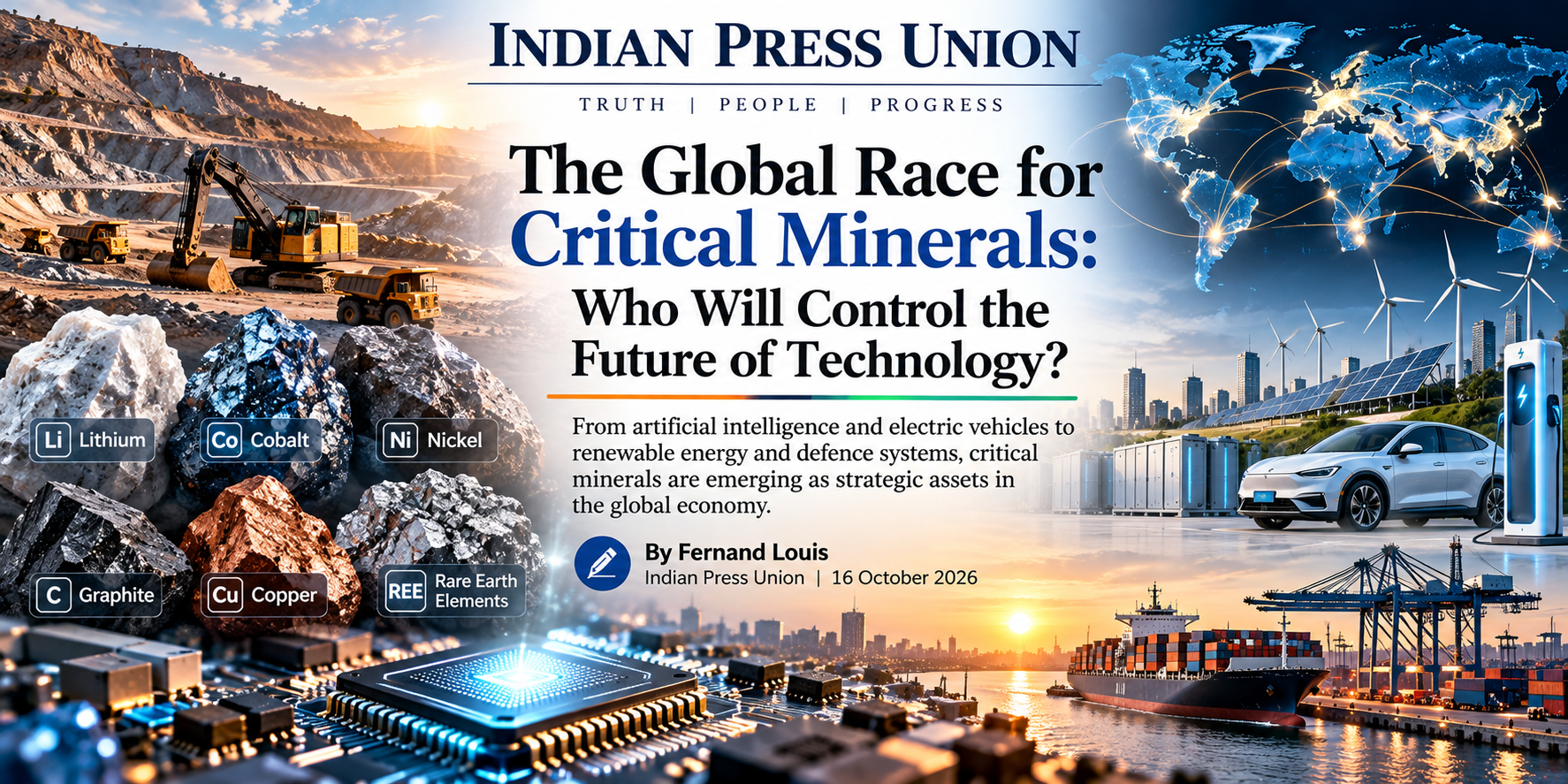
The Global Race for Critical Minerals: Who Will Control the Future of Technology?
Critical Minerals: The New Frontier of Global Economic Competition
By Fernand Louis
Indian Press Union | 16 October 2026
As countries compete for technological leadership, the minerals powering artificial intelligence, electric vehicles, semiconductors and clean energy are becoming strategic assets of the twenty-first century.
The next major global economic competition may be shaped not only by technology patents and financial markets, but also by access to essential natural resources. Lithium, cobalt, nickel, graphite, copper and rare earth elements support a wide range of modern industries, from electric mobility and renewable energy to telecommunications and advanced manufacturing.
The New Strategic Resources
Oil played a central role in international economic and geopolitical relationships throughout much of the twentieth century. Today, critical minerals are gaining strategic importance as countries expand clean-energy infrastructure and digital technologies.
Lithium and graphite are used in many rechargeable batteries, copper is essential to electrical networks, and certain rare earth elements are used in high-performance magnets for electric motors and wind turbines.
The International Energy Agency's Global Critical Minerals Outlook 2026 highlights growing concerns about concentrated supply chains, particularly in refining and processing. Its findings underline the importance of diversification and resilient supply networks.
The Supply Chain Challenge
Mineral security involves more than extracting resources. Mining must be followed by processing, refining and manufacturing before raw materials become usable industrial components. Countries with mineral reserves may still depend on overseas suppliers for processing technologies and advanced materials.
China has a significant role in several critical-mineral processing markets, while Indonesia is a major supplier of nickel. The IEA reported that refining concentration increased for most key energy minerals in 2025, highlighting potential vulnerabilities when supply is concentrated in a small number of countries.
India's Strategic Opportunity
India has taken steps to strengthen its critical-mineral value chain. In January 2025, the Union Cabinet approved the National Critical Mineral Mission for a seven-year period covering 2024–25 to 2030–31.
The mission includes proposed government expenditure of ₹16,300 crore and expected investment of ₹18,000 crore from public-sector undertakings and other stakeholders. Its objectives include strengthening exploration, mining, processing, recovery and recycling of critical minerals.
For India, these efforts could support electric-vehicle manufacturing, battery production, renewable-energy equipment, electronics and industrial research. Progress will depend on technical expertise, responsible investment and the development of competitive processing infrastructure.
Environmental Responsibility
Critical-mineral development also raises environmental and social concerns. Mining and processing can require substantial land, water and energy resources, while poorly managed operations may affect ecosystems and nearby communities.
Environmental safeguards, responsible waste management, water conservation and community participation are therefore important elements of sustainable mineral policy. Recycling used batteries, electronic equipment and industrial waste can also recover valuable materials and reduce demand for newly mined resources.
International Cooperation and Economic Security
No country possesses every mineral, technology and manufacturing capability required for the global energy and digital transition. Diversified trade relationships, joint exploration, technology sharing and investment in processing can help strengthen supply security.
For India, partnerships with mineral-producing countries could improve access to resources while creating opportunities for domestic value addition. The objective is to develop reliable and diversified supply chains rather than rely entirely on domestic production or a narrow group of foreign suppliers.
Critical minerals are becoming an important part of global economic strategy. Their availability, processing and responsible use will influence the competitiveness of industries linked to artificial intelligence, clean energy and advanced manufacturing.
The countries best positioned for the future will not necessarily be those with the largest mineral reserves, but those able to transform resources into sustainable industrial capabilities, technological innovation and economic opportunity.
Fernand Louis
Author | Technology Researcher | Solution Architect
The views expressed are those of the author.