The Invisible Cost of Digital Progress: Is India Ready for the Next Economic Transformation?
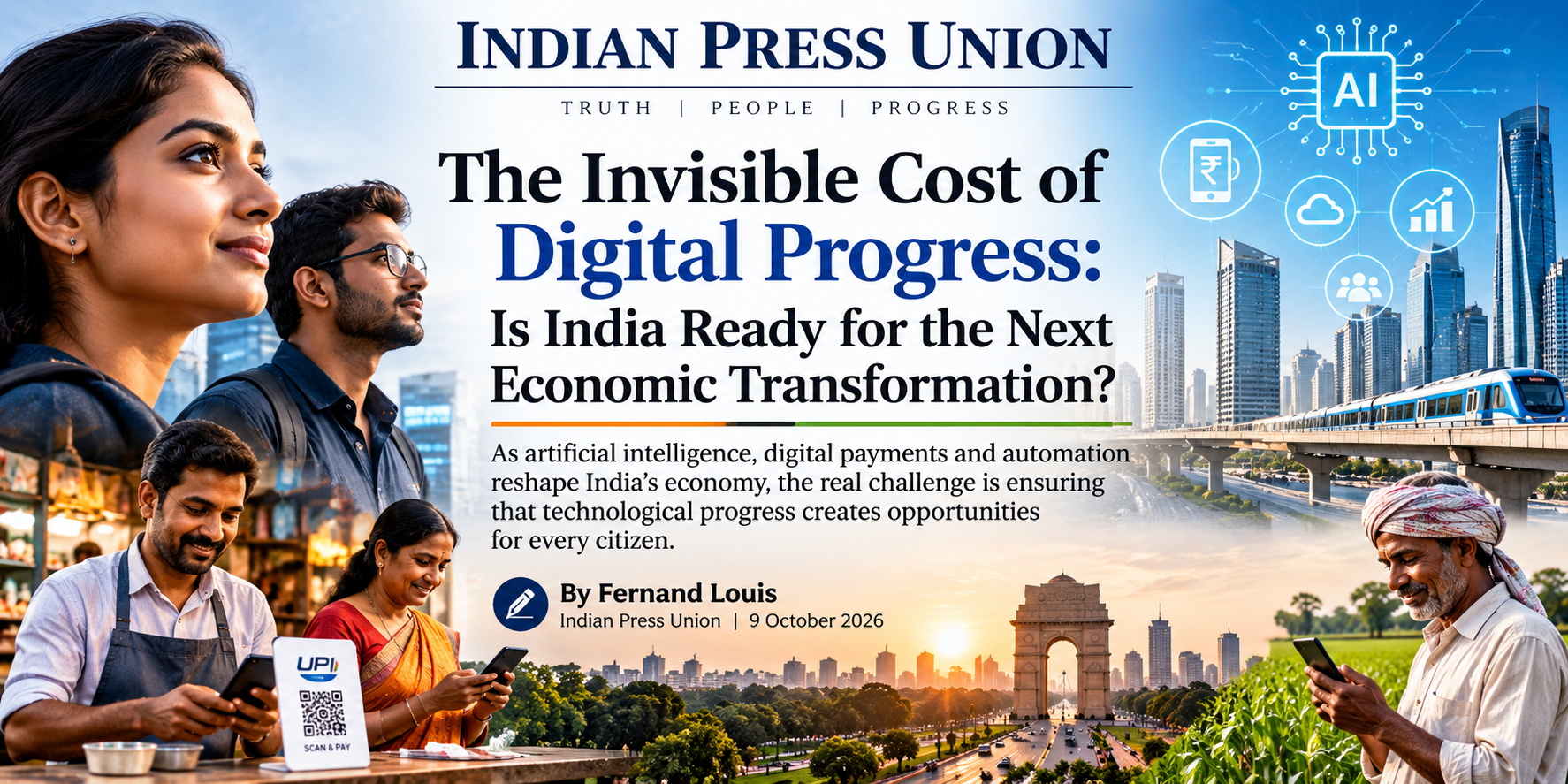
As artificial intelligence and digital infrastructure accelerate economic growth, India must ensure that technological advancement translates into meaningful prosperity for its people.
By Fernand Louis
Indian Press Union
India is entering a defining phase of its economic transformation. Artificial intelligence, digital payments, automation and data-driven governance are changing how businesses operate, governments deliver services and citizens participate in the economy.
Yet, beneath the remarkable achievements of digital India lies a fundamental question: Are we building a technologically advanced nation, or are we building an economically empowered society?
A Digital Economy on the Rise
India's digital achievements are significant. According to the Ministry of Electronics and Information Technology's August 2026 assessment, the digital economy contributes approximately 12–14% of national GDP, with projections suggesting that its share could reach 20% over the next decade.
The Unified Payments Interface (UPI) has transformed everyday transactions, connecting small merchants, businesses and consumers through an accessible payment ecosystem.
Digital infrastructure has become an important economic asset. However, technological adoption alone cannot guarantee financial security, higher household incomes or sustainable employment.
The Changing Nature of Employment
Artificial intelligence is creating new opportunities while transforming traditional occupations.
An October 2026 technology employment report indicated that active technology job openings in India reached approximately 123,000, representing 17% year-on-year growth. Nevertheless, much of the demand remains concentrated in experienced and specialised roles.
This creates an important policy challenge.
While companies increasingly seek professionals skilled in artificial intelligence, cybersecurity and advanced analytics, millions of young Indians require accessible pathways to acquire these capabilities.
The future of employment must therefore involve more than technology investment. It requires coordinated investment in education, vocational training, digital literacy and continuous professional development.
The Household Economy Must Matter
National economic growth becomes meaningful when families experience improvements in their daily lives.
A small business owner may accept digital payments but still struggle to obtain affordable working capital. A graduate may possess a degree but lack industry-relevant skills. A farmer may receive digital financial assistance yet remain vulnerable to unpredictable market prices.
These realities highlight the difference between digital connectivity and economic empowerment.
India's next phase of reform should focus on measurable household outcomes, including income stability, employment opportunities, financial savings and access to essential services.
Technology should not merely accelerate transactions. It should improve the economic circumstances of the people conducting them.
Responsible Innovation and Public Trust
As artificial intelligence becomes integrated into financial services and governance, data protection, cybersecurity and algorithmic accountability become increasingly important.
Digital systems can improve efficiency, but poorly designed systems may also introduce exclusion, discrimination or operational vulnerabilities.
Citizens must have confidence that automated decisions are transparent, personal information is protected and accessible grievance mechanisms are available.
Responsible innovation is not an obstacle to technological progress. It is a necessary foundation for public confidence and long-term adoption.
Building an Inclusive Economic Future
India possesses considerable strengths: a growing digital ecosystem, entrepreneurial talent, expanding infrastructure and a large domestic market.
The next opportunity is to connect these strengths with practical economic outcomes.
Policymakers, educational institutions, technology companies and financial organisations must collaborate to ensure that innovation benefits rural communities, small enterprises, young professionals and economically vulnerable households.
Progress should be measured not only through transaction volumes, digital adoption rates or investment announcements, but also through the quality of employment, household financial resilience and accessibility of opportunity.
India's greatest achievement will not be the number of technologies it develops, but the number of lives those technologies improve.
The future of digital India must ultimately be judged by a simple principle: technological progress should serve human prosperity.
Fernand Louis
Author | Technology Researcher | Solution Architect