The Mecca Pact: THREE COUNTRIES, Shared Anxieties & India’s concerns.
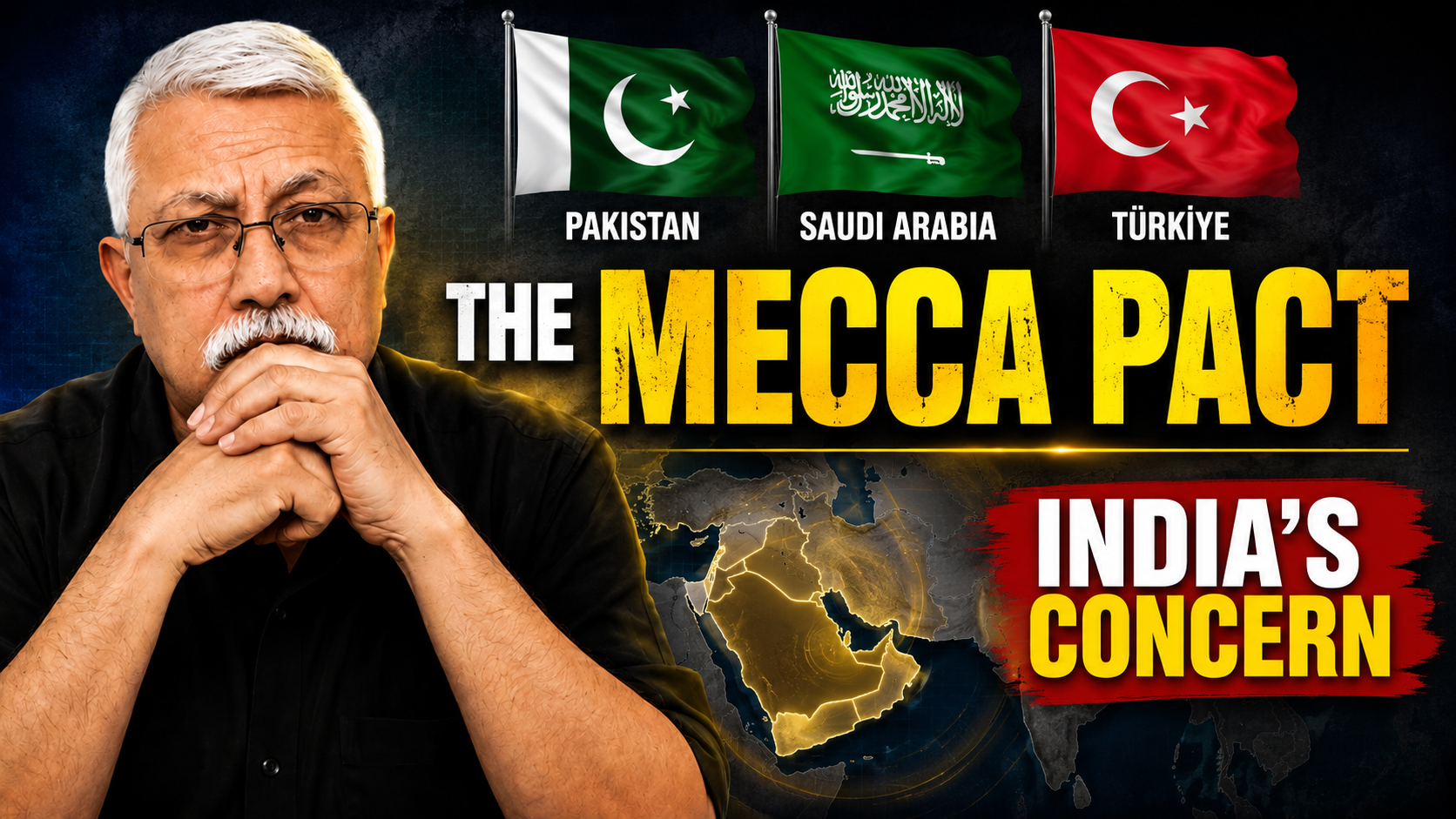
The Mecca Pact: THREE COUNTRIES, Shared Anxieties & India’s concerns.
Recently, Turkiye, Pakistan agree for military deployment under Mecca pact against Houthis.
So, its imperative that we Indians do not take this lightly as it can have implications on India.
The Joint Defence Agreement signed by Pakistan, Saudi Arabia and Türkiye in Mecca on August 7 reflects not only a shared strategic anxiety,
but also a deeper shift taking place in West Asia’s security architecture.
The agreement provides for collective defence, with an attack on one signatory to be treated as an attack on all three.
Although right now it has three members but given the statements issued by Turkiye Foreign minister , it is likely to be joined by several others particularly Egypt .
But what does this agreement really mean?
To understand its implications, we need to ask four questions:
First, what are the shared anxieties that have brought these three countries together?
Second, what does each signatory stand to gain from the agreement?
Third, is this essentially an anti-Iran arrangement—or could it be the beginning of something resembling a NATO-like regional security framework?
And finally, what does this mean for India?
Let us begin with the first question:
What are the shared anxieties?
1. Israel’s growing military dominance
Israel has emerged as the region’s most dominant military power, while Iran’s conventional and unconventional deterrence has been repeatedly weakened—raising fears of a serious imbalance in West Asia, which was seen as a counter to Israel’s dominance. This growing imbalance is now compounded by increasingly open Israeli talk of a “Greater Israel.”
2. Türkiye could be next
Israeli leaders are increasingly identifying Türkiye as a major strategic rival, giving Ankara a direct reason to strengthen its regional deterrence.
3. Fear of being dealt with individually
With Israel expanding military operations in Gaza, Lebanon and the West Bank, unmindful of global reactions and ceasefire declarations and even US peace plan for Gaza several regional countries fear that, without collective security, they could eventually face pressure one by one.
4. Declining faith in the US security umbrella
The continuing conflicts have reinforced a perception that Washington either cannot or will not restrain Israeli military action when regional interests clash with those of Israel.
5. The need for a regional security architecture
The underlying message is becoming clear: West Asian countries can no longer afford to depend entirely on an external power for their security; they need greater collective deterrence of their own.
That is the larger context in which the Mecca Defence Agreement needs to be understood -
What is in it for each ?
Saudi Arabia: Another Layer of Security
• Strategic insurance: The agreement gives Riyadh another layer of deterrence at a time when it is increasingly wary of depending on any single security partner.
• Reduced dependence on the US: It does not mean abandoning Washington, but rather diversifying its security partnerships and reducing reliance on the American security umbrella.
• Greater strategic flexibility: With Pakistan and Türkiye alongside the US and GCC, Saudi Arabia gains more options to respond to changing regional threats.
• Stronger regional leadership: By bringing major regional powers into a security framework, Riyadh strengthens its position as a key player in shaping West Asia’s security architecture.
Türkiye: From Regional Power to Security Provider
• Greater regional leadership: Türkiye wants to move from being a regional power to becoming a key architect of West Asia’s security, potentially expanding the pact beyond the three signatories.
• Stronger deterrence: With growing tensions with Israel, the agreement gives Ankara additional strategic depth and stronger regional security partnerships.
• Defence-industrial gains: Closer ties with Saudi Arabia and Pakistan could open new markets for Türkiye’s expanding defence industry.
• Greater economic influence: Defence cooperation can deepen political trust, trade and investment links across the region, strengthening Türkiye’s position between West Asia, Europe and South Asia.
.
Pakistan: Money, Prestige—and Strategic Access
• Financial support: Pakistan needs Saudi Arabia’s financial backing, making the agreement as much about economic security as military cooperation.
• Greater prestige: As a nuclear-armed Muslim-majority country, Pakistan’s participation gives the alliance greater political and strategic weight—and enhances Islamabad’s standing in the Muslim world.
• Strategic relevance to the US: The agreement allows Pakistan to present itself as a useful regional security partner, particularly at a time when Washington is seeking greater burden-sharing from its allies.
• Defence and economic opportunities: Pakistan can leverage its military capabilities to attract Saudi financing, defence cooperation and potentially new markets for its defence industry.
• Kashmir dimension: India remains central to Pakistan’s security calculations, and closer defence ties with Saudi Arabia and Türkiye give Islamabad greater political access to two influential countries—although this does not mean automatic support for Pakistan on Kashmir.
• A wider geopolitical role: Ultimately, Pakistan gains an opportunity to project its influence beyond South Asia by positioning itself as a security provider in the wider Muslim world.
Is This Really About Iran?
• Not simply an anti-Iran alliance: Iran is certainly a factor, but the agreement appears equally driven by concerns over Israel’s growing military dominance and the weakening credibility of the US security umbrella.
• A search for strategic autonomy: Years of conflict have exposed the limits of relying on an external power for regional security. The agreement reflects a desire to build indigenous regional deterrence.
• Iran, Israel—and the US: The emerging architecture may therefore be designed to hedge against multiple threats, rather than target Iran alone. The larger message is: West Asia wants more than one security umbrella.
Is This “Muslim NATO”?
• Not yet: Three countries do not make a NATO, and the agreement lacks NATO’s integrated command, institutional structures and decades of military cooperation.
• But the potential is significant: If more countries join and cooperation expands into intelligence-sharing, air defence, military exercises and defence production, it could evolve into something much larger.
• The real significance: The Mecca agreement may be less important for what it is today than for what it could become—a West Asian security architecture increasingly designed by regional powers themselves.
.
What Does It Mean for India?
• A stronger diplomatic platform for Pakistan: Türkiye and Saudi Arabia have considerable influence in the Muslim world, and their closer defence relationship with Pakistan could give Islamabad greater space to raise Kashmir at the OIC and international forums.
• Pakistan, since its inception, has consistently sought to use every external agency, organisation and international platform to target India—from the UN and OIC to CENTO. To expect that this time would be any different would therefore be naïve.
• A potentially stronger military equation: With Chinese military support, Turkish defence technology and Saudi financial capacity, Pakistan could strengthen its military and drone capabilities. This does not automatically change the military balance, but it is a development India cannot afford to ignore.
• India’s answer must go beyond geopolitics: India has successfully maintained strong relationships with Saudi Arabia, the UAE, Iran and Israel despite their competing interests. But in Kashmir, long-term security will ultimately depend on deeper social, economic and emotional integration—not merely infrastructure or symbolic gestures.
And this is where India needs to be particularly careful. Development that ignores local aspirations, damages fragile ecosystems or disrupts local heritage can create resentment rather than integration. Real integration is not just about building roads and bridges; it is about making people feel that development is happening with them, not to them.
Prof. Amitabh Mattoo highlights that true national integration requires deep social, economic, and emotional connection rather than mere symbolic acts like hoisting a flag.
Note ; Pl do not look at this article from the point of view that wether it is critical of Govt or not. What you should edit is - If the article is abusive, if the article contains only allegations without evidence. Because if you edit the article with an aim to remove sentences which are critical of Govt , you are not helping the country.