The number everyone quoted about Indian IT last year was almost meaningless
India's five biggest IT services companies cut 6,981 jobs in FY26.
It's a clean number. It got quoted everywhere. And it hides almost everything that actually happened.
Because TCS alone shed 23,460 people that year — the largest single-year reduction in its history, and roughly double the 12,200 it had announced. Infosys, Wipro and HCLTech were adding staff over the same stretch. Net it all out and you get 6,981, a figure that describes no company's actual experience.
Averages are where stories go to die. The real one is underneath.
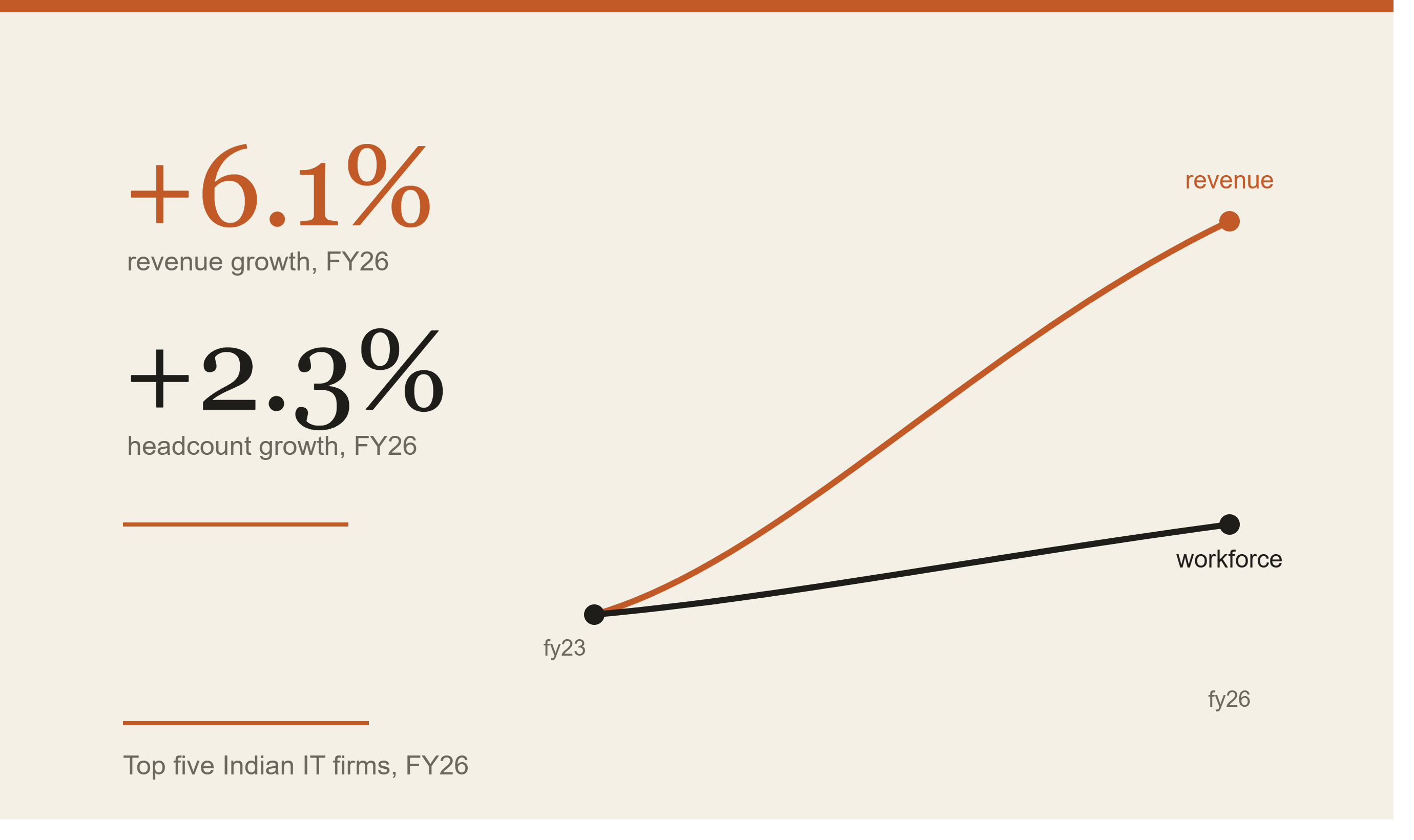
Revenue went up. Hiring didn't follow.
Here is the statistic worth carrying around: in FY26, sector revenue grew 6.1% while headcount grew 2.3%.
For thirty years those two lines moved together. That was the whole business. More work meant more people, and more people meant more revenue, because the product being sold was, in effect, engineering hours.
HCLTech's CEO C Vijayakumar said it out loud in October — revenue grew, headcount didn't. He framed it as productivity, not as a cut. He's right, and that's precisely what makes it significant. Nobody had to fire anyone for the model to change.
What Wipro's "20,000" actually means
In September, Wipro's chief technology officer Sandhya Arun told Reuters that the company's AI work had freed capacity equivalent to about 20,000 employees.
That headline travelled fast and mostly travelled wrong. Wipro did not cut 20,000 jobs. It employs roughly 243,000 people and says the freed capacity has been redeployed. Arun was explicit that this isn't, in her words, person-to-person replacement by an agent — the same engineer might now be supervising a set of AI agents, or moved to a different project, or retraining for a different role.
So: no layoff. But read it again. Wipro is saying it can now produce the output of roughly 8% more workforce without hiring 8% more workforce.
Nobody loses a job in that sentence. A lot of jobs simply never get created.
That is the quieter, harder thing to report. Layoffs generate press releases. Hiring that doesn't happen generates nothing at all.
Why this lands hardest in India
India's IT industry was built on an arbitrage that was almost embarrassingly simple. Global companies had vast technology needs. India had millions of English-speaking engineers who could do the work for a fraction of the cost.
So Indian firms got very, very good at one specific thing: deploying large teams, fast.
Clients weren't really buying software. They were buying capacity — thousands of billable hours, staffed and managed. More scope meant more headcount meant more billing.
AI breaks that arithmetic. If a project that needed 100 engineers now ships with 65, the client asks the obvious question, and some are not waiting to be polite about it. Reuters reported in August that the $315-billion industry is being pushed away from hours-based billing toward contracts priced on outcomes. Some clients are reportedly pushing for 20–30% price reductions on new contracts.
That's the disruption. Not the layoffs — the layoffs are a symptom. The disease is that the unit of sale is changing, and Indian IT spent three decades optimising for the old one.
The fresher squeeze, and the contradiction inside it
The work AI handles best is, awkwardly, the work that used to be the front door: basic coding, manual testing, documentation, first-level support, routine maintenance, data processing.
That was the training ground. You hired ten thousand graduates, ran them through it for two years, and the good ones came out the other side as engineers. Remove the training ground and you have a problem that shows up five years later, not next quarter.
But here's where the panic narrative falls apart.
TCS ended FY26 at 584,519 employees — and says it remains on track to hire 40,000 freshers. Infosys held a 20,000-fresher target. Nasscom data shows the overall Indian tech workforce actually grew by about 1.4 lakh to reach roughly 59 lakh people.
Cutting bench strength while hiring graduates at scale sounds contradictory. It isn't. It's a filter.
Companies aren't hiring fewer freshers. They're hiring different ones — weighted hard toward AI, data engineering, cloud and cybersecurity, and away from the generalist campus intake that defined the industry for two decades.
The shortage isn't jobs. It's job-ready people for the jobs being created.
The layer nobody wants to talk about
Freshers get the headlines. The middle of the org chart may be more exposed.
When TCS announced its FY26 reduction, it said the cuts would fall primarily on middle and senior management. That's worth pausing on, because it inverts the usual assumption that automation eats from the bottom.
Think about what a lot of middle management in IT services actually consists of: status tracking, resource allocation, documentation, coordinating between teams, assembling reports. A meaningful share of that is administrative connective tissue — exactly the category AI handles competently.
A manager who ran ten people may end up running five people and a set of agents.
Managers don't disappear. But the ones who mainly coordinate work look considerably more replaceable than the ones who exercise judgement, own client relationships, or make calls when the answer isn't in the data.
What's actually being built
Watch the job titles, because they're where the future shows up first.
TCS plans to build a team of up to 8,900 forward-deployed engineers. Infosys is targeting around 6,000. These are engineers who sit inside the client's business and push AI systems from pilot into production — part engineer, part consultant, part translator.
That role barely existed three years ago. Now it's being staffed in the thousands.
Add the rest of the emerging list: AI engineers, data engineers, model evaluators, AI product managers, AI governance and security specialists, domain experts who understand both an industry and the technology. And a set of roles nobody has named yet.
Every technological shift has run this way. The internet destroyed jobs and created web developers, cloud architects, security professionals, digital marketers — categories that couldn't have been described in advance.
So the question isn't whether AI destroys IT jobs. It will destroy some. The question is whether India builds the new ones fast enough, and whether the people losing the old ones are the same people who get the new ones.
Those are not the same question. The second one is harder.
The advice that stopped working
For twenty years, the safest thing you could tell an ambitious Indian teenager was: learn to code.
That advice isn't wrong now. It's just no longer sufficient on its own.
Writing code still matters. But the person who is hard to replace over the next decade is the one who can define the problem, use AI to attack it, check whether the output is actually correct, stitch several systems together, explain it to a customer, decide what to do when the answer is ambiguous — and then own the result.
Notice that only one item on that list is a technical skill.
For an industry that spent thirty years selling technical hours by the thousand, that may be the most disruptive sentence in this entire story.