THE TELEVISION ERA
WHEN TELEVISION WAS AN EVENT
There was a time when television was not just an appliance. It was an event.
We waited for it. Planned around it. Argued over it. Gathered around it—and sometimes even fought over who got to hold the remote.
For our generation, television was almost a member of the family. The living room was arranged around it. When a favourite programme came on, conversations stopped.
There was no “I'll watch it later.”
No pause button.
No streaming.
No catch-up.
If you missed it, you missed it.
That limitation gave television its power.
Families adjusted their schedules around programmes. Neighbours gathered together when not everyone owned a television. Even advertisements became part of the experience. We knew the jingles, remembered the characters and could often recite commercials word for word.
Television created something we rarely have today:
A SHARED CULTURAL MOMENT
Millions of people watching the same programme at the same time.
FROM BEHIND THE SCREEN
Coming from a background in the media and television industry, my relationship with television was more than personal. It became part of my professional life, my imagination and, in many ways, my identity.
I saw what happened behind those 30 or 60 minutes on screen—the writers, producers, directors, camera crews, editors, technicians, presenters, advertising teams and countless others working against the clock.
I remember the frantic phone calls, last-minute changes, tapes being rushed around and programmes being edited almost until transmission time.
There was something magical about knowing that at a particular moment, something we had created would leave the studio and enter thousands—or even millions—of homes.
Today, a video can reach the world within seconds.
It is easier.
Faster.
More democratic.
But somehow, it feels a little less magical.
THEN CAME CHOICE
Television's greatest competitor was not another television.
IT WAS CHOICE.
First came cable.
Then satellite television.
Channels multiplied—news, sports, music, movies, business and children's programming.
Then came the internet.
YouTube.
Netflix.
Prime Video.
Streaming platforms without end.
And suddenly, the question changed.
“What's on television tonight?”
became
“What do you want to watch?”
The television stopped dictating our viewing habits.
WE BEGAN DICTATING THEM.
THE TELEVISION BECAME A SCREEN
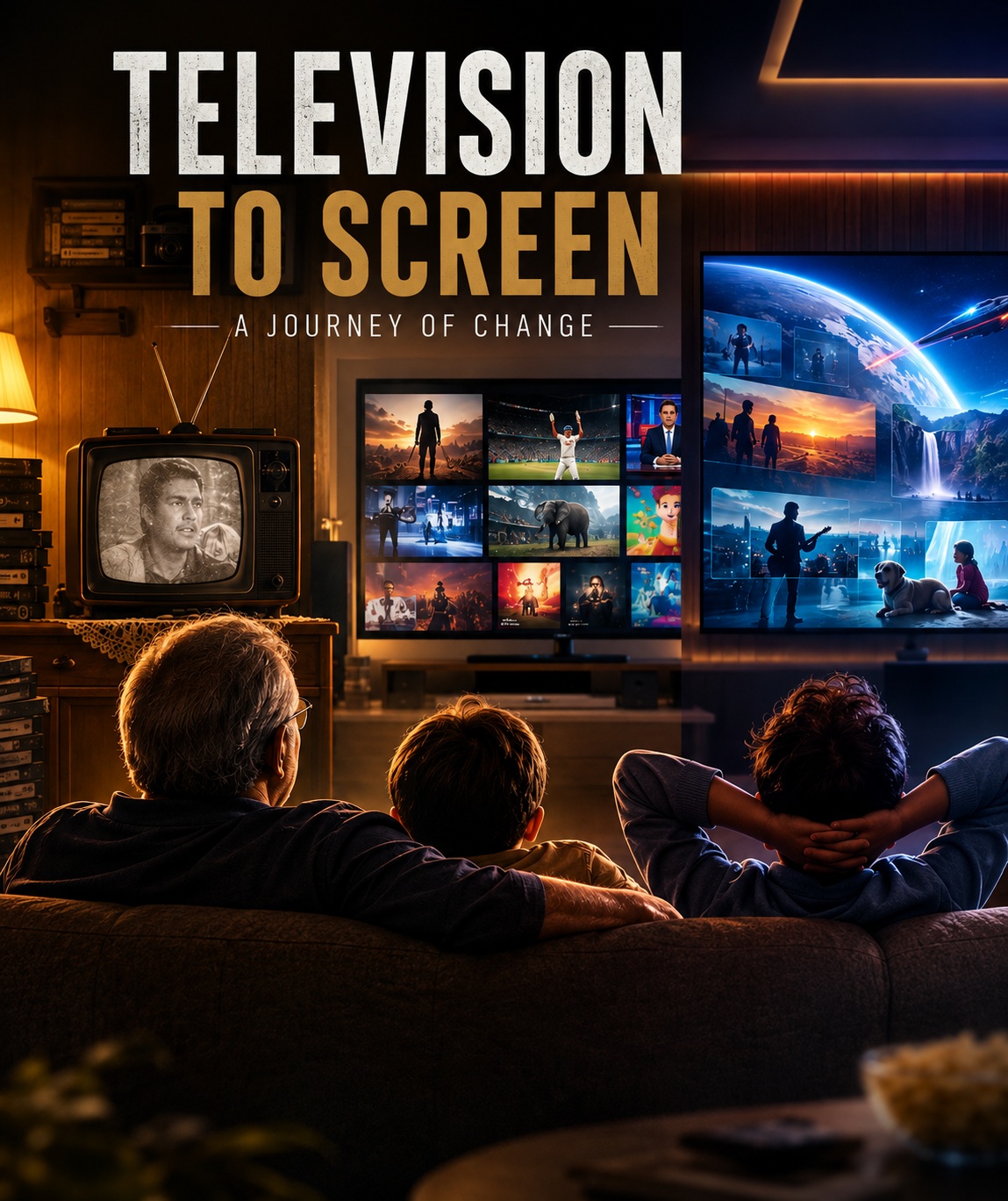
Walk into a modern home today and the television may still be the largest object in the room.
But conceptually, it is no longer necessarily a television.
It is a display.
A portal.
A computer with a very large screen.
One moment it shows cricket. The next, YouTube. Then a video call, photographs, a movie or a game.
The hardware survived.
THE CONCEPT CHANGED.
The camera didn't really die; it became part of the phone.
The Walkman disappeared, but music became more accessible.
Maps disappeared from our pockets, only to return as something infinitely more powerful through our phones.
Perhaps television is following the same path.
WHAT WILL OUR GRANDCHILDREN THINK?
Imagine telling a child 20 years from now:
“When I was young, we had something called television. Programmes came on at specific times, and if you wanted to watch something, you had to wait.”
They may look at us with genuine disbelief.
“Why couldn't you just watch it whenever you wanted?”
For them, the television may simply be a screen—another interface through which they access whatever they want.
And perhaps that is where the sadness lies.
When technology becomes invisible, we sometimes forget the enormous cultural role it once played.
YET, I AM HAPPY TOO
I am not unhappy about the change.
Technology is supposed to evolve.
Today, a child anywhere can access knowledge, documentaries, films and entertainment from across the world. Independent creators can reach audiences without needing a television network.
The gatekeepers have been weakened.
The possibilities have exploded.
As someone who has worked in media, that excites me enormously.
But I will still miss the old television.
I will miss the anticipation.
The family gathering around one screen.
The excitement of a programme beginning at exactly 8 p.m.
The feeling that millions of strangers were watching exactly what you were watching.
And perhaps most of all, I will miss the idea that television was a place you went to, rather than simply another device you used.
TELEVISION MAY DIE. STORYTELLING WON'T.
Perhaps that is the real lesson.
The television set may eventually disappear.
Channels may disappear.
The remote may disappear.
Even the word television may eventually become an old-fashioned expression.
But storytelling will remain.
People will always want to laugh, cry, learn, escape and be entertained.
The screen will become thinner.
The technology will become invisible.
Artificial intelligence may completely transform how programmes are created and personalised.
But somewhere, someone will still be sitting in front of a screen, waiting for a story to begin.
And I will probably watch that transformation with a strange mixture of pride and nostalgia.
Because I knew television when it was an object.
I knew it when it was an industry.
I knew it when it was an event.
And now I am watching it become something much bigger and much less tangible.
A SCREEN.
Perhaps that isn't the death of television after all.
Perhaps it is simply television's final act—disappearing into the very technology it helped create.