Time-Share Property Explained: How Vacation Home Usage Models Work
By RAJAT MALHHOTRA: ULTRA LUXURY PROPERTY SPECIALIST, COLUMNIST, NUMEROLOGIST
PALAMPUR, HIMACHAL PRADESH: What if owning a holiday home did not necessarily mean purchasing and maintaining an entire cottage yourself? That is the basic idea behind a time-share vacation-home model—a structure in which customers receive a defined right to use a holiday property for specified periods, subject to the terms of their agreement.
For buyers considering a second home in Palampur, the concept can be particularly relevant. The town is surrounded by tea gardens and pine and deodar forests, with trekking opportunities and access to Bir-Billing and other Kangra Valley attractions. Himachal Tourism describes Palampur as a quiet mountain destination and places Bir about 29 km away and Billing about 43 km away.
What does a time-share customer actually receive?
The most important point is that time-share should not automatically be described as part ownership.
Depending on the legal structure of the offering, a customer may receive a contractual right to occupy or use a particular cottage or holiday accommodation for an agreed number of days or weeks each year. Whether the customer receives any ownership interest in the underlying land or building depends entirely on the legal documents.
Therefore, buyers should examine exactly what is being purchased—not simply the marketing terminology.
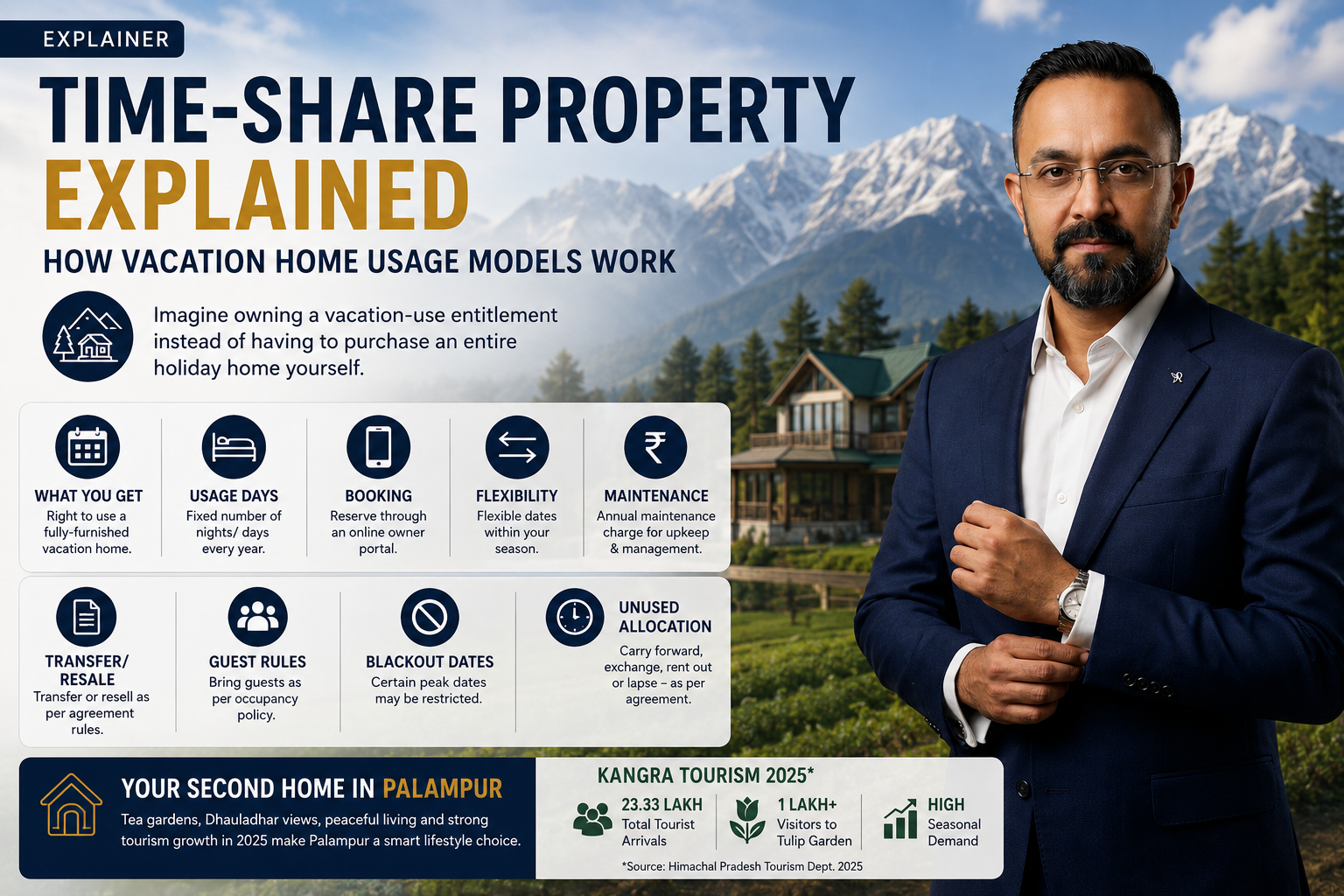
A professionally structured time-share agreement should clearly specify the number of usage days, booking procedure, fixed or flexible dates, maintenance charges, guest policy, transfer or resale provisions, blackout dates and rules governing unused entitlement.
If a customer does not use the allocated period, the agreement should explain whether those days can be carried forward, exchanged, transferred, rented through an approved programme or simply lapse.
Why Palampur makes the concept interesting
Tourism data indicates substantial visitor activity in the wider Kangra district.
According to the Himachal Pradesh Tourism Department's 2025 estimates, Kangra recorded 2,230,888 domestic and 102,479 foreign tourist arrivals, a combined figure of approximately 23.33 lakh visitors. The official data is district-level rather than Palampur-specific, so it should not be interpreted as 23.33 lakh tourists visiting Palampur alone.
There were also clear signs of strong seasonal demand in Palampur during 2025. Local reporting in June said hotels in Palampur and neighbouring destinations such as Bir-Billing and Barot were close to full capacity during a long weekend, while a December report described hotels, homestays and camping sites across the region as operating at near-full capacity during the Christmas-New Year period.
Palampur also recorded more than one lakh visitors to its Tulip Garden in 2025, up from around 80,000 the previous year, according to officials cited by Hindustan Times.
What kind of return can a second home generate?
This is where buyers need to distinguish between financial return and lifestyle value.
A time-share may provide value through personal holiday usage, potentially reducing the need to book accommodation repeatedly. If the contract permits rental or revenue sharing when the owner is not using the allotted period, there may also be an income component.
However, tourist arrivals do not guarantee property returns.
For illustration only, if a cottage achieved an average realised rental rate of ₹7,500 per night for 100 paid nights, its gross accommodation revenue would be ₹7.5 lakh. After hypothetical operating expenses of 35%, approximately ₹4.88 lakh would remain before taxes, financing and other capital costs. On a ₹1 crore all-in property cost, that would represent an illustrative operating yield of about 4.9%—not a guaranteed Palampur market return.
Actual returns will depend on purchase price, location, occupancy, seasonality, tariffs, management fees, maintenance, taxes and the contractual revenue-sharing arrangement.
Why a second home in Palampur deserves consideration
For urban families, the attraction of Palampur may ultimately be broader than rental income. A second home can provide a recurring mountain retreat surrounded by tea gardens, forests and the Dhauladhar landscape, while keeping adventure destinations such as Bir-Billing within reach.
The smart buyer, however, should first understand the legal structure, usage entitlement, costs and exit provisions—and only then consider projected returns.
A second home should be evaluated not only by how much it can earn, but by how much life you can get out of it.
SEO Tags
Worked for 12s
Time-Share Property Explained: How Vacation Home Usage Models Work
PALAMPUR, HIMACHAL PRADESH: What if owning a holiday home did not necessarily mean purchasing and maintaining an entire cottage yourself? That is the basic idea behind a time-share vacation-home model—a structure in which customers receive a defined right to use a holiday property for specified periods, subject to the terms of their agreement.
For buyers considering a second home in Palampur, the concept can be particularly relevant. The town is surrounded by tea gardens and pine and deodar forests, with trekking opportunities and access to Bir-Billing and other Kangra Valley attractions. Himachal Tourism describes Palampur as a quiet mountain destination and places Bir about 29 km away and Billing about 43 km away.
What does a time-share customer actually receive?
The most important point is that time-share should not automatically be described as part ownership.
Depending on the legal structure of the offering, a customer may receive a contractual right to occupy or use a particular cottage or holiday accommodation for an agreed number of days or weeks each year. Whether the customer receives any ownership interest in the underlying land or building depends entirely on the legal documents.
Therefore, buyers should examine exactly what is being purchased—not simply the marketing terminology.
A professionally structured time-share agreement should clearly specify the number of usage days, booking procedure, fixed or flexible dates, maintenance charges, guest policy, transfer or resale provisions, blackout dates and rules governing unused entitlement.
If a customer does not use the allocated period, the agreement should explain whether those days can be carried forward, exchanged, transferred, rented through an approved programme or simply lapse.
Why Palampur makes the concept interesting
Tourism data indicates substantial visitor activity in the wider Kangra district.
According to the Himachal Pradesh Tourism Department's 2025 estimates, Kangra recorded 2,230,888 domestic and 102,479 foreign tourist arrivals, a combined figure of approximately 23.33 lakh visitors. The official data is district-level rather than Palampur-specific, so it should not be interpreted as 23.33 lakh tourists visiting Palampur alone.
There were also clear signs of strong seasonal demand in Palampur during 2025. Local reporting in June said hotels in Palampur and neighbouring destinations such as Bir-Billing and Barot were close to full capacity during a long weekend, while a December report described hotels, homestays and camping sites across the region as operating at near-full capacity during the Christmas-New Year period.
Palampur also recorded more than one lakh visitors to its Tulip Garden in 2025, up from around 80,000 the previous year, according to officials cited by Hindustan Times.
What kind of return can a second home generate?
This is where buyers need to distinguish between financial return and lifestyle value.
A time-share may provide value through personal holiday usage, potentially reducing the need to book accommodation repeatedly. If the contract permits rental or revenue sharing when the owner is not using the allotted period, there may also be an income component.
However, tourist arrivals do not guarantee property returns.
For illustration only, if a cottage achieved an average realised rental rate of ₹7,500 per night for 100 paid nights, its gross accommodation revenue would be ₹7.5 lakh. After hypothetical operating expenses of 35%, approximately ₹4.88 lakh would remain before taxes, financing and other capital costs. On a ₹1 crore all-in property cost, that would represent an illustrative operating yield of about 4.9%—not a guaranteed Palampur market return.
Actual returns will depend on purchase price, location, occupancy, seasonality, tariffs, management fees, maintenance, taxes and the contractual revenue-sharing arrangement.
Why a second home in Palampur deserves consideration
For urban families, the attraction of Palampur may ultimately be broader than rental income. A second home can provide a recurring mountain retreat surrounded by tea gardens, forests and the Dhauladhar landscape, while keeping adventure destinations such as Bir-Billing within reach.
The smart buyer, however, should first understand the legal structure, usage entitlement, costs and exit provisions—and only then consider projected returns.
A second home should be evaluated not only by how much it can earn, but by how much life you can get out of it.