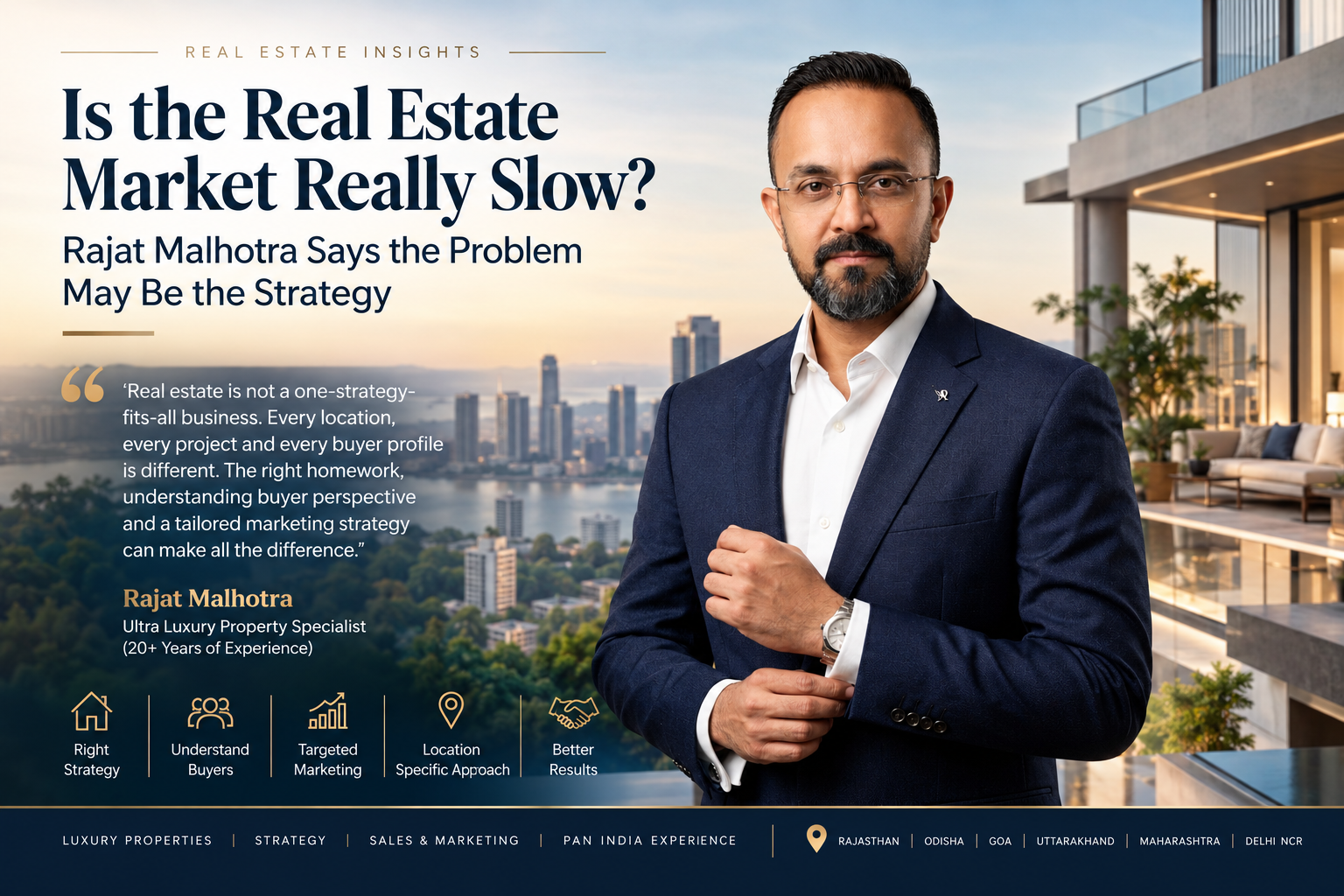
Is the Real Estate Market Really Slow? Rajat Malhotra Says the Problem May Be the Strategy
Is the Real Estate Market Really Slow? Expert Rajat Malhotra on Changing Buyer Expectations
By: Rajat Malhotra, Ultra-Luxury Property Specialist, Columnist and Numerologist
New Delhi: Talk of a “slow” real estate market has become increasingly common among developers, channel partners and property buyers. However, according to Rajat Malhotra, an ultra-luxury property specialist with nearly two decades of experience across India, the larger question is whether developers are approaching the market in the right way.
Having worked across Rajasthan, Odisha, Goa, Uttarakhand, Maharashtra and Delhi NCR, Malhotra believes that real estate demand has not disappeared entirely. In his view, buyer expectations have changed, competition has increased and traditional sales and marketing strategies may no longer deliver the same results in every market.
“Real estate is not a one-strategy-fits-all business,” says Malhotra. “Every location, every project and every buyer profile is different. The way a luxury project in Goa is positioned cannot be the same as a residential development in Delhi NCR.”
Is the Real Estate Market Actually Down?
The perception of a slow market can emerge when enquiries do not convert into sales. Developers may see fewer site visits, lower responses to advertisements or higher customer acquisition costs and conclude that demand is weak.
Malhotra, however, argues that developers should examine the reasons behind these trends before reaching such a conclusion.
According to his assessment, factors such as positioning, pricing, communication, targeting and understanding buyer preferences can influence the performance of a project.
Luxury and ultra-luxury property buyers, in particular, may evaluate more than just the size of a property. Lifestyle, location, privacy, brand credibility, architecture, amenities, future value and the overall experience associated with a project can also influence purchasing decisions.
If marketing does not communicate these factors effectively, even a well-positioned project may find it difficult to attract the intended audience.
Every Project Needs a Different Marketing Strategy
One of the challenges identified by Malhotra is the use of similar sales and marketing strategies across different projects.
A strategy that works in one micro-market may not necessarily produce the same results in another, he says.
“Developers sometimes have a fixed way of working and apply it to every project. That is where the problem begins,” he explains. “You have to understand the location, study the competition, identify the actual buyer and then build the strategy around the project.”
This approach involves looking beyond conventional lead generation, newspaper advertising and digital campaigns. While these tools can continue to have a role, Malhotra believes they should be supported by market research and appropriate positioning.
Understanding the Buyer Comes First
For Malhotra, effective real estate marketing begins with understanding the buyer’s perspective.
Questions such as who the buyer is, what motivates the purchase and whether the property is being considered as a primary residence, second home, investment or lifestyle asset can influence the marketing strategy.
Understanding the concerns that may prevent a potential buyer from making a decision can also help determine the project's messaging, sales approach and promotional channels.
In the ultra-luxury segment, where buyers may be more selective and transactions involve substantial investments, Malhotra believes a generic marketing approach may be less effective.
The Importance of Market Research
Malhotra’s experience across different Indian real estate markets has led him to emphasise the importance of understanding local conditions before designing a sales strategy.
Rather than attributing weaker sales immediately to broader market conditions, he suggests that developers examine what is working, what is not and the reasons behind the results.
His approach focuses on adapting sales and marketing strategies according to the location, project characteristics and intended buyer profile.
Real estate markets move through different cycles, while buyer preferences can also change over time. Developers therefore need to assess local demand, competition and customer expectations when planning their marketing strategies.
Malhotra believes the focus should be on identifying what the market wants and presenting the right property to the appropriate buyer through suitable communication and positioning.
Perhaps, then, the question developers should be asking is not simply, “Is the market slow?” but also whether their strategy is aligned with the changing expectations of today's buyers.