WHY DOES THE WORLD NEED INDIA?
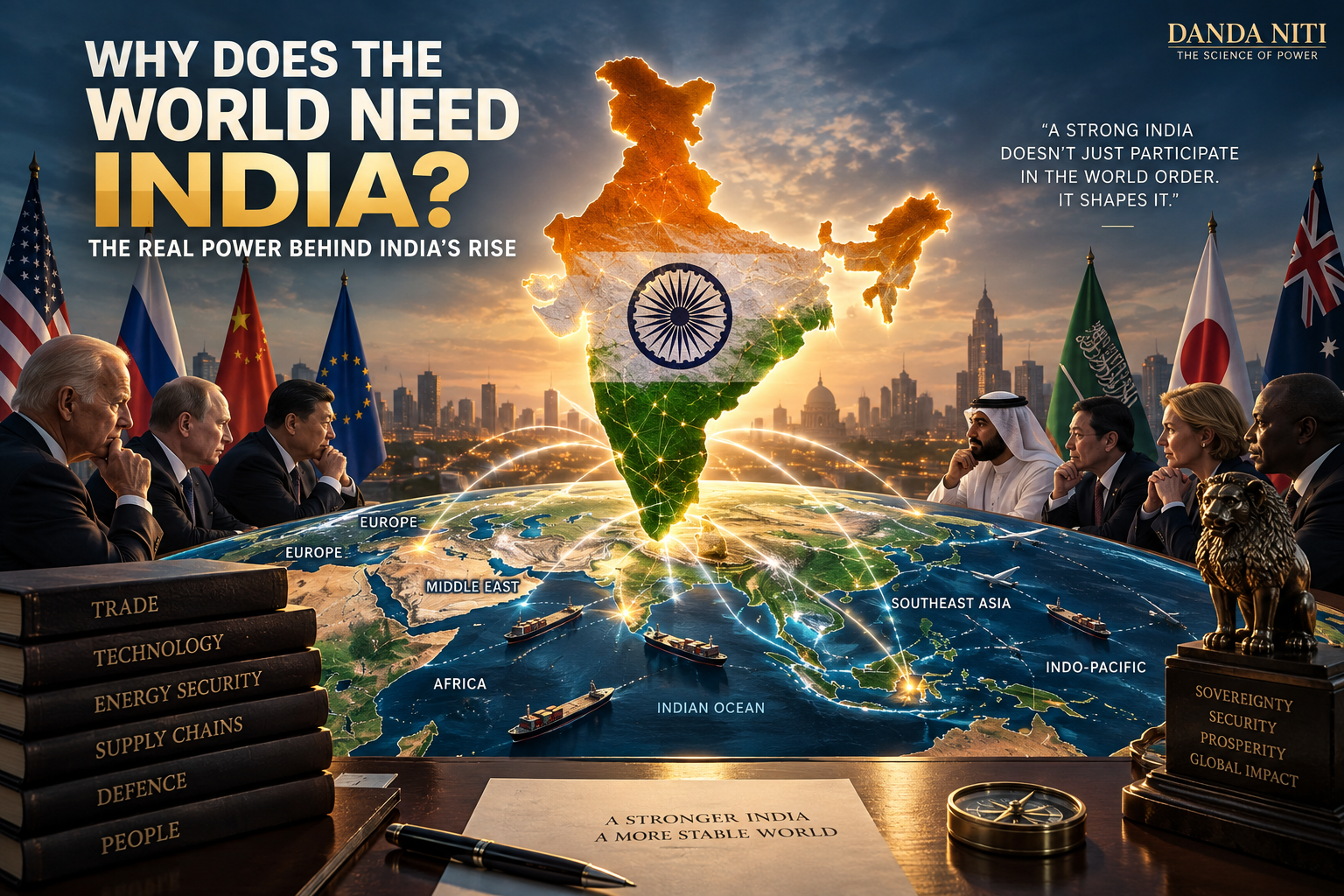
Why Does the World Need India? The Real Power Behind India's Rise
For much of the post-independence era, India's foreign policy was shaped by one fundamental requirement: protect India's freedom to make its own choices.
Today, that objective remains.
But India's position in the international system has changed.
The question is no longer simply whether India can protect its strategic autonomy. The bigger question is whether India has accumulated enough economic, diplomatic, military and geopolitical weight to influence the choices of others.
That is a very different definition of power.
And it is worth examining how India reached this point.
India Did Not Suddenly Become a Global Power in 2014
It is tempting to divide Indian foreign policy into a simple “before Modi” and “after Modi” story.
That would be historically inaccurate.
India's tradition of strategic autonomy predates the present government by decades. The Ministry of External Affairs itself describes maintaining strategic space and autonomy as a continuing objective of Indian foreign policy.
What has changed during the Modi years is the scale and visibility of India's external engagement, along with a greater effort to convert India's economic size, geography and diplomatic relationships into strategic influence.
The difference is therefore not:
Old India versus New India.
It is better understood as:
India with growing capabilities trying to extract greater strategic value from those capabilities.
That distinction matters.
BRICS Is a Good Place to See the Change
Consider what happened to BRICS.
The original grouping brought together Brazil, Russia, India and China, with South Africa joining later.
Then came the Johannesburg Summit in 2023.
The group decided to expand, and Egypt, Ethiopia, Iran, Saudi Arabia and the UAE joined the enlarged framework. Indonesia subsequently became a full member in January 2025. BRICS now has 11 full members.
And the story did not stop there.
A separate partner-country mechanism was created at the 2024 Kazan Summit. By 2025, countries including Belarus, Bolivia, Cuba, Kazakhstan, Malaysia, Nigeria, Thailand, Uganda, Uzbekistan and Vietnam had joined that category.
More than 30 countries had expressed interest in participating as members or partners.
But there is a mistake we should avoid.
BRICS should not automatically be interpreted as a single anti-American or anti-Western bloc.
India itself has rejected that interpretation. External Affairs Minister S. Jaishankar has described BRICS as a platform for countries seeking a greater voice in the international system while explicitly stating that India does not see itself as anti-Western.
That tells us something important about India's strategy.
India does not necessarily want to choose one camp.
It wants enough relationships and enough room to operate across several camps.
That is where strategic autonomy becomes a source of leverage.
The G20 Moment Was Bigger Than a Summit
India's 2023 G20 presidency offers another example.
The most visible achievement was not simply hosting world leaders in New Delhi.
The G20 declaration welcomed the African Union as a permanent member of the G20, and specifically acknowledged India's presidency and the efforts that helped make that inclusion possible.
Why does this matter?
Because India was dealing with a question much larger than India's own representation.
It was helping push a broader argument:
If global decisions affect the Global South, the Global South needs a greater voice in making those decisions.
That is a fundamentally different diplomatic proposition from simply demanding a larger role for India.
India was attempting to position itself as a bridge—between developed and developing economies, between different political groupings, and between competing strategic interests.
Whether that role can be sustained is another question.
But the attempt itself is strategically significant.
Then Look at the Numbers
Geopolitical influence requires an economic foundation.
According to World Bank data, India's GDP reached approximately $3.96 trillion in 2025, while real GDP growth was 7.6%.
These numbers do not automatically make India a great power.
GDP is not power.
But GDP creates capacity.
A larger economy gives a country more room to invest in infrastructure, defence, technology, trade, energy security and international partnerships.
It creates a larger domestic market.
It attracts capital.
It gives businesses greater scale.
And it gives the government more options when negotiating with other states.
In simple terms:
Economic capacity creates strategic choices.
And strategic choices can create bargaining power.
But India's Most Valuable Asset May Be Its Position on the Map
Now look away from the statistics.
Look at the map.
India sits between several strategic regions of the world.
To the west: the Gulf and the wider Middle East.
To the north: Central Asia and the Himalayan frontier.
To the east: Southeast Asia.
To the south: the Indian Ocean and the maritime routes connecting some of the world's most important economic centres.
This geography cannot be relocated.
And neither can its strategic importance.
India therefore occupies a position that matters not only to its neighbours, but to countries thousands of kilometres away.
This is one reason the Indo-Pacific has become such an important strategic concept.
And this brings us to the country that makes India's geography even more consequential.
China.
India and China: The Strategic Reality
India and China are simultaneously neighbours, trading partners, competitors and military rivals.
Their relationship cannot be reduced to one label.
For India, China represents a major economic relationship and a significant security challenge.
For China, India's growing economic and strategic capabilities are impossible to ignore.
For the United States and its partners, a stronger India has implications for the balance of power in the Indo-Pacific.
For Russia, India remains an important long-term strategic and economic partner.
For Japan and Australia, India is an increasingly important part of the regional strategic architecture.
For Gulf economies, India represents a huge market, investment destination, technology partner and source of human capital.
This creates an unusual situation.
Several countries with very different interests have reasons to maintain strong relations with India.
That does not mean India controls them.
It means India increasingly has something extremely valuable in international politics:
Options.
The Power of Having Options
Think about it.
India can deepen cooperation with Washington without becoming a formal American ally.
India can remain connected to Russia while simultaneously expanding strategic ties with Europe.
India can participate in BRICS while developing deeper relationships with Western economies.
India can strengthen relations with Israel while building extensive partnerships across the Arab world.
India can work with Japan and Australia while managing competition with China.
None of these relationships is free of friction.
That is precisely the point.
Foreign policy is not about finding perfect friends.
It is about managing interests in an imperfect world.
And a country that has several viable relationships has more room to negotiate.
That room can become a source of power.
But Here Is Where the Celebration Must Stop
It would be intellectually lazy to conclude that India has already arrived as a superpower.
India still has enormous structural challenges.
The country needs more productive employment.
Manufacturing must become more globally competitive.
Human capital needs continued improvement.
Energy security remains strategically important.
Defence manufacturing and technological self-reliance have significant ground to cover.
Exports must grow substantially if India wants economic power to translate into sustained global influence.
And most importantly:
India has to convert potential into capability.
The world may respect India's potential.
But countries ultimately respond to capability.
So, What Actually Changed?
Perhaps the most important transformation is not that India suddenly became powerful.
India did not.
The transformation is that India's existing assets have become more strategically valuable at a time when the international system itself is changing.
The world is becoming more multipolar.
Supply chains are being reorganised.
The United States and China are competing for influence.
Russia remains a major geopolitical actor.
The Global South is demanding greater representation.
The Indo-Pacific has become central to international strategy.
And in this environment, India sits at an unusual intersection of market, geography, demography, diplomacy and strategic capability.
That combination is difficult to ignore.
The Question We Should Really Be Asking
So forget the slogan:
“India is becoming a superpower.”
That is easy to say.
The harder and more meaningful question is:
When the United States makes a decision, does India matter?
When Russia makes a decision, does India matter?
When China makes a decision, does India matter?
When the Gulf makes a decision, does India matter?
When the Global South discusses the future of the international system, does India matter?
If the answer to these questions increasingly becomes yes, then India's rise is not merely about GDP rankings.
It is about something deeper.
Influence.
Because ultimately, national power is not measured only by what a country owns.
It is measured by how much other countries must account for that country's interests when making their own decisions.
India has not completed that journey.
But it has clearly travelled further along it.
And the next decade will determine whether India can convert its growing economic weight, diplomatic reach, technological capability and strategic geography into something much harder to acquire:
the ability to shape outcomes.
That is the real story behind India's rise.
And that is the question DANDA NITI will keep asking:
Not just what happened.
Not just who said what.
But who has the power to change what happens next—and why?
DANDA NITI | दण्डनीति
The Science of Power