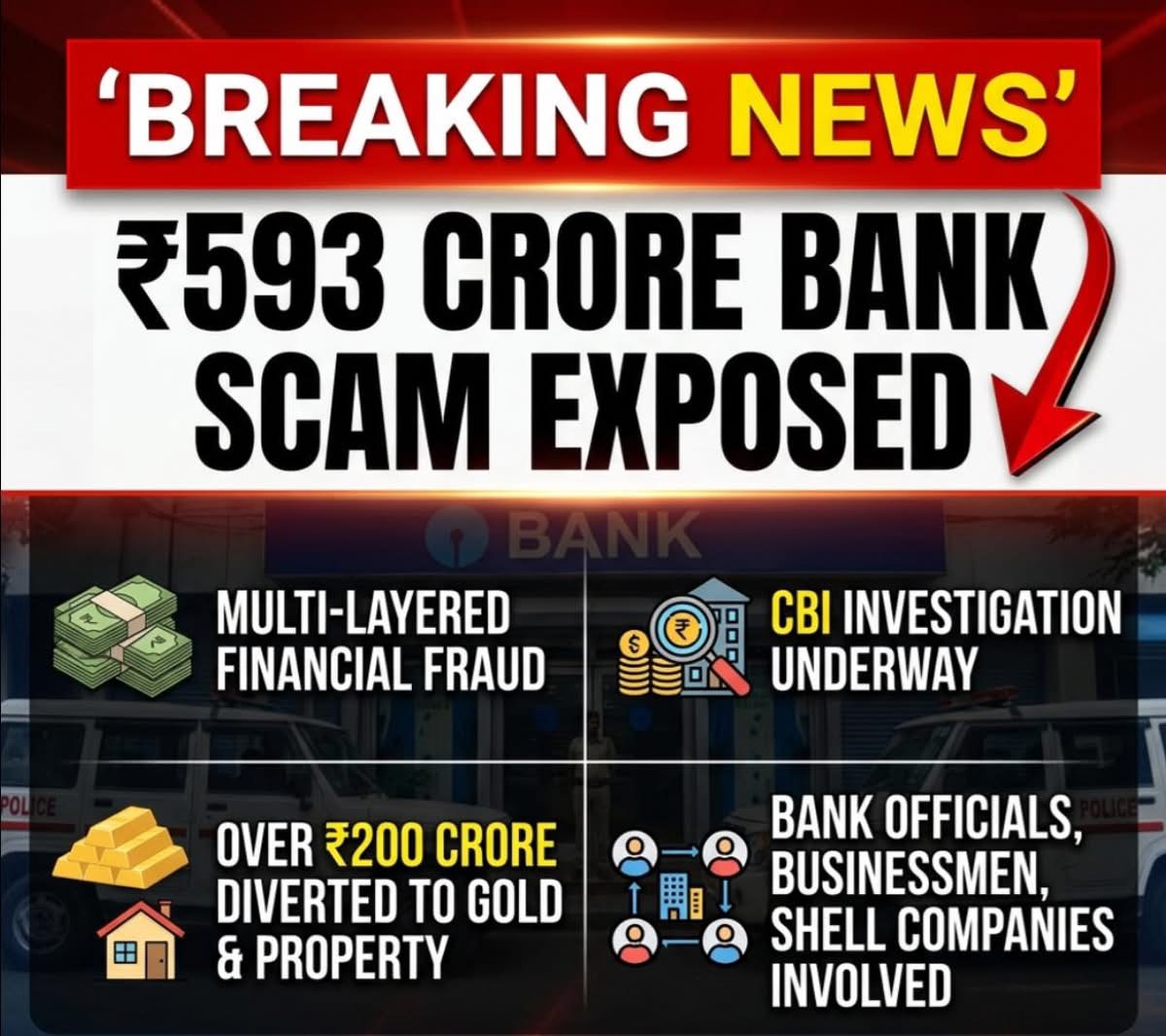
📰 ₹593 Crore Bank Scam Exposed: Inside the Multi-Layered Financial Fraud
A massive banking fraud worth ₹593 crore has recently come under the scanner, exposing a deep-rooted financial crime network involving bank officials, businessmen, and shell companies. The case, now being investigated by the Central Bureau of Investigation (CBI), highlights how systemic loopholes and insider involvement can lead to large-scale misuse of public funds.
🔍 How the Scam Worked
According to investigators, the fraud originated from the misappropriation of government-linked funds deposited in a private bank branch. These funds, belonging to multiple departments, were illegally diverted through a series of transactions instead of being used for legitimate purposes. 
The accused allegedly used:
* Fake accounts and unauthorized transactions
* Multiple shell companies
* Layered financial transfers to hide the money trail
This complex structure made it difficult to detect the fraud in its early stages.
💰 ₹200+ Crore Converted into Gold & Property
One of the most shocking revelations is that over ₹200 crore of siphoned money was:
* Converted into gold purchases through jewellers
* Invested in real estate and immovable assets 
Investigators found that:
* Gold was bought using non-bullion shell companies
* Assets were often registered under associates and proxies
* The money was circulated multiple times to avoid detection
This method is commonly used in financial crimes to launder money and preserve value.
👥 Key Accused and Network
The scam involves a wide network, including:
* Bank officials who allegedly enabled unauthorized transactions
* Businessmen and builders who helped route and invest funds
* Jewellers who facilitated gold purchases
* The main accused, a former banker, who allegedly orchestrated the scheme
So far:
* 25+ individuals have been arrested or questioned
* Several bank employees are under scrutiny for serious procedural lapses 
🏦 Role of Bank Officials
Investigators have pointed to internal failures within the banking system, including:
* Lack of monitoring of high-value transactions
* Unauthorized handling of accounts
* Possible collusion between insiders and external parties
These lapses allowed the fraud to continue undetected for a significant period.
🧠 Use of Shell Companies
A critical part of the scam was the use of shell companies, which:
* Had no real business operations
* Were used only to transfer and disguise money
* Helped create a layered transaction trail, making investigation complex
Such techniques are commonly seen in organized financial crimes and money laundering networks.
⚖️ Investigation & Legal Action
* The case was initially probed by a state vigilance agency and later handed over to the CBI
* The Enforcement Directorate (ED) is also examining the money laundering angle
* Courts have allowed extended custody of key accused for deeper interrogation 
Authorities are now:
* Tracing assets purchased with illegal funds
* Identifying additional beneficiaries and accomplices
* Working to recover siphoned money and properties
⚠️ What This Scam Reveals
This case exposes serious concerns:
* Weak internal banking controls
* Growing use of gold and real estate for laundering money
* Increasing involvement of organized networks in financial frauds
It also highlights the need for:
* Stronger regulatory oversight
* Advanced fraud detection systems
* Accountability of bank officials and institutions
📊 Conclusion
The ₹593 crore bank scam is not just a case of financial fraud — it is a systemic failure involving multiple layers of corruption and manipulation. With large amounts diverted into gold and property, the case underscores how modern financial crimes are becoming more sophisticated, organized, and difficult to trace.
As investigations continue, this case may become a benchmark example of large-scale banking fraud in India, prompting stricter reforms in the financial system.