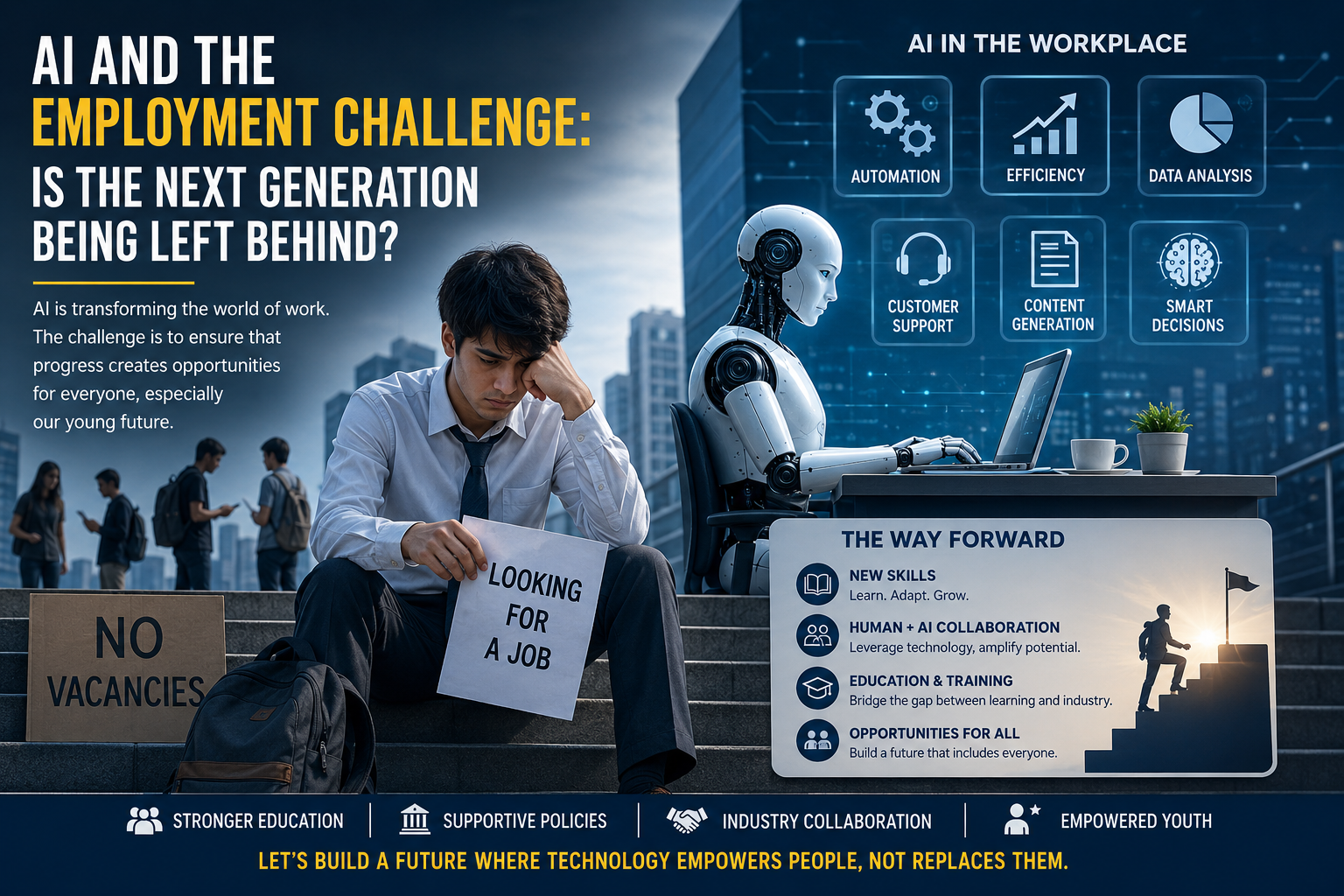
Artificial Intelligence (AI) is transforming industries at a rapid pace. From customer service and software development to finance, healthcare, manufacturing, and human resources, AI is changing how organizations operate. While this technological shift offers significant opportunities for innovation and productivity, it has also raised concerns about employment opportunities for young graduates and first-time job seekers.
For many years, entry-level positions have provided graduates with opportunities to gain practical experience and develop workplace skills. Today, some routine tasks traditionally performed in these roles are increasingly being supported by AI-powered tools. Functions such as data processing, report generation, customer support, scheduling, coding assistance, and document analysis can now be completed more efficiently through technology-assisted systems.
As a result, employers in some sectors are placing greater emphasis on specialized skills, practical experience, and digital literacy. This has created new challenges for fresh graduates seeking to enter the workforce and gain professional experience.
The impact is particularly noticeable in industries such as information technology, business process outsourcing (BPO), accounting, marketing, and administrative services. While AI is not eliminating entire professions, it is changing the nature of many entry-level roles and the skills required to perform them.
Experts note that these changes may have broader economic implications, including challenges related to youth employment, workforce participation, and skills development. At the same time, technological advancement continues to create new opportunities in emerging fields.
AI-related industries are generating demand for professionals in areas such as machine learning, cybersecurity, cloud computing, data science, AI governance, digital transformation, and human-AI collaboration. These sectors are expected to play an increasingly important role in the future job market.
Education and workforce development institutions are adapting by introducing programs focused on digital skills, critical thinking, problem-solving, and AI literacy. Employers are also expanding internship, apprenticeship, and graduate training initiatives to help young professionals transition into evolving workplaces.
Governments, educational institutions, and industry stakeholders continue to explore strategies that support workforce development, encourage innovation, and promote responsible adoption of AI technologies.
For young professionals, adaptability remains essential. Skills such as creativity, communication, leadership, emotional intelligence, ethical decision-making, and complex problem-solving continue to be highly valued alongside technical expertise. Understanding how to work effectively with AI tools is increasingly becoming an important professional skill.
The future of work is likely to be shaped by collaboration between people and technology. As industries continue to evolve, preparing the next generation with relevant skills and opportunities will remain an important priority for sustainable economic growth and workforce development.