Four Asiatic Wild Buffaloes from Kaziranga Reached Kanha Tiger Reserve of Madhya Pradesh for rehabilitation :
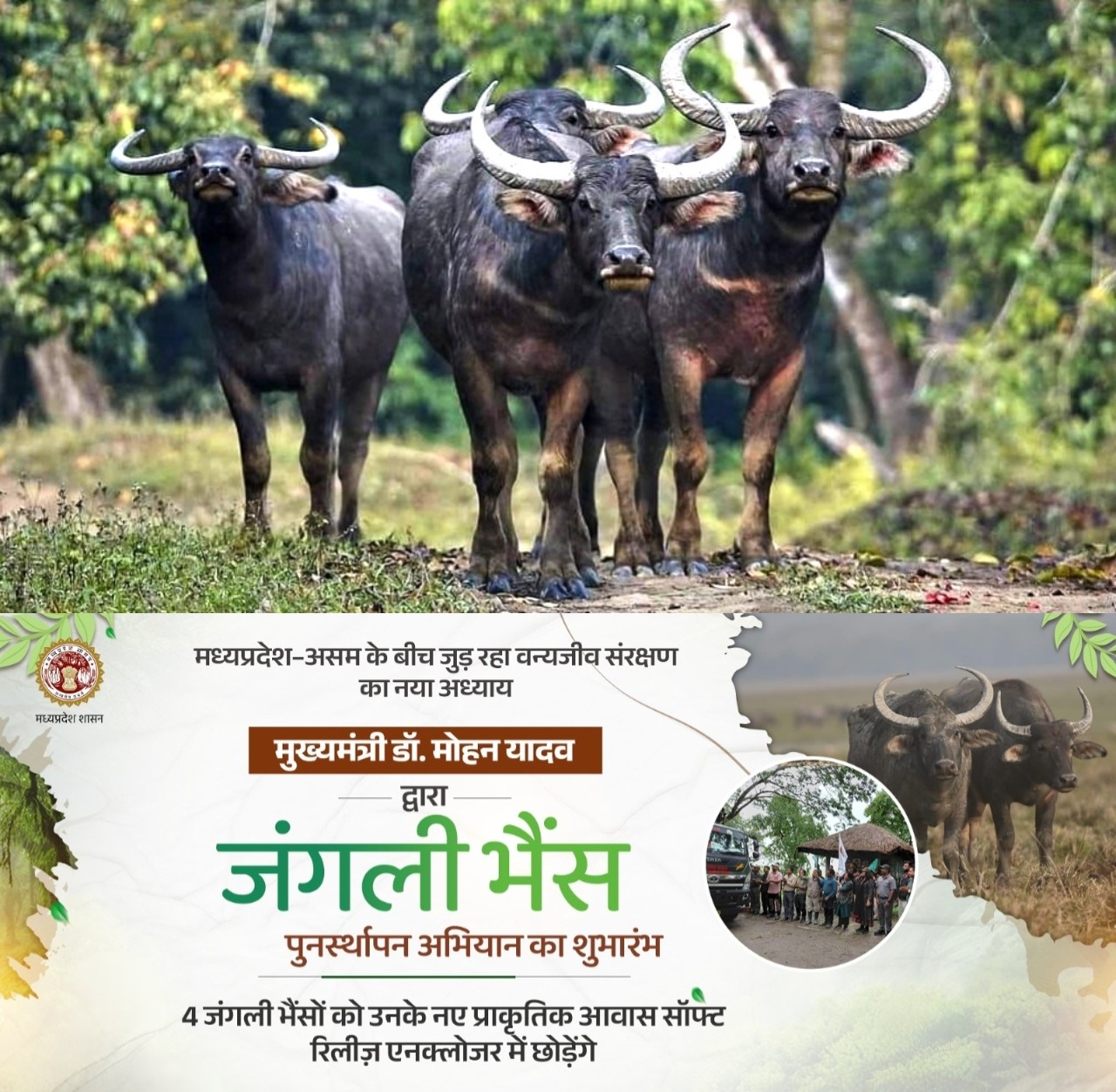
Based on a bilateral agreement signed between the Assam and Madhya Pradesh Forest Departments in January this year, it was decided to translocate 50 Asiatic wild buffaloes from Kaziranga National Park and Tiger Reserve to Kanha Tiger Reserve in Madhya Pradesh. Under this agreement, on the morning of April 25, four buffaloes—three females and one male—were sent from Kaziranga to Kanha. Today, these four buffaloes have successfully reached Kanha Tiger Reserve. They were formally released at the Supkhar and Topla forest ranges of Kanha by Madhya Pradesh Chief Minister Dr. Mohan Yadav.
After a month-long effort, the buffaloes were tranquilized and captured in the forest, then kept under observation in a specially constructed enclosure at Mihimukh in Kaziranga’s central range. A five-member veterinary team led by Dr. Saurav Burhagohain (Forest Veterinary Officer) and Dr. Bhaskar Choudhury (Senior Veterinary Officer, Wildlife Rehabilitation and Conservation Centre, Borjuri, Bokakhat) conducted health examinations before the buffaloes were transported on April 25. The journey was accompanied by Kaziranga’s Deputy Conservator of Forests Chakrapani Roy, Dr. Saurav Burhagohain, and forest staff from both Kaziranga and Kanha.
Initially, the buffaloes will be kept in temporary enclosures at Kanha before being released into the reserve. Kaziranga DFO Arun Vighnesh informed that another four buffaloes are currently under observation at Agoratoli forest range and will be sent in the second phase. Altogether, 50 Asiatic wild buffaloes will be translocated from Kaziranga to Kanha in phases.
Preparations began on March 15 under the supervision of a high-level committee, during which eight buffaloes were captured in Kaziranga’s Kohora and Agoratoli ranges. They were kept in temporary enclosures for health checks and monitoring. The Central Zoo Authority, Wildlife Institute of India, and National Tiger Conservation Authority are overseeing the long-term monitoring of the translocated buffaloes. Although the plan was to send 15 buffaloes at once, logistical challenges limited the first phase to four.
Kaziranga National Park currently holds the largest viable population of Asiatic wild buffalo, with an estimated 1,660 individuals. Historically, Dibru-Saikhowa and Manas National Parks also supported strong populations, but numbers have declined sharply there. Earlier, one buffalo was translocated from Manas in 2020, and four were sent from Assam to Barnawapara Tiger Reserve in Chhattisgarh in 2023.
Globally, the Asiatic wild buffalo population is fewer than 4,000. Once widespread in central India’s Mandla, Balaghat, and Satpura forests, the species became locally extinct in Madhya Pradesh by 1979. Under the current wildlife exchange agreement, Assam will send 50 wild buffaloes, a pair of rhinoseros, and three king cobras to Madhya Pradesh, while Madhya Pradesh will provide Assam with 3 tigers and 6 gharials.