Commercialization of Education in Modern Indian Society: The Coaching Capital Paradox and the Future of Learning
Education has long been regarded as the foundation of a nation’s progress. It empowers individuals, reduces inequality, and creates opportunities for innovation and social mobility. However, in recent decades, the increasing commercialization of education in India has transformed learning into a highly competitive and often expensive marketplace. What was once viewed primarily as a public good is now, in many cases, perceived as a service that families invest in with the hope of securing better opportunities for their children.
Alongside schools and universities, the rapid expansion of coaching institutes has contributed to what many observers describe as the “coaching capital paradox.” While these institutions help millions of students prepare for competitive examinations, their growing influence has also raised important questions about affordability, equal opportunity, academic pressure, and the broader purpose of education. As families spend a significant share of their income on private coaching, many students perceive that classroom education alone may not be sufficient for highly competitive entrance examinations.
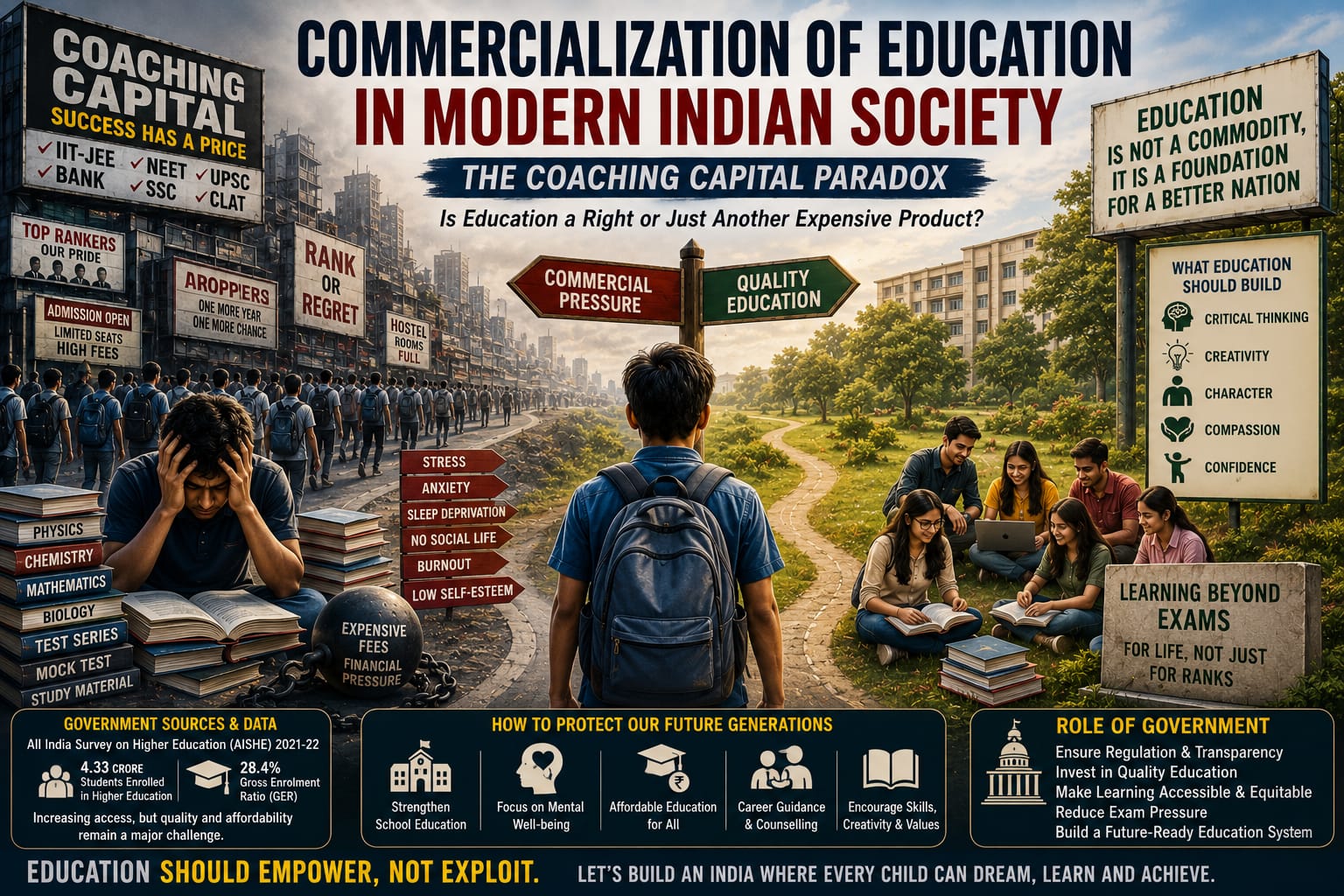
According to the All India Survey on Higher Education (AISHE) published by the Ministry of Education, India has made significant progress in expanding access to higher education, with enrolment reaching approximately 4.33 crore students and the Gross Enrolment Ratio (GER) rising to 28.4 percent. However, increasing enrolment alone cannot guarantee quality, affordability, or equitable access.
From Public Service to a Competitive Marketplace
India’s education system has evolved considerably since independence. Government schools and public universities have played a vital role in making education accessible to millions. Over time, economic reforms, population growth, technological advancement, and rising aspirations have encouraged greater private participation in the education sector.
Private schools, colleges, universities, and coaching centres have expanded rapidly to meet growing demand. Many institutions have introduced modern infrastructure, specialized teaching methods, and innovative learning practices. However, the increasing cost of education has also created financial challenges for many middle-income and economically weaker families.
The expansion of the private coaching industry reflects another important trend. Students preparing for engineering, medical, civil services, management, and other competitive examinations often supplement classroom learning with coaching. While coaching has helped many students improve their preparation, it has also highlighted concerns about unequal access and the effectiveness of mainstream education.
The Coaching Capital Paradox
Across India, several cities have emerged as nationally recognized coaching hubs, attracting thousands of students every year.
This has created a significant paradox. Schools are intended to provide comprehensive education, yet many students perceive coaching as an essential supplement for success in competitive examinations. Consequently, coaching is increasingly viewed as a necessity rather than an optional support system.
Government survey findings also indicate that private coaching has become increasingly common, particularly in urban areas. Families often bear the combined cost of school fees, coaching fees, study materials, accommodation, transportation, and digital learning resources, increasing the overall financial burden.
Impact on Students
One of the most significant consequences of educational commercialization is its impact on young learners.
Many students experience continuous academic pressure through examinations, coaching classes, mock tests, and performance comparisons. In such an environment, examination scores and rankings can sometimes overshadow creativity, curiosity, critical thinking, and holistic learning.
Educational experts have also expressed concern that sustained academic pressure may contribute to stress, anxiety, emotional burnout, and reduced interest in learning. Students from economically weaker backgrounds may face additional challenges if they are unable to access expensive coaching despite strong academic potential.
Government Initiatives and the Changing Education Landscape
Government reports indicate encouraging progress in educational access. According to the Ministry of Education’s AISHE survey, higher education enrolment has increased substantially over the past decade, female participation has improved, and the Gross Enrolment Ratio continues to rise. Government institutions continue to account for a significant share of total student enrolment.
The National Education Policy (NEP) 2020 also emphasizes equitable access, multidisciplinary education, skill development, conceptual learning, reduced learning gaps, and improved educational quality while encouraging reduced dependence on rote learning.
These developments reflect India’s commitment to expanding educational opportunities. However, ensuring that educational expansion is accompanied by affordability, accessibility, and quality remains an important policy challenge.
Strengthening Mainstream Education
Addressing commercialization does not necessarily require eliminating private educational institutions or coaching centres. Instead, strengthening mainstream education can help reduce excessive dependence on external coaching.
Greater investment in teacher training, classroom infrastructure, digital education, curriculum modernization, and practical learning can improve educational outcomes. Schools can place greater emphasis on conceptual understanding, problem-solving, communication skills, creativity, and experiential learning rather than examination-oriented memorization.
Parents also play an important role. Encouraging balanced development, emotional well-being, sports, arts, and life skills alongside academic achievement can help reduce unnecessary pressure. Career guidance and counselling can further assist students in making informed educational choices based on their interests and abilities rather than social expectations.
The Role of Government
Government regulation remains essential to ensure fairness, transparency, and accountability across the education sector.
Transparent fee structures, effective institutional oversight, scholarships, financial assistance, and continued investment in quality public education can help reduce educational inequality. Expanding well-equipped government schools and higher educational institutions can provide students with strong alternatives to costly private education.
Effective implementation of reforms under the National Education Policy, combined with sustained public investment and continuous monitoring, can strengthen confidence in India’s formal education system while encouraging innovation.
Future Challenges
If commercialization continues without adequate regulation, educational opportunities may increasingly become influenced by economic capacity rather than academic ability. This could widen educational disparities and reduce opportunities for deserving students from economically disadvantaged backgrounds.
Excessive academic competition may also contribute to rising levels of stress, mental health concerns, and burnout among students.
Over time, there is a risk that education could become overly examination-oriented, potentially limiting the development of creativity, ethical values, leadership, critical thinking, and practical problem-solving skills.
Conclusion
The commercialization of education represents one of the important policy and social challenges facing modern India. Private participation has undoubtedly expanded educational opportunities, improved infrastructure, and introduced innovation. At the same time, the rapid growth of expensive schooling and coaching has created new questions regarding affordability, equity, and educational outcomes.
The “coaching capital paradox” reflects a broader concern: when many students believe that classroom education alone is insufficient for competitive success, confidence in the formal education system may gradually weaken.
India has made significant progress in expanding educational access, as reflected in government data showing increased enrolment, improved gender participation, and wider access to higher education. The next phase of educational reform should therefore focus not only on expanding enrolment but also on ensuring affordability, quality, inclusiveness, and equal opportunity.
The future of India’s education system depends on creating a balanced model in which schools provide strong foundational learning, coaching remains a matter of choice rather than necessity, and financial limitations do not determine academic success. Governments, educators, parents, and society all have an important role in promoting curiosity, innovation, critical thinking, and lifelong learning while reducing unnecessary academic pressure.
Education should continue to serve as a powerful instrument of social transformation—one that remains accessible to every learner, regardless of economic background.
Disclosure: This article is an analytical opinion based on publicly available government reports, education policy documents, and broader discussions on the evolving education landscape in India. It is intended for public awareness and informed discussion.