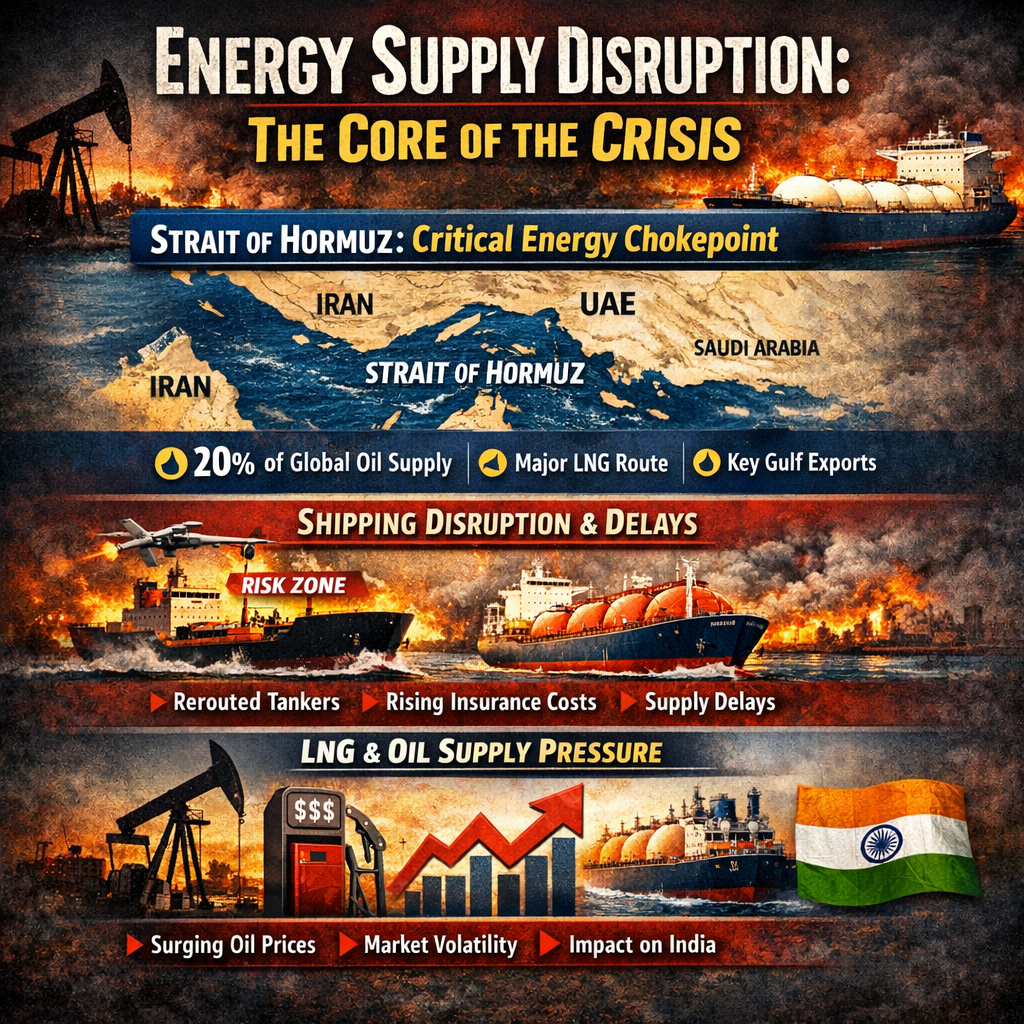
The ongoing conflict in West Asia has emerged as a major disruptor of global energy supply chains in recent years. At the center of this instability is the Strait of Hormuz, a narrow but strategically critical maritime passage through which a significant share of the world’s crude oil and liquefied natural gas (LNG) is transported daily. Even minor geopolitical tensions in this region have the potential to create immediate ripple effects across global energy markets.
Strait of Hormuz: A Critical Global Energy Route
The Strait of Hormuz connects key oil-producing nations in the Gulf region with major consumer markets across Asia, Europe, and other parts of the world. Its importance makes it one of the most sensitive energy chokepoints globally.
Nearly 20% of global crude oil trade passes through this route, along with a large portion of LNG shipments. Countries such as Saudi Arabia, the United Arab Emirates, Iraq, and Kuwait rely heavily on this corridor for uninterrupted exports.
Rising Risks to Shipping and Logistics
Due to escalating tensions in West Asia, tanker movements have slowed, rerouted, or faced delays. Shipping companies are increasingly avoiding high-risk zones, while insurance premiums for energy cargoes have risen significantly. These disruptions have created uncertainty in delivery schedules and global supply chain stability.
Pressure on Oil and Gas Supply
In addition to crude oil, LNG supplies have also been affected. Several shipments have been delayed or reduced, while storage and distribution networks face mounting pressure. Security concerns and operational risks at export terminals have further tightened supply conditions.
Market Volatility and Price Impact
When supply tightens while demand remains stable, global markets react quickly. Crude oil prices become volatile, energy trading becomes unpredictable, and governments face challenges in stabilizing domestic fuel costs. This creates a global supply squeeze, increasing both cost and uncertainty.
🇮🇳 Impact on India and Import-Dependent Economies
India, which imports nearly 85% of its crude oil requirements, is particularly exposed to such disruptions. The immediate impact includes higher import bills, rising fuel prices, increased electricity generation costs, and pressure on transport and logistics sectors.
Broader effects include inflationary pressures, widening trade deficits, and currency fluctuations due to higher dollar demand.
Conclusion
The disruption in West Asia—especially around the Strait of Hormuz—has become a central factor in global energy instability. With supply tightening and prices rising, import-dependent economies like India continue to face significant economic pressure.