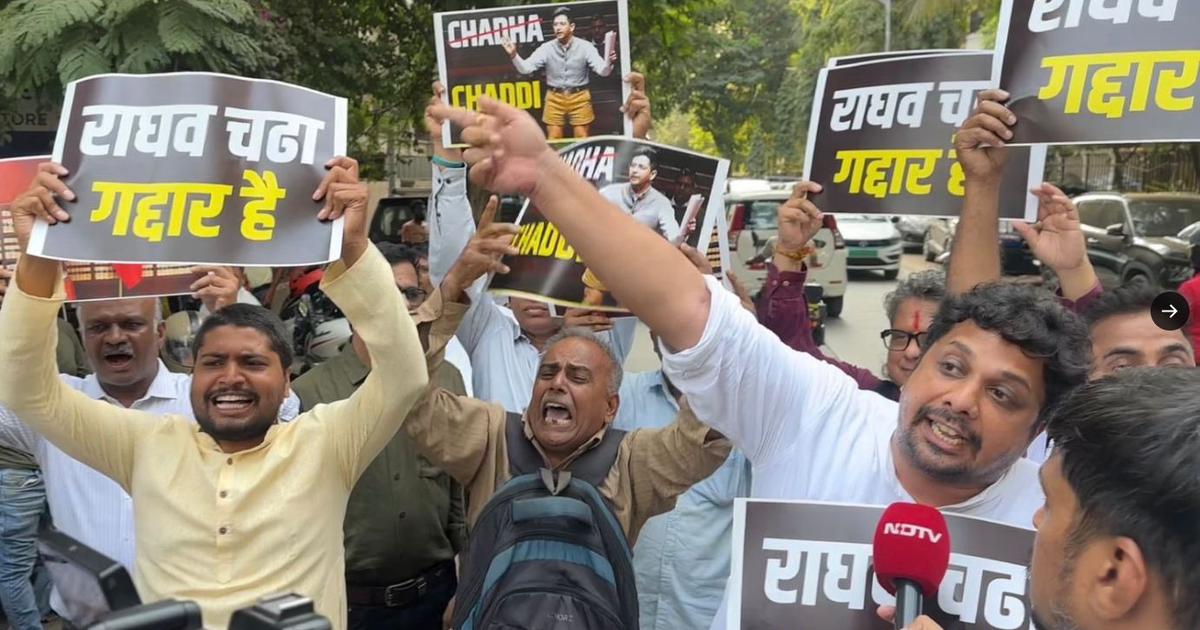
The political landscape in Mumbai took a dramatic turn as the Mumbai Police lodged a first information report (FIR) against seven leaders of the Aam Aadmi Party (AAP) on Sunday. The FIR stems from a protest organized by the party against its own Rajya Sabha member, Raghav Chadha, and six other AAP MPs who recently made headlines by merging with the Bharatiya Janata Party (BJP) legislature party.
Among those named in the FIR is Ruben Mascarenhas, the Mumbai working president of AAP, who expressed deep discontent over the police’s actions. The FIR includes charges related to unlawful assembly, a decision that has sparked controversy and debate about the freedom of political expression in India.
Prior to the planned demonstration outside Chadha’s residence in Khar, several AAP members found themselves detained by the police. Mascarenhas alleged that the authorities were trying to quash the protest before it even began. He indicated that he had formally notified the police of the protest intentions a day earlier and even received acknowledgment of this communication early on Sunday. However, despite this, police personnel arrived at Mascarenhas’s home around 1:45 PM, well before the protest was set to commence at 3:30 PM, effectively preventing him from attending.
In a poignant social media post, Mascarenhas voiced his frustration, stating, “I am not being allowed to leave my house. This is illegal and unacceptable.” Following his detention, Mascarenhas was taken to the Khar police station along with fellow AAP members before being released later. Despite the heavy police presence and roadblocks leading to Chadha’s residence, around 50 AAP volunteers managed to gather and express their dissent, demonstrating the party’s resolve amidst the restrictions.
This incident is not just a local event; it highlights broader tensions within Indian politics, particularly as AAP navigates its identity and strategy following the significant political shifts involving its leaders. The merger with the BJP has raised questions about allegiance and ideology, and the protests reflect the party’s internal dissatisfaction.
As political dynamics continue to evolve in India, the actions of the Mumbai Police and the response of AAP may have implications for the party’s future and its relationship with its supporters. The situation underscores the challenges faced by political parties in maintaining their core values while dealing with the complexities of alliance politics.