There are moments in history when societies begin to sense change before it fully arrives. Not always through war declarations, elections or market crashes, but through shifts in public mood, economic uncertainty and global instability.
India in 2026 appears to be facing one such moment.
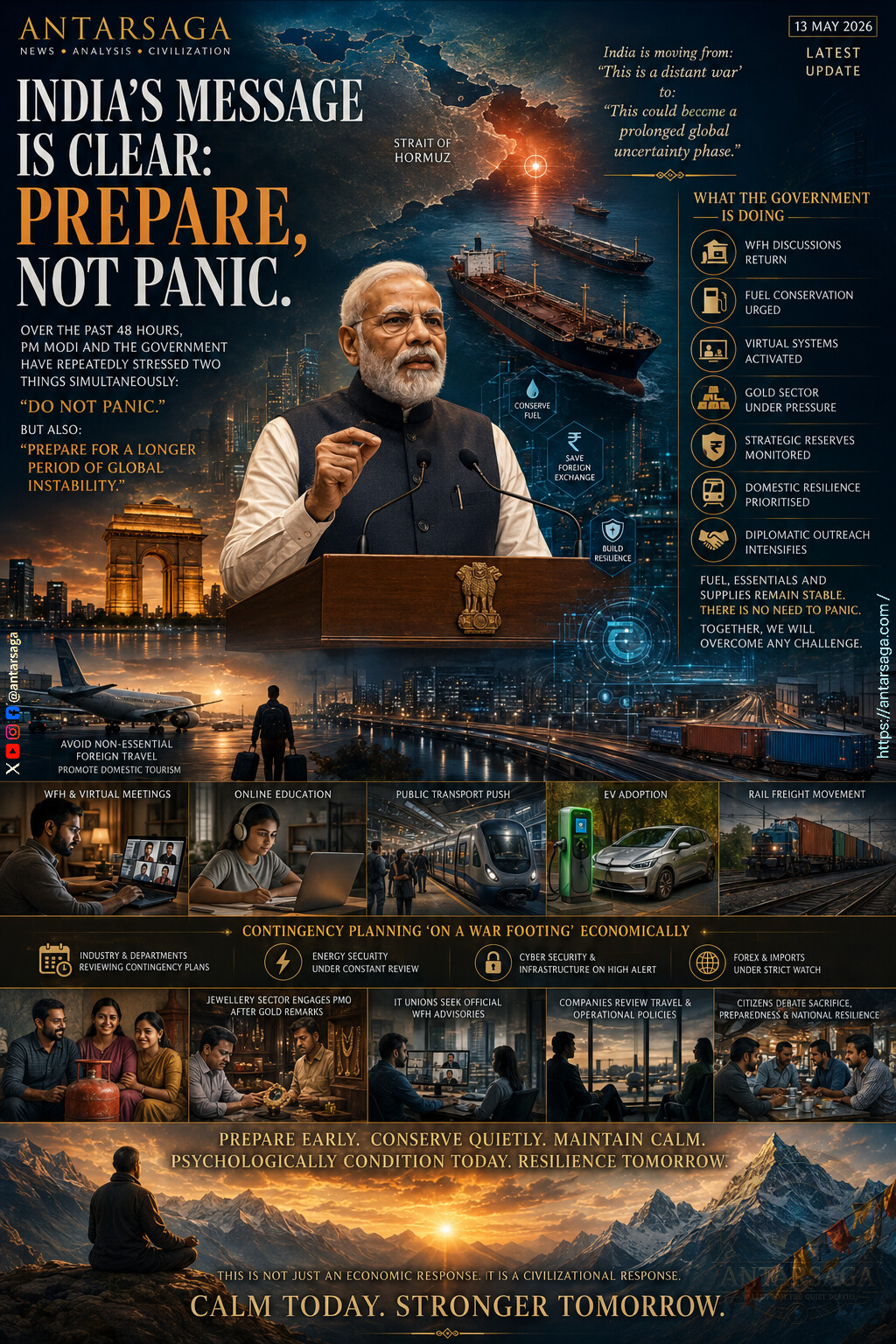
Rising geopolitical tensions in West Asia, concerns over global energy supplies and discussions around economic resilience have increasingly entered public conversation. These concerns became more visible after Prime Minister Narendra Modi, during a public address in Hyderabad, urged citizens to reduce unnecessary fuel consumption, avoid wasteful expenditure and adopt more sustainable habits.
The Prime Minister also emphasized the importance of conserving resources and reducing pressure on the country’s foreign exchange reserves, particularly due to imports of petroleum products, gold and edible oils.
While many viewed the remarks as routine economic advice, others interpreted them as part of a broader message about preparedness in an uncertain global environment.
The immediate concerns are linked to geopolitical instability in West Asia, including tensions involving Iran, Israel and key international powers. Any disruption around the Strait of Hormuz — one of the world’s most important energy transit routes — can affect global oil and gas supplies, leading to higher fuel prices, inflationary pressures and supply-chain disruptions across multiple countries.
Modern conflicts increasingly affect ordinary life through economic channels such as fuel costs, food prices, shipping delays, insurance markets and currency fluctuations. For countries like India, which import a significant portion of their energy requirements, global instability can directly impact household budgets and business costs.
Experts across the world have also highlighted the importance of energy conservation, economic resilience and diversification of supply chains in response to emerging global uncertainties.
India’s historical and philosophical traditions have often emphasized balance, moderation and preparedness during periods of uncertainty. Concepts such as restraint, sustainability and responsible consumption continue to hold relevance in discussions about economic resilience and environmental sustainability.
The broader global conversation today is increasingly focused on how nations can adapt to a changing world marked by geopolitical competition, technological transformation, climate pressures and economic volatility.
Several possible paths remain open before the international community.
One possibility is gradual stabilization through diplomacy, diversification of energy systems and stronger regional cooperation. Another possibility is prolonged economic and geopolitical fragmentation, where supply chains become more regionalized and global instability remains elevated for an extended period.
Strategic experts also continue to caution against escalation between major powers, emphasizing the importance of diplomatic engagement and conflict prevention.
For India, the challenge is twofold: maintaining economic stability while strengthening long-term resilience. This includes improving domestic manufacturing, reducing excessive dependence on imports, investing in infrastructure and encouraging sustainable patterns of consumption.
At the same time, India’s social and cultural resilience has historically helped communities navigate periods of uncertainty and transition. Strong family structures, local economic networks and community-based support systems continue to play an important role during difficult periods.
The current global environment serves as a reminder that economic stability and social resilience are closely connected. Public awareness, responsible policymaking and international cooperation will remain important in addressing future challenges.
While uncertainty remains, experts agree that preparedness, adaptability and social stability are critical for navigating periods of geopolitical and economic transition.
The future is still unfolding, and global developments will continue to shape how societies respond to the challenges of the coming years.