Kedarnath Chaos: Administration Under Fire After Gujarat Pilgrim’s Death and Hours-Long Struggle for Transport A Sacred Journey, A Preventable Ordeal
The opening days of the annual Kedarnath Temple pilgrimage are meant to mark devotion, endurance, and spiritual fulfilment. Instead, the 2026 season has begun with uncomfortable questions for the authorities managing one of the toughest religious routes in the country.
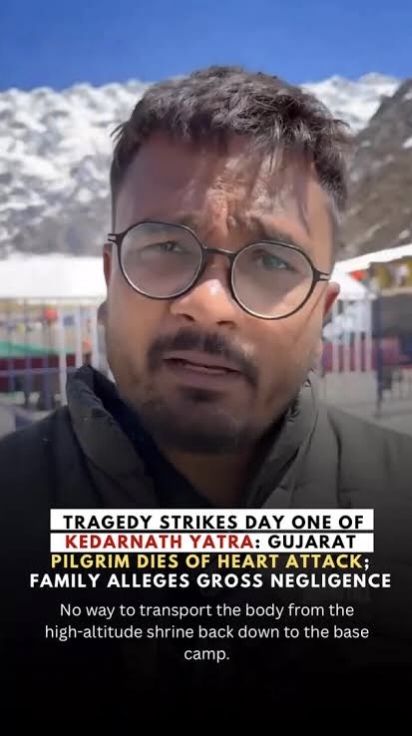
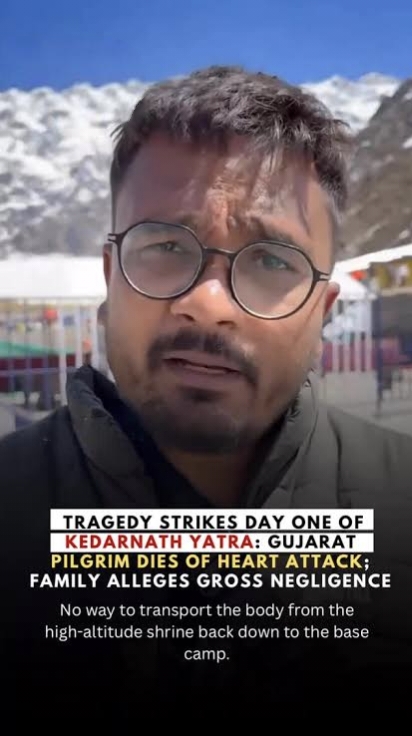
A 69-year-old pilgrim from Vadodara, Dilip Bhai Mannu Mali, suffered a fatal heart attack during the trek. What followed, according to multiple verified reports and the family’s account, was a prolonged struggle to obtain timely medical and helicopter support to bring his body down from the high-altitude shrine.
“In high altitudes where minutes matter, delay is not an inconvenience — it is a failure.”
What Happened on the Trail
Early in the morning, before temple gates opened for the season, Mali collapsed on the route near Kedarnath. Family members rushed him toward the nearest medical point, but he could not be revived.
Their distress deepened after his passing. Requests for helicopter evacuation reportedly went unanswered for hours. Officials later cited aviation safety clearances as the reason for the temporary halt in sorties.
With no immediate solution, the family arranged a private helicopter at a reported cost of ₹65,000 to airlift the body and accompanying relatives to a lower base.
Geography Is Harsh. Administration Cannot Be.
The Kedarnath route sits above 3,500 metres, where oxygen is thin and cardiac emergencies are not uncommon. This is precisely why rapid response systems, medical posts, and aerial evacuation are considered essential components of yatra planning — not optional services.
The incident has triggered broader conversations among pilgrims already on the route, many of whom describe crowd pressure, slow coordination, and confusion during emergencies in the initial days of the season.
“Faith brings people to the mountains. Systems are supposed to bring them back safely.”
Policy vs. Ground Reality
Authorities have stated that helicopter services were paused for mandatory checks and that safety protocols are in place for the yatra. However, critics argue that such procedures should be completed well before peak pilgrim movement begins.
The gap between preparedness on paper and responsiveness on the ground is now under scrutiny.
The Char Dham Yatra attracts lakhs of devotees every year. Managing this scale in extreme terrain requires not only planning, but flawless execution under pressure.
A Call for Accountability, Not Blame
This tragedy is not being viewed as an act of fate, but as a moment that exposes systemic weaknesses. Families undertaking the pilgrimage trust that in moments of crisis, help will be immediate and organised.
That trust, many feel, must now be rebuilt through visible administrative improvement.
“Pilgrims prepare their bodies for the climb. Authorities must prepare their systems for the fall.”
The Larger Question
How prepared are emergency systems when thousands converge in a compressed, high-altitude zone?
Until that question is convincingly answered, the incident will remain a sobering reminder that devotion alone cannot compensate for delayed response.