More Than Stents: A Cardiologist’s Case for Sacred Art as Medicine
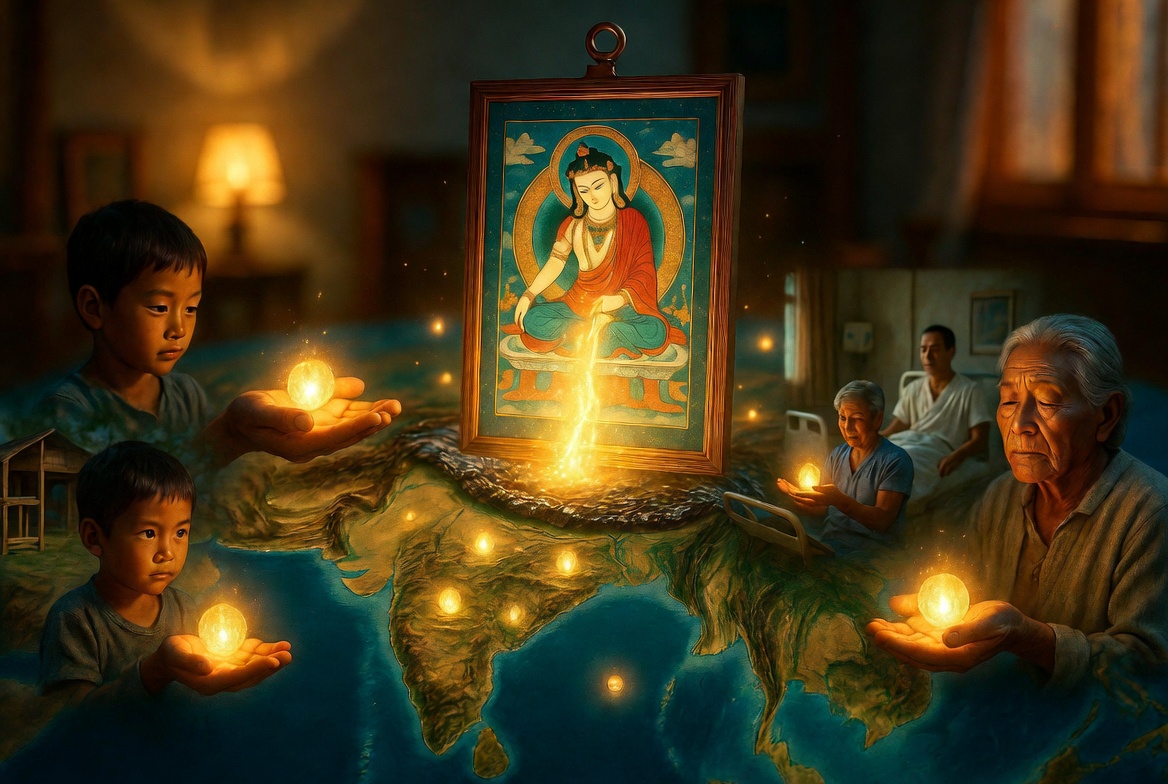
A Cardiologist’s Prescription for Healing – Where Science Meets Spirituality, and Every Painting Becomes a Blessing
I have spent my life studying the heart. As an interventional cardiologist trained in Japan and now
practicing in Kathmandu, I have held thousands of hearts in my hands—some weak, some strong,
all remarkable. Over the years, I have come to understand something that no textbook taught me:
the heart is more than a muscle that pumps blood. It is the seat of our emotions, the centre of our
deepest connections, and often, the first place where the pressures of modern life make
themselves felt.
India today is a country on the move. Our cities hum with ambition, our economy surges forward,
and our people work harder than ever. But there is a cost. Lifestyle diseases are spreading faster
than we can treat them. According to the World Health Organization, heart disease now accounts
for roughly one in every four deaths in India—a staggering burden. Indians suffer heart attacks
about a decade earlier than people in Western countries, a trend documented in The Lancet and
widely reported in the Indian Express. More than 60 million Indians live with heart disease; over
300 million have high blood pressure. Diabetes affects an estimated 101 million, with another 136
million on the brink, according to a 2021 ICMR study.
These numbers are not merely statistics. They are the men and women I see in my
clinic—professionals in their thirties with arteries aged beyond their years, mothers whose hearts
bear the weight of unrelenting responsibility, young people whose bodies are showing signs of
burnout long before their time.
Modern medicine has given us extraordinary tools: angioplasty, stents, life‑saving drugs. But I
have learned that healing requires more than fixing what is broken. It requires creating space for
stillness, for meaning, for something that speaks to the deeper needs of the human soul.
A Different Kind of Medicine
This is why I have returned to something I first encountered long ago, in the quiet studios of
Kathmandu: Thangka painting. These sacred artworks, created over months by master painters
using hand‑ground minerals and 24‑karat gold, are not merely decorative. They are visual
sanctuaries—objects of contemplation that have been used for centuries to calm the mind and
open the heart.
I do not simply collect these paintings. I work directly with the artists who create them. I sit with
them as they grind lapis lazuli into a deep, luminous blue, as they meditate before touching brush
to canvas, as they follow iconometric rules passed down through generations. Each Thangka is a
unique collaboration between the artist’s skill and the owner’s intention. When you acquire one,
you are not buying a piece of décor. You are inviting a living tradition into your home—a tradition
that understands art as a form of medicine.
What Science Is Discovering
For a long time, the idea that art could heal was considered poetic but not provable. That has
changed. In the past decade, a new field called neuroaesthetics has emerged, bringing together
neuroscientists, psychologists, and artists to study how the arts affect our brains and bodies.
One of the most compelling voices in this field is Susan Magsamen, founder of the International
Arts + Mind Lab at Johns Hopkins University. In her book Your Brain on Art (2023), she explains
that engaging with art triggers the release of feel‑good chemicals—dopamine, serotonin,
oxytocin—that reduce stress and lift our mood. She calls the arts an “evolutionary superpower,”
wired into our DNA because they helped our ancestors communicate and bond. As she notes in a
2019 article for the Journal of the American Medical Association, aesthetic experiences “alter a
complex physiological network of interconnected systems” in ways that nothing else can.
A 2025 study from King’s College London, reported by The Guardian and CNN, showed that
people who viewed original art in a gallery experienced a 22% drop in cortisol—the stress hormone
that, when chronically elevated, damages the heart, raises blood pressure, and weakens the
immune system. The researchers described the experience as a “physiological dance,” a rhythmic
cycle of excitement and calm that left participants feeling refreshed and centred. Notably, they also
found reductions in pro‑inflammatory markers like IL-6 and TNF-α, suggesting that art may help
protect the body from chronic inflammation.
The BBC has covered similar findings: a 2023 documentary series explored how music and visual
art can reduce pain, ease anxiety, and even help dementia patients reconnect with lost memories.
The New York Times has run multiple features on neuroaesthetics, highlighting how hospitals in
the US and UK are now prescribing museum visits for patients with chronic stress and depression.
A review of research published in the British Medical Journal found that arts engagement can lower
anxiety, improve coping, and even shorten recovery times.
These studies confirm what Thangka artists have known for centuries: a beautiful, meaningful
image, viewed with attention, can literally change the way our bodies function. It can lower our
heart rate, steady our breath, and quiet the mental noise that fuels so many modern diseases.
What a Thangka Can Do for You
Imagine coming home after a long day. The city’s noise still rings in your ears, your inbox is
overflowing, your mind is racing. In your living room hangs a Thangka of Green Tara—the
embodiment of compassion. You pause in front of it for a few minutes. You notice the gold leaf
catching the light, the delicate lines of the lotus, the gentle expression in the eyes. You feel your
breath slow. Your shoulders relax. For a moment, the world falls away.
This is not mysticism. It is the simple biology of attention. When we focus on something beautiful
and meaningful, our brain’s default mode network—the part that usually churns with
self‑referential thoughts—quietens. The reward system releases dopamine, giving us a gentle
sense of well‑being. Oxytocin, the bonding chemical, rises, making us feel more connected to
ourselves and others.
Over time, this daily pause can have profound effects. People who live with sacred art often report
better sleep, lower anxiety, and a greater sense of resilience. In my own practice, patients who
have acquired Thangkas tell me they feel “held” by the painting, as if it provides a quiet presence
that supports them through difficult times.
This is the unique gift of sacred art: it asks nothing of you except your presence. It does not
demand belief or ritual. It simply exists, radiating the intention of the artist who created it, offering a
moment of stillness in a noisy world.
The Karma of Collecting
There is another dimension to this that I believe matters deeply. A significant portion of every
Thangka sold through our initiative goes directly to supporting orphaned and underprivileged
children in Nepal—providing healthcare, education, and hope to those who have lost everything.
The Bhagavad Gita speaks to this in Chapter 18, Verse 5:
यज्ञदानतपःकर्म न त्याज्यं कार्यमेव तत् | यज्ञो दानं तपश्चैव पावनानि मनीषिणाम्
Acts of sacrifice, charity and austerity are not to be abandoned; they are surely to be undertaken.
Sacrifice, charity and austerity are verily the purifiers of the wise.
This verse is often cited to remind us that selfless giving—dana—is not a burden but a path to
inner purification. The Gita places charity alongside sacrifice and self‑discipline as essential
practices for anyone seeking a meaningful life. Here, “the wise” (manīṣiṇām) are not merely those
who accumulate knowledge, but those who understand that true prosperity is measured not by
what we possess, but by what we give.
When you acquire a Thangka from our collection, you are not simply buying an object of beauty.
You are engaging in dana—a conscious act of giving that flows in two directions. First, you support
the master artists who have dedicated their lives to preserving a thousand‑year‑old tradition,
ensuring they are honoured and sustained. Second, a significant portion of your acquisition
reaches orphaned and underprivileged children in Nepal, providing them healthcare, education,
and hope. In this way, your act of collecting becomes an act of purifying charity—a thread of
compassion that connects your home to a child’s future, your heart to the heart of a living tradition.
This is what I call “art with purpose.” It transforms collecting from consumption into participation.
You become a custodian, not merely a possessor. You hold something that heals you, and through
that act, you help heal others. The Gita’s words remind us that such giving is not a sacrifice but a
joy—a cleansing of the self that enriches both giver and receiver.
A Cardiologist’s Prescription
If you are navigating the beautiful chaos of modern life, I offer you this simple prescription:
Pause. Place a piece of sacred art where you will see it daily. Let it be a visual anchor.
Look. Spend a few minutes each day simply looking. Notice the colours, the details, the
expressions. Let your breath slow.
Reflect. Let the image speak to you. If it is a Medicine Buddha, contemplate healing. If it is a
mandala, contemplate order. If it is Tara, contemplate compassion.
Know. Know that your act of acquiring this art reaches beyond your walls. It supports artists
preserving a thousand‑year tradition and children receiving a chance at life.
I am a cardiologist. I believe in stents, in drugs, in the miracles of modern science. But I also
believe that true healing requires more than repairing the body. It requires restoring the soul. In a
time of global anxiety, of wars and uncertainty, we need anchors of peace more than ever.
This is why I have brought my collection to Mumbai—to share these sacred paintings with a city
that has embraced me with warmth and purpose. Here, where the pace is relentless and the
stakes are high, a Thangka offers something precious: stillness, blessing, and a chance to be part
of something larger than ourselves.
The healing of one heart contributes to the healing of the world. That is the medicine I now
practice. And I invite you to join me.