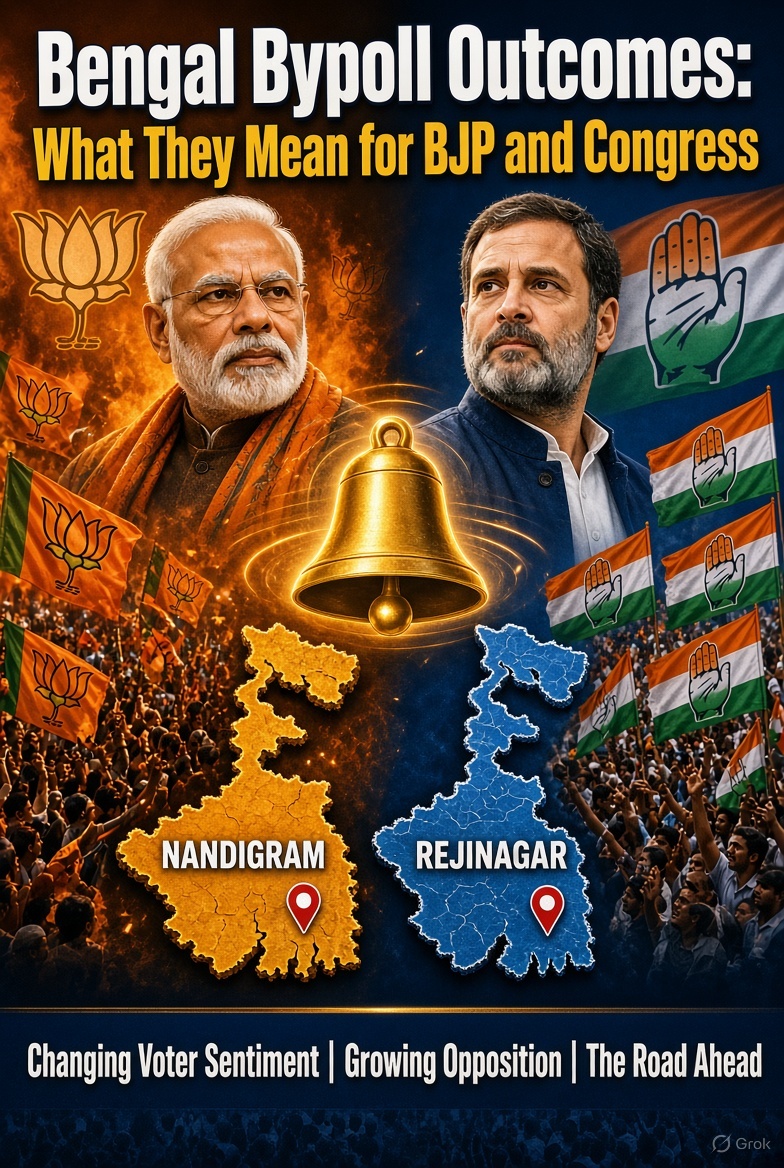
Bengal Bypoll Outcomes: What They Mean for BJP and Congress
West Bengal Bypoll Results: What They Could Mean for BJP and Congress
Political Analysis | By Sanjeev K. Gupta
The recent by-election results in West Bengal have renewed discussion about the political prospects of the Bharatiya Janata Party (BJP) and the Congress. While the outcomes in Nandigram and Rejinagar offer insights into local electoral dynamics, their broader implications for state and national politics require careful examination.
What the Results Show
According to the figures cited in this analysis, BJP candidate Hansi Rani Rath won Nandigram with 1,64,427 votes, while Congress candidate Milan Pradhan received 41,674 votes. In Rejinagar, Shankharavh Sarkar was reported as the winner, followed by Golam Nabi Azad (Robin) of the Aam Janata Unnayan Party. The final vote totals and candidate details should be confirmed against official election records before publication.
These results provide a starting point for assessing the performance of individual parties. However, by-election outcomes can be influenced by local concerns, candidate selection, turnout, alliances and constituency-level campaigning. They should not automatically be treated as evidence of a statewide or national political shift.
Congress and the Question of Political Recovery
Congress faces the challenge of strengthening its local organisation, attracting voters and translating political engagement into consistent electoral performance. Improvements in individual constituencies could offer opportunities for the party, but a broader revival would require sustained support across regions and elections.
The party's future prospects will depend on its ability to develop credible local leadership, communicate a clear policy agenda and address issues such as employment, education and economic opportunity. Its performance in a small number of contests alone cannot establish whether a durable recovery is underway.
Challenges Facing the BJP
The BJP has built a substantial national political presence around leadership, governance, infrastructure development and its ideological agenda. At the same time, voter priorities can vary by region and election. Employment opportunities, household expenses, public services and local development may influence electoral choices alongside national political issues.
For the BJP, the results offer an opportunity to assess constituency-level performance and voter concerns. However, the outcomes alone do not establish that the party is experiencing a wider decline in support.
Younger Voters and Emerging Issues
Employment security, career opportunities, education costs and changing workplace requirements are important policy concerns for many young people. Artificial intelligence and automation may also shape debates about future employment, although their influence on voting decisions varies among individuals and communities.
Congress leaders Rahul Gandhi and Priyanka Gandhi Vadra remain prominent figures in the party's public outreach. Whether this visibility translates into sustained support among younger voters will depend on organisational strength, policy proposals and performance in future elections.
Local Results, Wider Questions
The Nandigram and Rejinagar contests should be assessed in the context of their official results and local political circumstances. BJP victories in these constituencies do not, by themselves, prove that Congress is recovering nationally or that the BJP faces an electoral setback.
For Congress, the task is to demonstrate that its political outreach can translate into durable electoral support. For the BJP, the challenge is to remain responsive to changing voter expectations and constituency-level concerns.
Conclusion
The by-election results provide an opportunity for both parties to review their electoral strategies. Their wider significance will become clearer through subsequent elections, comparative vote-share data and developments in local political organisation. Any conclusion about a broader change in voter sentiment should be based on evidence from multiple constituencies and electoral cycles rather than on isolated results.