BLINKIT’S DELIVERY CHARGES UNDER SCRUTINY: DO POST-ORDER ADD-ONS RAISE QUESTIONS ABOUT PRICING TRANSPARENCY AND FAIR BUSINESS PRACTICES?
Blinkit Delivery Charges Under Scrutiny After Customer Screenshots Raise Billing Questions
Guwahati, Assam | October 24, 2026: Customer screenshots have raised questions about delivery-fee transparency on Blinkit, one of India’s leading quick-commerce platforms. The images show different order configurations and amounts payable, prompting questions about how delivery and handling charges are applied.
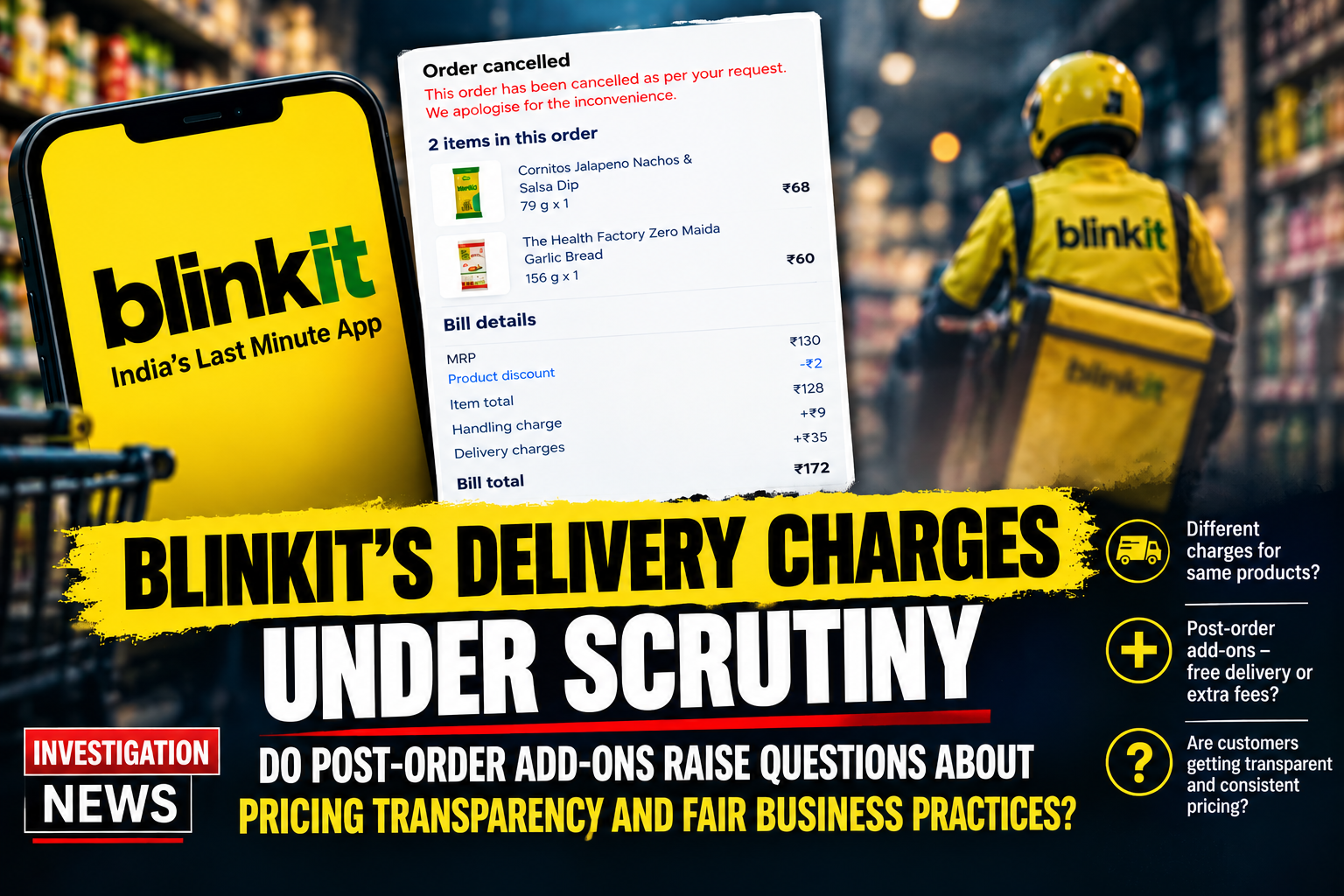
In one billing screenshot, a customer was charged ₹35 as a delivery fee and ₹9 as a handling fee on a merchandise total of ₹128. A separate order-tracking screen subsequently displayed three products and a total payable amount of ₹204, without separately itemising a delivery charge on that screen.
The available screenshots raise a question about whether the ordering sequence affected the fees. However, the tracking screen alone does not establish the final breakdown of charges or confirm that the customer received different delivery-fee treatment for an otherwise identical basket.
1. What the Screenshots Show
Screenshot A: Two products and additional charges
- Cornitos Jalapeno Nachos & Salsa Dip: ₹68
- The Health Factory Zero Maida Garlic Bread: ₹60
- Merchandise total after discount: ₹128
- Handling charge: ₹9
- Delivery charge: ₹35
- Total bill: ₹172
The displayed figures add up to ₹172, including ₹44 in delivery and handling charges beyond the merchandise total.
Screenshot B: Three products on the order-tracking screen
- Cornitos Jalapeno Nachos & Salsa Dip
- Parle Milano Hide & Seek Milano Choco Chip Biscuit
- The Health Factory Zero Maida Garlic Bread
The subsequent tracking screen displays a total payable amount of ₹204. However, it does not separately itemise the delivery charge. The final invoice is needed to establish the complete breakdown of the amount.
2. Why the Post-Order Addition Feature Matters
In December 2025, Blinkit introduced a feature allowing customers to add forgotten items to an existing order while it is being packed, without placing a separate order or paying an additional delivery charge for the added items.
The feature raises a relevant question in this case: how are the original delivery charges handled when customers add items after checkout?
If an order initially attracts a delivery fee, customers may reasonably want to understand whether that fee changes when additional products are added. The answer depends on the applicable terms and the actual billing records for the transaction.
3. What Blinkit’s Published Terms Say
Blinkit’s published terms state that orders may include delivery, handling, convenience, small-cart, surge and other service charges. They also state that applicable charges are disclosed at checkout and may vary between orders based on factors such as cart value, distance, time, delivery demand and other operating conditions.
These terms provide context for understanding why fees can differ. However, they do not establish which conditions applied to the orders shown in the customer’s screenshots.
The key issue is whether the fees charged in this particular transaction were consistent with the terms displayed to the customer at checkout and during the post-order addition process.
4. Does the Discrepancy Indicate an Unfair Trade Practice?
India’s Consumer Protection Act, 2019, provides a framework for addressing unfair trade practices and misleading representations in consumer transactions. Whether a particular billing issue falls within that framework depends on the facts and applicable terms.
A difference between an order total and a tracking-screen display does not, by itself, establish fraud or an unlawful charge. A more conclusive assessment would require the original checkout screen, the post-order addition confirmation, the final itemised invoice and the applicable delivery-fee conditions.
5. Five Questions That Need Clarification
- How does Blinkit handle the original delivery charge when customers add products after checkout?
- Does the final fee calculation change when additional products are added to an existing order?
- Where can customers see the complete revised breakdown of delivery and handling charges?
- Can the timing of product selection affect the fees applied to an order, and under what conditions?
- What process can customers use to request an explanation or correction if a charge appears inconsistent with the displayed terms?
6. What Evidence Would Resolve the Question?
The most useful additional evidence would be the final itemised invoice for the ₹204 order, the original checkout summary, and the confirmation screen showing the additional items being added.
These records would allow a direct comparison of merchandise values, discounts, delivery fees, handling fees and other applicable charges. They would also help establish whether the original delivery fee was retained, recalculated or simply not displayed on the tracking screen.
If the records show that a fee was applied contrary to the terms presented to the customer, the customer would have a clearer basis to seek an explanation or correction from Blinkit.
Conclusion: Clear Billing Information Matters
The supplied screenshots raise a reasonable question about the presentation and calculation of Blinkit’s delivery charges across different order configurations. One billing screen lists ₹35 in delivery charges and ₹9 in handling charges on a merchandise total of ₹128, while a separate tracking screen displays three products and ₹204 payable without separately showing a delivery fee.
However, the available images do not establish the final fee breakdown for the second order or prove that Blinkit charged the customer incorrectly. The final invoice and relevant checkout records are necessary to determine whether the two transactions received different fee treatment.
Blinkit’s published terms explain that service charges can vary by order and are disclosed at checkout. Clarification of how those terms apply when customers add items after placing an order would help address the concern.
Editorial note: The allegations in this report are based on the customer-provided account and screenshots. No conclusion of deliberate deception or unlawful conduct can be drawn from the available evidence alone.