BOMBAY HIGH COURT: CREATING A WHATSAPP GROUP WITHOUT PERMISSION IS NOT GROUNDS FOR DISMISSAL, ORDERS TISS TO REINSTATE PROFESSOR WITH BACK WAGES
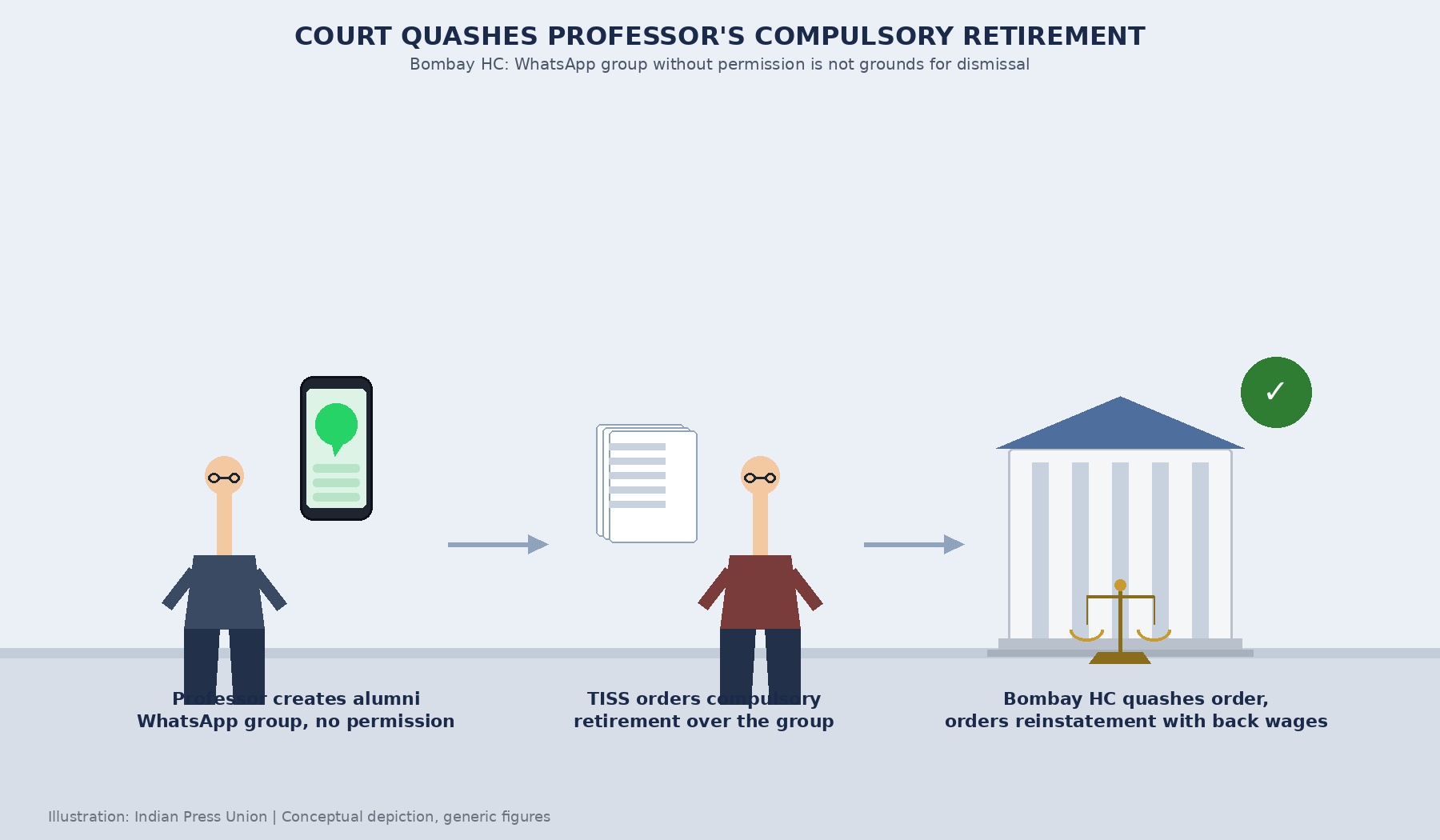
In a ruling with significant implications for disciplinary practices at educational and public-sector institutions across the country, the Bombay High Court has quashed the compulsory retirement of a Tata Institute of Social Sciences (TISS) professor, holding that creating a WhatsApp group without institutional permission does not amount to misconduct grave enough to warrant termination of service.
The judgment, delivered by a division bench of Justice M.S. Karnik and Justice Sandesh D. Patil in Writ Petition No. 1487/2018 — Dr. Swapan Garaine v. Tata Institute of Social Sciences and Others — has ordered the institute to reinstate the professor with continuity of service and 50 per cent back wages, along with all consequential retirement benefits.
The Allegation: An Unauthorised WhatsApp Group
The case traces back to September 2017, when Dr. Swapan Garaine, then a professor at TISS, was compulsorily retired by the institute. The disciplinary action stemmed from allegations that he had created a WhatsApp group titled "TISSians Career Impact2" without seeking the institution's permission, and had used TISS's official logo on the group in a manner the institute alleged amounted to running a parallel, unauthorised placement service.
Dr. Garaine contested the institute's characterisation of the group, submitting that it existed solely to share employment opportunities with the institute's alumni and that he had derived no personal financial benefit whatsoever from its operation — a claim that would prove central to the court's eventual findings.
Court Finds No Evidence of Commercial Misuse
After examining the record, including chat logs from the group that had been placed before the inquiry, the High Court concluded that the platform had been used entirely in the interest of students' career prospects, with no evidence that the professor had extracted any financial or personal advantage from it. The bench found that the internal inquiry's conclusions to the contrary were unsupported by evidence and, in the court's words, perverse.
"You Cannot Use a Sledgehammer to Crack a Nut"
Central to the court's reasoning was the doctrine of proportionality — the principle that any punishment imposed by a disciplinary authority must be commensurate with the gravity of the alleged offence. Invoking a celebrated formulation attributed to Lord Diplock of the English judiciary, the bench observed that one does not require a sledgehammer to crack a nut, characterising the punishment of compulsory retirement as grossly disproportionate to the conduct alleged.
The court further noted that while using the institute's logo without prior authorisation may have constituted an administrative lapse — one that Dr. Garaine had, in fact, rectified by removing the logo from the group at a later stage — such a lapse could not, on its own, justify the severest form of disciplinary action available to the institution.
Conduct Rules Cited by TISS Found Inapplicable
TISS had built its case around the Central Civil Services (Conduct) Rules, 1964, specifically invoking Rule 3, which mandates absolute integrity and devotion to duty, and Rule 15, which restricts government or institutional employees from engaging in private trade or employment without prior sanction. The institute had argued that the WhatsApp group effectively functioned as an unauthorised commercial placement venture in violation of these provisions.
The court, however, held that the mere creation of a social media group to keep former students informed of job opportunities did not establish either an illegal private business or misconduct serious enough to attract these provisions — the absence of any pecuniary gain to the professor being a decisive factor in this determination.
Scope of Judicial Review: When Courts Can Intervene
The judgment also addressed the boundaries of judicial review in service matters. While courts ordinarily exercise restraint in interfering with the findings of internal disciplinary committees, the bench reiterated — drawing on Supreme Court precedent — that High Courts retain the power under Article 226 of the Constitution to intervene and quash a punishment where the underlying findings are irrational, unsupported by evidence, or contrary to principles of natural justice.
Reinstatement Terms: Continuity of Service and Retirement Benefits Protected
The court's reinstatement order carries substantial financial and career implications for Dr. Garaine. Under the principle of continuity of service, the law treats the professor as though he was never actually removed from his post — meaning the disputed period will not be excluded from his total length of service. This preserves his entitlement to gratuity, provident fund accumulation, and pension calculations without any adverse deduction for the years he was kept out of service.
The order also entitles Dr. Garaine to notional promotions and increments — meaning that if his peers received regular annual increments or seniority-based promotions during the intervening years, he too will be deemed to have received them, ensuring his basic pay upon reinstatement reflects what it would have been had his service never been interrupted.
Back Wages Fixed at 50 Per Cent, Citing Supreme Court Precedent
On the question of back wages, the court applied the framework laid down by the Supreme Court in Deepali Gundu Surwase v. Kranti Junior Adhyapak Mahavidyalaya, which holds that while back wages are not automatic even where a termination is quashed, an employee whose dismissal is found wholly illegal and arbitrary is ordinarily entitled to them — subject to the employee demonstrating that they were not gainfully employed elsewhere during the period of exclusion.
Balancing the professor's technical lapse in using the institute's logo without authorisation against the disproportionate nature of the punishment imposed, the court settled on 50 per cent back wages rather than full back pay, covering the period from March 2016 — when Dr. Garaine was first placed under suspension — through to his official age of retirement.
Wider Implications for Institutions
Legal observers say the ruling is likely to serve as an important precedent for educational institutions and public sector undertakings across India, signalling that disciplinary authorities cannot resort to extreme measures such as compulsory retirement on the basis of institutional ego or personal bias against an employee. The judgment also carries a cautionary financial dimension: institutions that pursue disproportionate administrative action risk exposing themselves to significant liability in interest and back wages should courts later find such decisions untenable, as has now occurred with TISS.
(This report is based on the text of the Bombay High Court's judgment in Writ Petition No. 1487/2018. Readers are advised to verify case citations, statutory provisions and factual particulars against the original judgment, bare act, or official gazette before relying on them for legal proceedings.)
Viral Tripathi is a District Report contributor with the Indian Press Union, covering civic and legal affairs in Ahmedabad.