"BRICS 2026 and India’s Rise: Can Strategic Autonomy Become Strategic Power?"
From Diplomatic Influence to Economic, Technological and Military Capability
By Col. (Dr.) Ashwani Kumar, MiD, VSM (Retd.)
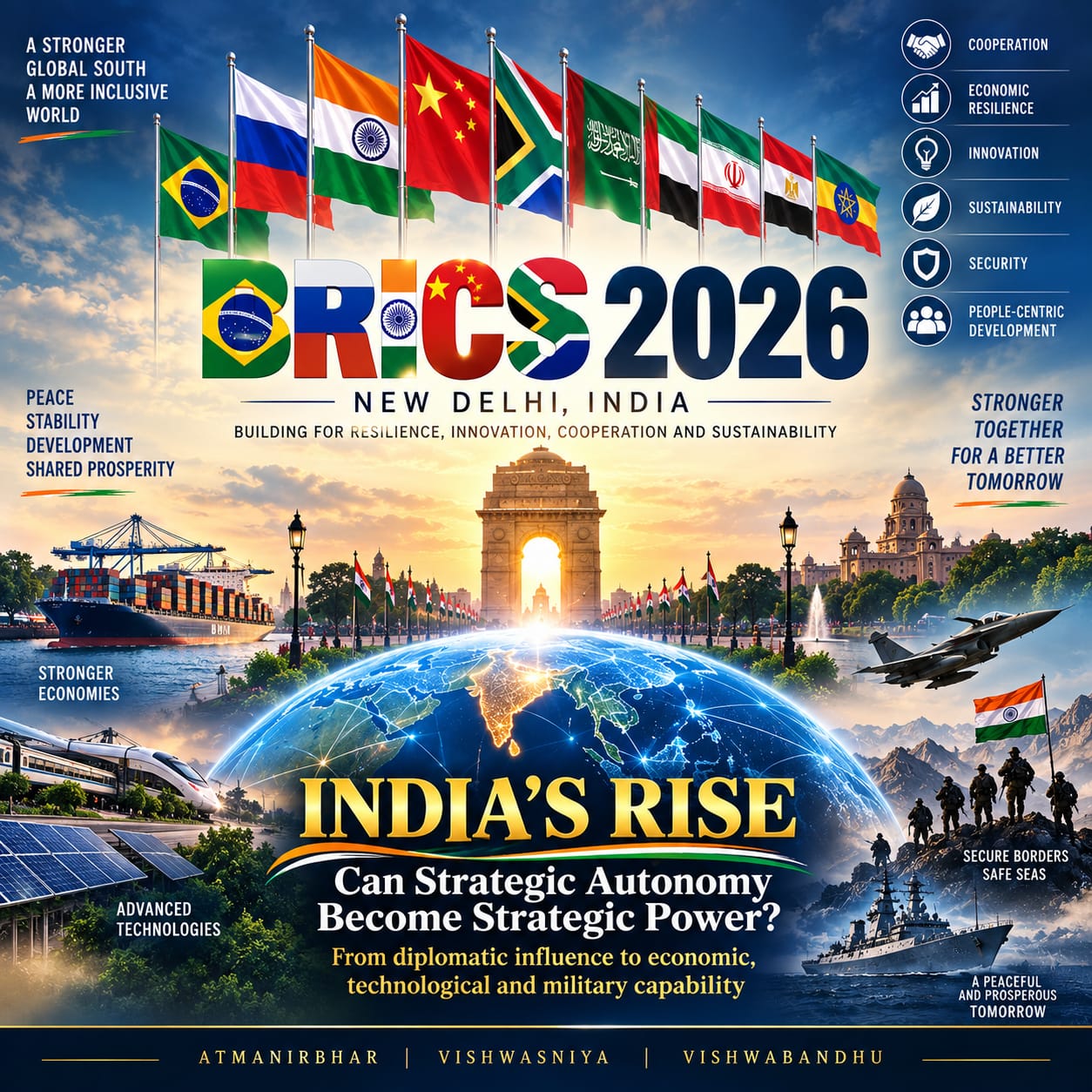
The 18th BRICS Summit, being hosted by India in New Delhi on 12-13 September 2026, is much more than another diplomatic gathering. It comes at a defining moment in international affairs, when the established global order is being challenged by geopolitical conflicts, economic realignments, technological competition, energy insecurity and the emergence of new centres of power.
India's BRICS chairmanship therefore presents both an opportunity and a test.
With the theme “Building for Resilience, Innovation, Cooperation and Sustainability,” India has sought to make its chairmanship practical and development-oriented. More than 350 BRICS meetings and engagements have been conducted during the year. But the larger question is: Can India convert its growing diplomatic influence into comprehensive national power and emerge as a credible global leader?
In my assessment, the answer will depend on how effectively India combines diplomacy, economic strength, technological capability and military power.
BRICS: An Opportunity for India
BRICS has evolved considerably from its original composition. Its expansion has increased its demographic, economic and geopolitical weight, but it has also made the grouping more diverse. Today, BRICS brings together countries with very different political systems, economic interests, regional priorities and relationships with the United States and the West.
This diversity is simultaneously a challenge and an opportunity. India should not attempt to transform BRICS into an anti-Western alliance. Nor should it allow the organisation to become dominated by any one power.
India's objective should be to establish BRICS as a credible platform for the Global South, one capable of influencing global governance while promoting practical cooperation in trade, technology, energy, development and security.
The success of India's chairmanship should therefore be judged not by the number of declarations issued, but by whether BRICS delivers practical outcomes.
Strategic Autonomy Requires Strategic Capability
As an Army officer, I would add an important dimension to the conventional debate on BRICS. India frequently speaks of strategic autonomy. But strategic autonomy cannot remain merely a diplomatic doctrine.
A nation can make independent choices only when it possesses sufficient economic, technological, diplomatic and military capability to withstand external pressure.
Excessive dependence on another country for critical defence equipment, technology, energy or financial systems inevitably places limits on strategic freedom. Therefore:
Strategic autonomy must ultimately be backed by strategic capability.
India has made remarkable progress in many areas. However, if India seeks to become a leading power in the 21st century, the ambition must extend considerably further.
A Strong Military is a Strategic Necessity
India's geography, contested borders, maritime interests and regional security environment require a strong military. But military power today cannot be measured simply by the number of soldiers, tanks, aircraft or warships. The character of warfare is changing rapidly.
Recent conflicts have demonstrated the growing importance of:
- Artificial intelligence
- Drones and counter-drone systems
- Electronic warfare
- Cyber warfare
- Space-based surveillance
- Precision weapons
- Autonomous systems
- Information warfare
- Integrated intelligence, surveillance and reconnaissance
- Long-range fires
- Air and missile defence
India therefore needs a military that is not merely larger, but smarter, integrated, networked, technologically superior and rapidly deployable. The battlefield of tomorrow will increasingly belong to the force that can see first, decide first and strike with precision.
From Defence Importer to Defence Technology Power
India's aspiration to become a global power cannot permanently coexist with excessive dependence on foreign defence technology.
Self-reliance should not mean isolation. India must continue to engage with technologically advanced nations. But the ultimate objective should be the indigenous capacity to design, develop, manufacture, upgrade and sustain critical military systems. India must move beyond simply assembling foreign equipment.
The next phase should focus on developing globally competitive capabilities in AI, drones, counter-drones, cyber, electronic warfare, quantum technologies, space systems, precision weapons, autonomous platforms and advanced materials.
India's BRICS chairmanship provides an additional opportunity here. Cooperation in AI, high-performance computing, quantum technologies, biotechnology, advanced materials and other emerging technologies can benefit both civilian development and national security. The civilian technology ecosystem and the defence establishment must therefore work much more closely together.
BRICS and Security Cooperation
BRICS should not become a military alliance. There is neither a strategic requirement nor sufficient convergence for a NATO-like structure. But this does not mean that security cooperation should be neglected.
India can promote practical cooperation in:
- Counter-terrorism
- Cyber security
- Maritime security
- Counter-drone technologies
- Disaster response
- Protection of critical infrastructure
- Space-related security
- Intelligence cooperation against transnational threats
- Emerging security technologies
Such cooperation would strengthen BRICS without turning it into a military bloc.
Maritime Power: The Missing Dimension
India's BRICS leadership must also recognise that economic security is inseparable from maritime security. India's energy supplies, exports, imports and global trade depend heavily on secure sea lanes.
The continuing instability in West Asia has demonstrated how quickly disruption around maritime choke points can affect energy prices, shipping and global supply chains. For India, therefore, a powerful Navy is not simply about war-fighting. It is about:
Protecting trade, securing energy, safeguarding sea lanes and preserving strategic freedom of action.
India should continue developing the capability to act as a net security provider in the Indian Ocean Region, while building sufficient maritime power to protect its interests beyond its immediate coastline.
Jointness and Military Reforms
If India wants to become a major military power, increasing defence expenditure alone will not be sufficient. The armed forces must become genuinely joint and integrated. Future conflicts will not be fought independently by the Army, Navy and Air Force. They will be fought through an integrated national military system combining:
Land + Air + Sea + Space + Cyber + Electronic Warfare + Intelligence + Industry.
India must therefore continue with:
- Greater jointness
- Integrated operational planning
- Common intelligence architecture
- Integrated logistics
- Network-centric warfare
- Integrated air and missile defence
- Stronger space and cyber capabilities
- Faster decision-making and mobilisation
The objective should be combat effectiveness, not merely organisational restructuring.
India as a Bridge Between Power Centres
India possesses a unique strategic advantage. It maintains significant relationships with the United States and the West, Russia, China, Iran, the Gulf countries, Africa and the wider Global South. This gives India the possibility of becoming a bridge between competing geopolitical systems.
But being a bridge does not mean being neutral on every issue. It means retaining the freedom to make decisions according to Indian national interests.
India should be able to cooperate with Washington without becoming subordinate to Washington; maintain its relationship with Moscow without becoming part of a Russia-China bloc; engage Beijing without compromising national security; and maintain relations with Iran and the Gulf while protecting India's wider economic and strategic interests.
That is the essence of strategic autonomy.
The China Question
No meaningful discussion of BRICS can avoid China.
China possesses enormous economic weight and considerable influence across the Global South.
India must therefore ensure that an expanded BRICS does not become a China-centric organisation.
At the same time, India should avoid turning every BRICS forum into an India-China confrontation.
The correct approach is:
Cooperate where interests converge, compete where interests diverge, and never compromise India's core national-security interests.
India's strength within BRICS will ultimately depend on its ability to maintain this balance.
What Should India Seek from BRICS?
India should pursue measurable outcomes in six areas:
- Global governance: Reform of the UN and international financial institutions, with greater representation for developing countries.
- Economic resilience: Greater trade, investment, supply chain diversification and opportunities for Indian industry and MSMEs.
- Technology: Cooperation in AI, quantum technologies, advanced computing, semiconductors and emerging technologies.
- Energy security: Reliable and diversified energy supplies and resilient maritime trade routes.
- Security cooperation: Counter-terrorism, cyber security, maritime security and emerging threats.
- Development: Infrastructure, disaster resilience, health, agriculture and digital public infrastructure.
The fundamental test should be:
Will BRICS create practical capabilities, or merely produce political declarations?
The Military Leader's Perspective
Having spent a substantial part of my professional life in uniform and in India and abroad, I believe there is one fundamental strategic reality that we must never lose sight of:
- Diplomacy is strongest when backed by national power.
- A strong economy gives a country endurance.
- Technology gives it an edge.
- Diplomacy gives it influence.
But military power gives it the ability to protect national interests when diplomacy fails. This does not mean India should become militaristic. A strong military should be an instrument of peace, deterrence and national security.
The best war is the one that never has to be fought because the adversary understands that India possesses both the capability and the political will to defend itself.
From Vishwaguru to Vishwabandhu
India's aspiration should not be to dominate the world.
Our civilisational tradition does not demand domination.
India can instead aspire to become a responsible leading power, one that contributes to peace, development, technology, humanitarian assistance and global stability.
The idea of 'Vishwabandhu' — a friend and responsible partner to the world — perhaps better captures India's potential role. But friendship also requires strength.
A weak nation may be respected for its intentions; a strong nation can ensure that its intentions are respected.
To conclude, BRICS 2026 provides India with a historic diplomatic platform. But hosting the summit will not, by itself, make India a global power. India's rise will depend upon whether it can convert:
- Demography into human capital
- Economic growth into national wealth
- Technology into strategic capability
- Diplomacy into global influence
- Military strength into credible deterrence
BRICS can provide India with a platform.
The Global South can provide India with a wider constituency.
Our economy can provide leverage.
Our technology can provide an edge.
But a strong, modern and technologically superior military will provide the strategic confidence required to protect India's choices.
Therefore, India's objective should not merely be to become a larger voice within BRICS. It should be to become a major pole of the emerging world order.
BRICS can give India the platform.
Economic strength can give India the leverage.
Technology can give India the edge.
But strategic military power will give India the freedom to exercise its choices.
That is the journey from strategic autonomy to strategic power.
Author's Note
The author is a retired military officer, a curator, historian, defence expert and strategic affairs commentator, writer and researcher. His perspective in this article is shaped by his professional experience in uniform and his continuing interest in national security, defence preparedness, disaster management, geopolitics and India's strategic role in the emerging international order.
Disclaimer
The views expressed in this article are those of the author in his personal capacity and are intended for informed public discussion. They do not represent the official position of the Government of India, the Indian Armed Forces, or any organisation with which the author may have been associated. The article is an independent strategic assessment based on publicly available information and the author's professional perspective.