"The Jungle Remembers, Cheddikulam, 20 October 1988"
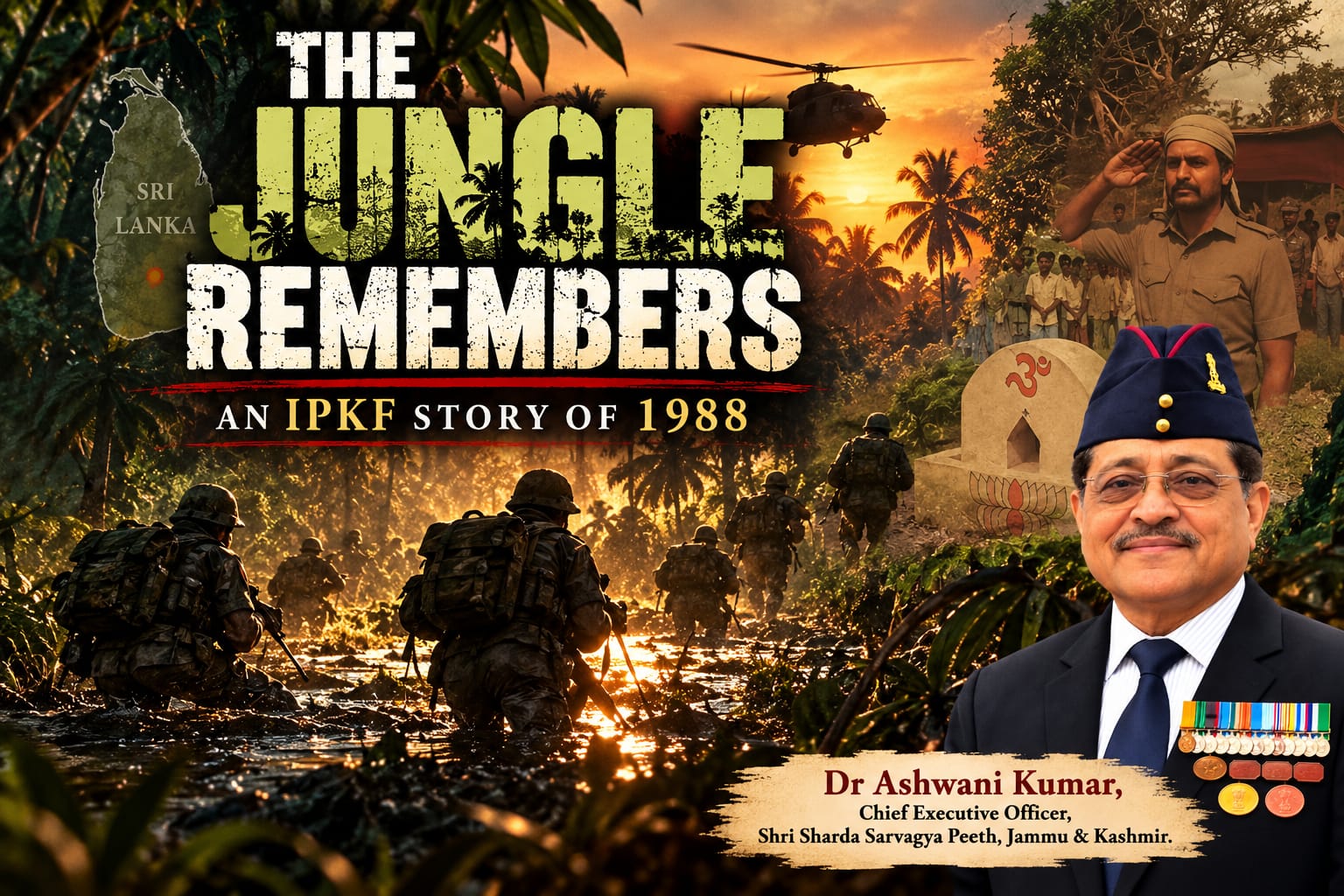
By Col (Dr.) Ashwani Kumar, MiD, VSM (Retd.)
A Soldier’s Story of Duty, Sacrifice and Comradeship.
Dedicated to the five brave soldiers of 4 JAT who never returned from Cheddikulam.
Thirty-Eight Years Later.
Some memories do not grow old. They remain somewhere deep within us, waiting for a date, a photograph, a familiar name or an unexpected thought to bring them back to life. While preparing this story, I realised that Dussehra would fall on 20 October 2026. The date immediately took me back thirty-eight years, to 20 October 1988, when five soldiers of my company lost their lives along railway line near Cheddikulam in Sri Lanka during Operation Pawan in 1988.
As I began writing, I felt goosebumps. My mind seemed to travel through time. I could see the old photographs, recall the faces of my men and hear again the sounds that had once shattered the silence of that distant morning. I was no longer simply a retired soldier remembering an old operation. I was once again a young Major, preparing to take over an isolated operational responsibility in a foreign land, thinking of my family, my one-year-old son and the men whose lives had been entrusted to my command.
The story of Cheddikulam must begin before the explosion, before the casualty message and before the five names became part of our unit's history. It must begin with a night, a hurricane lamp and an order.
The Commanding Officer’s Visit to my Tent.
I was serving with 4 JAT during Operation Pawan in Sri Lanka. In October 1988, my Commanding Officer visited me in my tent late at night. He did not call me to his location. He came to me.
There was little time for discussion. He informed me that my company is being changed and I am given a new task which had been assigned to me. Perhaps he had reached the final decision only at the last moment. Perhaps the circumstances demanded an immediate change. I cannot say what was passing through his mind, but I have often wondered whether he considered me suitable for the responsibility and therefore chose to entrust it to me second time a risky task to move to an Isolated post. Whatever his reasons, I honoured his words.
I was the junior-most Major in the battalion. Naturally, questions arose in my mind. Why had I been selected for such an isolated location? What was the nature of the responsibility awaiting me? How would I manage if the post came under attack and reinforcement could not reach us in time? These were the thoughts of an officer assessing the task before him, not an expression of reluctance.
In the Army, a commander's confidence is a responsibility in itself. Orders may come at inconvenient hours, with little time for preparation and without answers to every question. A soldier must understand the task, prepare himself and carry it out. There were no ifs and buts.
The move was scheduled for five o'clock the following morning. Under the dim light of a hurricane lamp, I began sorting my equipment and packing the items I would need. The small pool of yellow light illuminated my kit, while the darkness beyond it seemed to hold all the uncertainties of the assignment. I thought of my family. My son was barely one year old. At that age, a child knows little of military postings, operational areas or the risks his father may face. Yet the image of home came to me that night, as it must to many soldiers preparing for an unfamiliar task.
I also remembered the recent ambush near Trincomalee in which some of our senior officers had been wounded and hospitalised. We had lost our Regimental Medical Officer, Captain J. C. Bhatt, and Naik Rajpal Singh later succumbed to his injuries. Those losses were still fresh in our minds. I wondered how quickly help could reach the new post if we encountered trouble. The location was remote, the journey difficult and reinforcement uncertain. Road-opening operations were necessary before movement could safely proceed. I tried to rest, but sleep would not come easily. I cannot recall the precise moment when I finally drifted off. What remains clear is the arrival of my buddy with a cup of tea and the reminder that it was time to get ready. The night was over. The order had to be carried out.
The Road to Cheddikulam
After the necessary reporting and preparations, our movement began in a 3 X Ton Tata Shaktiman truck. I remember the journey in connection with Vavuniya, Anuradhapura and our onward movement towards Cheddikulam. The road was in a terrible condition. The truck jolted and bounced over broken stretches, and the journey seemed to test both the vehicle and its occupants. The landscape was unfamiliar. The countryside appeared quiet and deserted. There was a strange stillness about it, a silence that seemed almost unnatural after the concerns and activity of military life.
For a soldier, however, a quiet landscape does not necessarily mean a safe one. In an operational area, silence can be deceptive. The road ahead may look empty, the trees may stand motionless and the countryside may appear peaceful, yet danger can remain concealed beyond what the eye can see. Sri Lanka is a land of ancient civilisation, religious traditions and stories that have travelled across generations. The Ramayana traditions associated with Sita and Ashoka Vatika are part of the island's cultural imagination. The areas around Seetha Eliya and Hakgala, near Nuwara Eliya, are associated with those traditions, although their precise identification with the epic remains a matter of belief rather than conclusively established history.
Such stories belong to the wider history of the island. But that morning, my thoughts were occupied by immediate realities, the rough road, the isolation of the post, the operational responsibility and the men who would depend on my decisions as I was the only officer with the company. When we reached the post, I met the Company Commander of relieving Company in the dim light of a hurricane lamp. He had settled in a dug-in tent inside a building to be safer within the camp. The surroundings were austere. The faint light, the makeshift accommodation and the isolation made a lasting impression on me. I looked at the place and wondered again where I had been sent.
It was a location where communications could be difficult, movement could be arduous and timely reinforcement could not be taken for granted that was my first impression of the camp. But a soldier cannot choose the ground on which duty places him. He can only understand it, prepare for it and lead his men as best he can.
Taking Over the Responsibility of the Cheddikulam Post.
On 16 October 1988, ‘A’ Company, 4 JAT, under my command, took over operational responsibility for the General Area Cheddikulam from 5 RAJ RIF.
The operational environment demanded constant vigilance. Dense jungle, marshy ground, poor communications and militant activity complicated movement. The men had to remain alert, disciplined and prepared for the unexpected.
A company in such an area is more than a formation on a map. It is a collection of soldiers whose safety depends upon preparation, mutual trust and the decisions taken by their leaders. Every patrol, every movement and every road opening task carries its own risks. The company was settling into its responsibilities. We had much to learn about the terrain and the operational patterns of the area. The men were performing their duties, and the work of maintaining security continued. It was only the third day after taking over responsibility when the events of 20 October unfolded as outgoing officer was more protective about his men. I could not have known that the date would remain with me for the rest of my life.
The Morning of Dussehra.
It was Dussehra, 20 October 1988. A road-opening operation was being undertaken, and two parties moved out on separate tasks. One proceeded towards the Talaimannar Road, while the other moved towards the Anuradhapura area. The relieving company had advised us to take additional troops for the task. We accepted the requirement, understanding that the operation demanded adequate manpower. The parties moved out to carry out their duties. At the time, there was no reason to believe that the morning would become one of the most painful memories of my military service, as we were positioned in our sites. Then, at approximately 0645 hours, the silence was shattered.
A tremendous explosion rang out.
The sound struck me with immediate force. My heart sank. Before I received any information, my thoughts went straight to the men who had moved out on the other side. I was particularly worried about the party operating towards the Anuradhapura area. In an operational zone, an unexpected explosion is never merely a sound. It raises immediate questions. Where has it occurred? Which party is involved? How many men are there? Is the attack continuing? Can help reach them?
Those questions came rushing into my mind.
I waited anxiously for information.
Soon, the message arrived, one of our party operating towards the Anuradhapura area had been ambushed.
We had lost five jawans.
For a moment, the world seemed to narrow around those words. The men had left to perform an assigned duty. Now I was being told that five of them would not return. No military training can make such news painless. A commander may be trained to assess a situation, organise a response and act under pressure. But behind the uniform is a human being who knows the faces of his men, recognises their voices and shares their daily hardships. The explosion lasted only moments. Its consequences would remain for decades.
Five Names, Five Lives
The five soldiers whose loss became part of the history of Cheddikulam were:
(i) Havildar Jagdish Prasad Jat.
(ii) Naik Shivpal Singh.
(iii) Sepoy Sultan Singh
(iv) Sepoy Rajbir Singh
(v) Sepoy Randhir Singh.
Their names deserve to be recorded with dignity and remembered individually.
They were not merely five entries in a casualty report. They were soldiers of 4 JAT, men who had accepted the responsibilities of service and gone out to perform their assigned task. Each had a life beyond the operational area. Each had people who knew him not by his rank or service number, but by his name and his place in their lives. Their families had entrusted them to the uniform, just as the Army had entrusted them with a duty.
On that morning, the regiment lost five of its own.
I have often thought about the distance between an ordinary departure and a final one. A patrol moves out, its men carrying their equipment and preparing for the task ahead. They expect to return, report what they have done and prepare for the next assignment. That expectation is part of the rhythm of military life. But war can break that rhythm without warning. The men who left that morning could not know how the day would end. Neither could those who watched them move out.
Their sacrifice must not be reduced to a date, a place and a number. Their names must remain part of the memory of the unit they served.
A Commander’s First Duty.
Once the message confirmed the ambush, there was no time to remain absorbed in the shock of the news. I rushed to the scene with my Quick Reaction Team. The immediate priorities were clear, secure the area, reach our men, evacuate the fallen and prevent the attackers from escaping through the available routes. The terrain was difficult. The jungle offered concealment, and early darkness would soon make movement more complicated. Every minute mattered. The area was secured, and efforts were made to block the available escape routes. Despite these actions, the surviving militants managed to disappear into the dense jungle, as early hours give advantage to the attackers.
There are moments in a soldier's life when thought and action become almost inseparable. One cannot afford to surrender to grief while men still need assistance and a situation remains unresolved. The commander must act first and absorb the full weight of events later. That day, my immediate responsibility was to my men.
The operational details can be written in reports. The movement of the Quick Reaction Team, the securing of the area and the evacuation of the fallen can be recorded in military language. But the human experience is more difficult to describe. I was young had no experience of the war and all alone to handle the situation and may be this is what the leadership is taught to an Army Officer.
I remember the shock of the explosion, the anxious wait for information and the terrible finality of the message that followed. I remember the knowledge that five soldiers had gone out on duty and would never return to their company. The jungle remained where it was. The road remained where it was. But for those of us who had lost our comrades, the morning had changed everything.
The Burden of Remembrance Even after 38 Years
The loss at Cheddikulam demanded a firm response by Lieutenant General A. S. Kalkat, the GOC of IPKF, and GOC of the Inf Div, called for a determined answer to the loss. For a military unit, the days following casualties are difficult. There is work to be done, operational responsibility to maintain and decisions to take. The fallen must be honoured, the surviving men must continue their duties, and the mission cannot simply stop because the unit has suffered.
In the weeks that followed, ‘A’ Company continued its operational role. The subsequent Musalkutti raid, carried out by my company under me, in the early hours of 11/12 November 1988, became a separate chapter in the company's history. It was another operation, undertaken later, and should not be confused with the Cheddikulam ambush, but it was an action to take revenge and we completed our task.
Yet the memory of 20 October remained part of the company’s experience. The loss of comrades is not erased by the next assignment. A soldier moves forward because duty requires it, but he carries the memory of those who have fallen.
Military history often records objectives, movements, weapons, casualties and outcomes. These are essential facts. But behind every operational account are human beings who experienced fear, uncertainty, courage, grief and responsibility. The five soldiers of Cheddikulam belong to that human history.
The Photograph That Speaks.
Thirty eight years later, I look at the old photograph of myself with Subedar Mahaveer Singh, Sub Piyare Lal and the jawans of ‘A’ Company. The faces look back across time.
The photograph preserves a moment when we stood together as members of the same company, sharing the responsibilities and uncertainties of service. It cannot tell the entire story of what happened afterwards. Yet it reminds me of something that no official document can fully express: a military unit is held together not only by orders and organisation, but also by trust, shared hardship and comradeship. When I look at those faces, I do not see only soldiers in uniform. I see the people who formed part of that chapter of my life. I remember the responsibility of command and the knowledge that every order affected real men, each with a life beyond the battlefield.
Photographs preserve appearances. Memory preserves relationships.
The years have carried us far from Sri Lanka. The operational area may have changed, the roads may have improved or disappeared, and the jungle may have reclaimed old tracks. But the image of those men remains.
For me, the photograph is not simply a historical record. It is a reminder of an obligation, to remember the men who served under my command and, especially, those who did not return.
Dussehra, 20 October 2026.
As Dussehra approaches on 20 October 2026, I find myself returning to the same date in 1988. Thirty eight years have passed. I have lived through other chapters of life, carried other responsibilities and watched the world change in countless ways. Yet the memory of Cheddikulam remains remarkably close.
I can still recall the hurricane lamp beneath which I packed my equipment. I can remember thinking of my one-year-old son and wondering about the isolated assignment that lay ahead. I can recall the difficult journey in the Tata Shaktiman truck, the broken road, the quiet countryside and the austere post where I met the Company Commander.
And I remember the explosion at approximately 0645 hours. I remember how my heart sank and how I worried about the party operating towards the Anuradhapura area. I remember receiving the message that we had been ambushed and had lost five jawans.
These memories are not presented here to reopen old wounds. They are being recorded because time must not be allowed to turn sacrifice into silence. The men who died at Cheddikulam served far from home, in a difficult operational environment, carrying out the duties entrusted to them. Their story deserves to be remembered by their regiment, by the Army and by future generations who may never fully understand what those years demanded of Indian soldiers serving in Sri Lanka.
I write as a survivor, but also as a commander who continues to feel a responsibility towards those who did not return. Their memory is part of my own military journey, and it is my duty to preserve it with honesty and dignity.
The Jungle Remembers.
There is a silence that comes with the passing of time. Old operational locations fade from public attention. The men who once served together grow older, and the details of distant events gradually disappear from the memories of those who were not there. But some memories refuse to fade. Cheddikulam is one of them.
On 20 October 1988, five soldiers of 4 JAT lost their lives during an ambush while carrying out their duties. Their sacrifice remains a solemn part of our unit's history. Their names deserve to be spoken, their service deserves to be honoured, and their families deserve the assurance that the nation has not forgotten them.
This story began with a date that returned to me after thirty-eight years. It became a journey back to a tent, a hurricane lamp, a difficult road and a morning when an explosion shattered the silence. Above all, it became a tribute to five men whose lives and sacrifice remain inseparable from the memory of Cheddikulam. I cannot bring those men back. I cannot change what happened on that morning. But I can record what I remember, honour their names and ensure that their story is not lost among the pages of military history. The jungle may have changed. The years may have passed. The old road may no longer look as it did in 1988. But somewhere in the memory of those who served there, Cheddikulam remains alive.
The jungle may grow silent. The years may pass. But the jungle remembers.
In memory of the fallen.
Havildar Jagdish Prasad Jat.
Naik Shivpal Singh.
Sepoy Randhir Singh.
Sepoy Sultan Singh.
Sepoy Rajbir Singh.
Your duty ended on the battlefield. Your place in our memory remains forever.
********