China Rejects India’s Naming of 27 Arunachal Pradesh Places, Calls Move ‘Illegal, Null and Void’
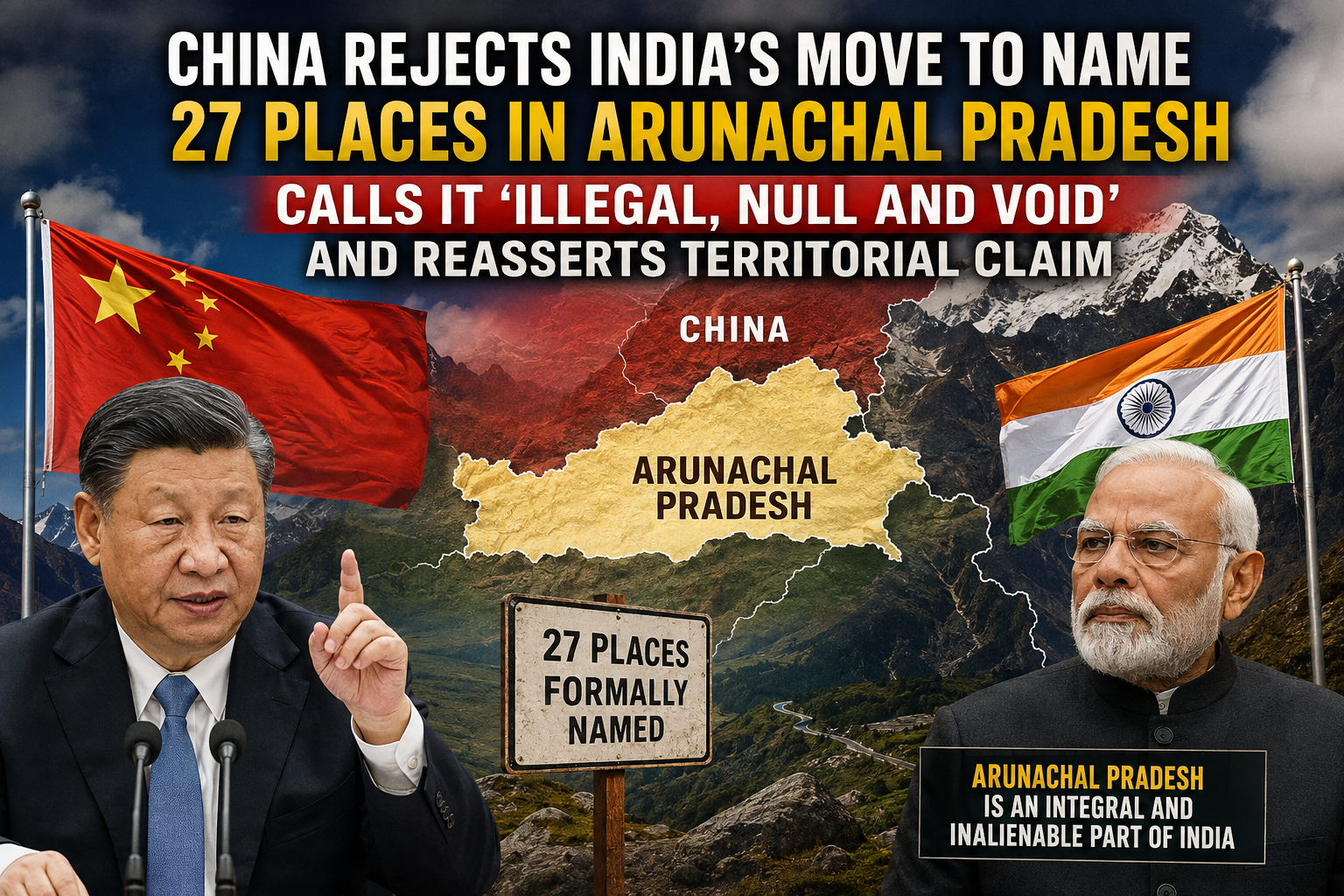
Subheading: Beijing reiterates its territorial claim over Arunachal Pradesh, while India maintains that the state is an integral and inalienable part of the country.
China has strongly rejected India’s recent move to formally identify 27 places and geographical features in Arunachal Pradesh using their standard Indian names, describing the decision as “illegal, null and void” and reiterating Beijing’s territorial claim over the northeastern Indian state.
Chinese Foreign Ministry spokesperson Guo Jiakun said on August 10 that China does not recognise the name “Arunachal Pradesh” and instead refers to the region as “Zangnan.” Beijing maintains that the area is part of Chinese territory, a position that India has repeatedly rejected.
India recently formalised the names of 27 locations and geographical features in Arunachal Pradesh for use on official maps and records. The locations reportedly include settlements, mountain passes, a lake and other geographical features. The move represents another assertion of India’s administrative position over the state.
China Rejects India’s Move
Responding to India’s naming exercise, Beijing said that actions by India to assign or standardise names in the disputed region cannot alter what China considers to be the territorial status of the area.
China has previously carried out similar naming exercises. In 2017, Beijing announced Chinese names for six locations in Arunachal Pradesh. India rejected the move at the time, maintaining that changing or inventing names could not alter the reality that Arunachal Pradesh is part of India.
The naming dispute has since become an additional point of diplomatic friction between the two countries.
India’s Position on Arunachal Pradesh
India has consistently maintained that Arunachal Pradesh is an integral and inalienable part of the country. New Delhi rejects China’s territorial claims over the state and has also opposed Beijing’s attempts to rename places within Indian territory.
Indian officials have repeatedly stated that such naming exercises do not change the ground situation or India’s administrative control over Arunachal Pradesh.
The state shares an international border with China and has remained a sensitive area in India-China relations for decades.
A Long-Running Territorial Dispute
The latest disagreement comes against the backdrop of the broader and longstanding India-China boundary dispute. Both countries have held multiple rounds of diplomatic and military discussions aimed at managing tensions along their disputed border.
Arunachal Pradesh remains one of the key areas of disagreement. China claims large parts of the state and refers to it as “Zangnan,” while India exercises administrative control over the territory and regards it as an integral part of the Indian Union.
The dispute over place names is therefore more than a question of geography. For both countries, the use of official names is closely connected to their respective claims of sovereignty and territorial authority.
Naming Does Not Change Ground Reality
Despite the strong statements from both sides, the latest naming exercise does not, by itself, change the existing administrative control over the disputed territory.
India’s decision to standardise the names of 27 locations is primarily an administrative and cartographic assertion of its position. Similarly, China’s previous attempts to introduce Chinese names have been viewed by India as political and diplomatic statements rather than actions that alter the actual situation on the ground.
The latest exchange highlights how the Arunachal Pradesh dispute continues to remain an important issue in India-China relations.
As both countries continue diplomatic engagement over their broader boundary differences, the competing claims and naming exercises demonstrate that Arunachal Pradesh remains a highly sensitive issue between New Delhi and Beijing.