GLOBAL AGRIBUSINESS AND RURAL ENTERPRISE: OPPORTUNITIES FOR A SUSTAINABLE RURAL FUTURE

Global Agribusiness and Rural Enterprise: Opportunities for a Sustainable Rural Future
Agriculture today is much more than growing crops. Modern agribusiness connects farmers with input suppliers, processors, traders, financial institutions, technology companies, transporters, retailers and consumers. This interconnected system creates opportunities not only in farming but also in processing, storage, marketing, logistics, technology and entrepreneurship.
Rural enterprises are an important part of this transformation. Small businesses such as food-processing units, dairy enterprises, nurseries, seed businesses, machinery services, storage facilities, transport services and digital agricultural services can generate employment and income within rural communities.
From Farmer to Agripreneur
Farmers are the foundation of agricultural value chains. Today, farmers increasingly need to consider not only production but also costs, quality, market demand, technology and profitability.
Farmer Producer Organizations (FPOs) and cooperatives can strengthen small farmers by supporting collective purchasing, aggregation, processing, storage and marketing.
Rural entrepreneurship can further diversify income. Opportunities exist in food processing, dairy, poultry, horticulture, beekeeping, mushroom production, agricultural machinery, logistics, e-commerce and digital advisory services.
Digital Agriculture and AI
Digital technology is creating new possibilities for rural enterprises. Digital platforms can provide market and price information, online purchasing, digital payments, farm records, inventory management, logistics tracking and customer information.
Artificial intelligence can support areas such as demand forecasting, price analysis, yield prediction, crop diagnosis, inventory management and supply-chain planning. However, the usefulness of AI depends strongly on the quality, availability and relevance of the data used.
Value Addition Creates More Opportunities
Processing agricultural products can increase their value while creating employment opportunities in rural areas.
- Milk → Cheese or Yogurt
- Tomato → Sauce or Puree
- Fruit → Juice or Jam
- Grain → Flour
- Spices → Packaged Products
Value addition can also reduce post-harvest losses and extend product shelf life.
Efficient cold chains and logistics are equally important, particularly for perishable commodities. Better storage, transportation and temperature management can reduce losses and expand the market reach of rural businesses.
Women and Youth: Major Rural Enterprise Opportunities
Women contribute significantly to rural economies through dairy, poultry, food processing, handicrafts, seed production, nursery management, retail, catering and digital services. Better access to finance, training, technology and markets can further strengthen women-led enterprises.
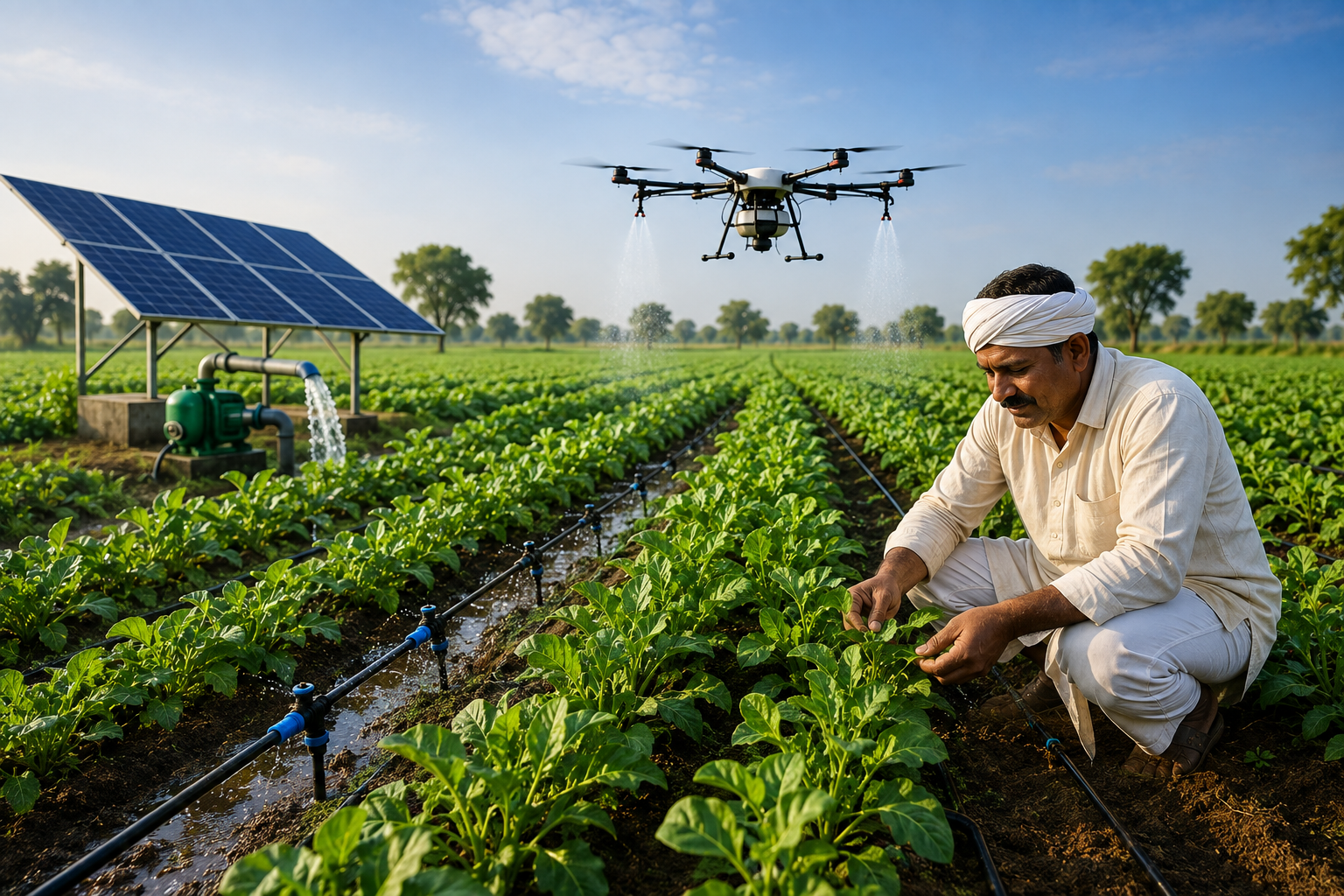
Rural youth can also become important drivers of modern agribusiness through drone services, precision farming, digital marketing, agri-e-commerce, machinery services, food processing, data management and agritech startups.
Sustainable and Climate-Resilient Enterprises
The future of agribusiness must balance profitability with environmental responsibility.
Rural enterprises can adopt efficient water use, renewable energy, soil conservation, recycling, circular agriculture, reduced food loss and sustainable packaging.
Agricultural waste can also become an economic resource:
- Crop residue → Animal feed
- Animal manure → Biogas or organic fertilizer
- Food-processing waste → Compost or bio-based products
Climate risks such as droughts, floods, heat waves and pests make diversification, water conservation, insurance, storage and climate-resilient production increasingly important.
What Rural Enterprises Need
For rural enterprises to grow, several elements need to work together:
Farmers + Entrepreneurs + Extension + Research + Finance + Technology + Markets + Government
Research provides innovation, extension services provide knowledge, finance provides capital, technology provides new tools, markets provide demand and government provides policy support.
However, rural enterprises still face challenges including limited access to finance, infrastructure gaps, market volatility, climate risks, skill shortages and weak bargaining power.
Conclusion
Global agribusiness offers a pathway for transforming agriculture from primary production into a broader economic system based on value addition, entrepreneurship, technology, employment and sustainable rural development.
The future will increasingly combine agriculture with artificial intelligence, digital marketplaces, precision farming, digital finance, traceability, climate-smart practices and circular business models.
The strongest rural enterprises will be those that combine local knowledge with modern technology, finance, skills and market connections.
Sources / References
- Goldsmith, A. A. (1985). The private sector and rural development: Can agribusiness help the small farmer? World Development, 13(10–11), 1125–1138.
- Wortman, M. S. Jr. (1990). A unified approach for developing rural entrepreneurship in the US. Agribusiness, 6(3), 221–236.
- Nakasone, E., Torero, M., & Minten, B. (2014). The power of information: The ICT revolution in agricultural development. Annual Review of Resource Economics, 6, 533–550.
- Aker, J. C., Ghosh, I., & Burrell, J. (2016). The promise (and pitfalls) of ICT for agriculture initiatives. Agricultural Economics, 47(S1), 35–48.
- Ma, M., & Sexton, R. J. (2021). Modern agricultural value chains and the future of smallholder farming systems. Agricultural Economics, 52(4), 591–606.
- Sharma, J. P., & Bhatt, A. (2022). Role of agri-business entrepreneurship, innovation and value chains/networks in farmer income improvement. Indian Journal of Agricultural Economics, 77(1), 120–132.
- Garima, Dhingra, A., Centobelli, P., & Cerchione, R. (2023). Factors and activities considered by first generation agripreneurs for agri-business sustainable development. Sustainability, 15(9), 7109.
Contributors
Deepika Verma
Ph.D. Scholar, Department of Agricultural Economics
Sri Karan Narendra Agriculture University, Jobner
Rudrakshi Durga Thilak
DBA Candidate, Rushford Business School, Lucerne, Switzerland