India’s Automobile Market Is Growing—But Liquidity Will Decide Who Scales
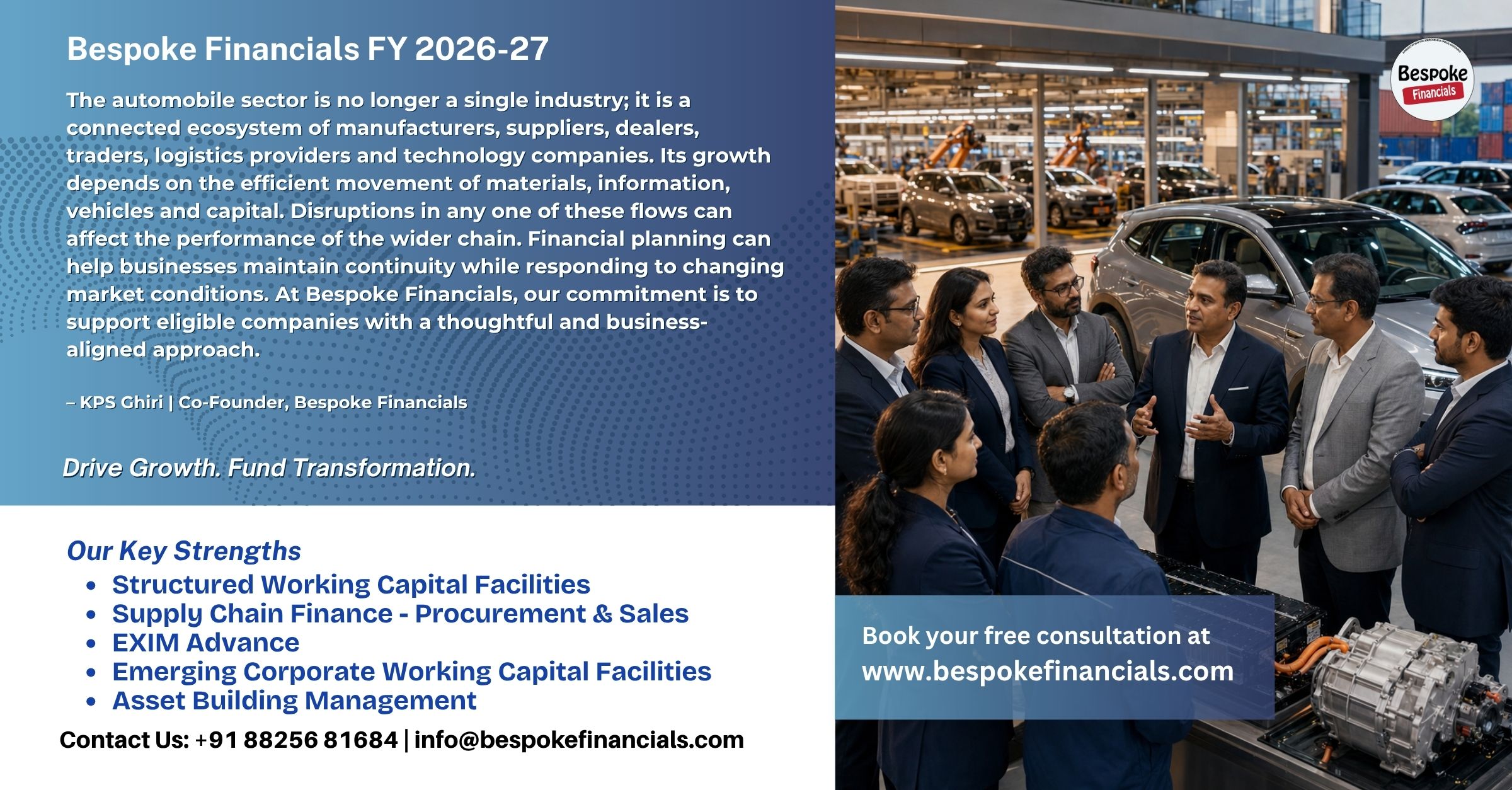
# India’s Automobile Sector Faces a New Liquidity Test
## Working-Capital Challenges from FY 2023–24 to FY 2025–26 and Suitable Financial Facilities for FY 2026–27
India’s automobile industry has entered FY 2026–27 with strong operating momentum, expanding domestic demand, rising exports and accelerated investment in electric mobility. However, higher sales volumes do not automatically translate into stronger cash flows. Manufacturers, auto-component suppliers, dealers, distributors, traders and exporters continue to manage a difficult time gap between procurement, production, inventory holding, invoicing, shipment, customer delivery and payment realisation.
The past three financial years have demonstrated that working capital is no longer merely a routine borrowing requirement. It has become a strategic factor determining whether automobile businesses can accept larger orders, maintain production continuity, fund technology upgrades, support dealers, manage inventory and participate in global supply chains.
## FY 2023–24: Recovery, Normalisation and Supplier-Side Pressure
FY 2023–24 was characterised by the gradual normalisation of production and demand after a period of supply-chain disruption and uncertainty. Vehicle manufacturers and component suppliers worked to restore production schedules, secure critical inputs and respond to changing customer preferences.
Auto-component companies faced pressure from fluctuating steel, aluminium, copper, rubber, electronics and energy costs. Many suppliers were required to maintain production readiness and inventory buffers even when customer payment cycles remained extended. Tooling, moulds, dies, testing systems and product-development costs also increased for businesses seeking new OEM programmes.
The financial challenge was particularly significant for MSME and mid-market suppliers. They often had confirmed demand and technically strong operations but limited collateral, modest net worth and restricted access to flexible finance. As a result, the increase in business activity frequently created additional borrowing requirements before it generated equivalent cash inflows.
## FY 2024–25: Demand Growth, Export Expansion and Rising Capital Intensity
During FY 2024–25, India’s automobile industry continued to grow, supported by infrastructure activity, replacement demand, new-model launches, vehicle financing and improving export opportunities. SIAM reported 7.3% growth in domestic vehicle sales and 19.2% growth in exports during the year. Passenger-vehicle demand was increasingly influenced by utility vehicles and feature-rich models, while component suppliers faced rising expectations relating to quality, technology and delivery reliability. [SIAM FY 2024–25 performance](https://www.siam.in/pressrelease-details.aspx?mpgid=48&pgidtrail=50&pid=579)
Growth created multiple working-capital pressures. Manufacturers had to procure materials and maintain production capacity ahead of collections. Dealers required additional inventory funding for new models and seasonal demand. Exporters had to finance production, documentation, freight and shipment periods before receiving foreign-currency proceeds.
The shift towards electric vehicles also began to change the funding profile of the industry. Businesses needed capital for battery systems, motors, power electronics, charging equipment, software integration, safety testing and specialised skills. These investments generally involve a longer commercialisation period than traditional inventory financing.
## FY 2025–26: Record Volumes but Uneven Cash Conversion
FY 2025–26 was a landmark year for the Indian automobile industry. SIAM reported the highest-ever annual sales across passenger vehicles, commercial vehicles, three-wheelers and two-wheelers. Passenger-vehicle sales reached approximately 46.43 lakh units, commercial-vehicle sales 10.80 lakh units, three-wheelers 8.36 lakh units and two-wheelers 2.17 crore units. Vehicle exports also recorded strong growth across several categories. [SIAM FY 2025–26 performance](https://www.siam.in/pressrelease-details.aspx?mpgid=53&pgidtrail=50&pid=605)
Nevertheless, the financial impact was not uniform across the value chain. Larger manufacturers benefited from scale and multiple funding channels, while dealers, component suppliers and smaller exporters continued to face pressure from inventory, receivables and procurement cycles.
SIAM noted that growth in FY 2025–26 was stronger in the second half of the year, supported by improved affordability, lower financing costs, policy measures and new-model activity. Such changes can create sudden funding requirements for inventory, supplier payments, production ramp-up and dealership expansion. At the same time, geopolitical uncertainty, commodity prices, fuel costs, exchange-rate movement and shipping disruptions remained important risks.
The beginning of FY 2026–27 has continued to show strong momentum. SIAM reported high growth across vehicle categories in the first quarter, including 25.9% growth in passenger vehicles, 20.3% in two-wheelers, 29.7% in three-wheelers and 18.3% in commercial vehicles compared with Q1 of FY 2025–26. [SIAM Q1 FY 2026–27 performance](https://www.siam.in/news-%26-updates/press-releases/auto-industry-sales-performance-of-june-2026-and-q1-apriljune-2026/610)
The central financial lesson is clear: strong demand can increase the need for liquidity faster than cash is generated.
## Major Working-Capital Challenges Faced by the Automobile Sector
### 1. Extended Receivable and OEM Payment Cycles
Auto-component manufacturers frequently incur costs for raw materials, labour, energy, quality control, packaging and logistics before receiving payment from OEMs or institutional customers. A delay in certification, inspection, debit-note settlement or invoice approval can further extend the cash-conversion cycle.
For smaller suppliers, even a moderate extension in receivable days can affect salaries, vendor payments, statutory obligations and production continuity. Businesses with growing order books may therefore experience financial stress despite reporting higher revenue.
### 2. Raw-Material, Energy and Freight Volatility
Steel, aluminium, copper, rubber, plastics, chemicals, semiconductors and battery-related inputs can experience rapid price changes. Energy, freight, warehousing and fuel costs add further pressure.
A supplier operating under fixed-price or delayed price-reset arrangements may have to absorb higher input costs before revised pricing is approved. This directly affects margins and increases the amount of working capital required to fund each order.
### 3. Dealer Inventory and Model-Mix Risk
Automobile dealers must finance vehicles before retail sales and customer collections are completed. They also carry demonstration vehicles, spare parts, accessories and service inventory.
New-model launches, festive demand, regional preferences, changing powertrains and discounting can cause inventory to remain blocked longer than expected. A dealer may therefore require additional liquidity even when market demand is healthy, particularly when customer-finance approvals slow down or inventory shifts between models.
### 4. EV Transition and Technology Investment
The transition to EVs and connected mobility requires investment in new machinery, tooling, testing equipment, battery systems, software, charging infrastructure and skilled manpower. Existing suppliers may need to support both internal-combustion and electric platforms during the transition period.
The PM E-DRIVE framework, which has been extended until 31 March 2028, covers categories including electric two-wheelers, three-wheelers, buses, trucks, charging infrastructure and testing-agency upgrades. This creates opportunities, but also requires businesses to prepare financially for new product development and capacity creation. [Ministry of Heavy Industries – PM E-DRIVE extension](https://heavyindustries.gov.in/en/ministry-heavy-industries-extends-tenure-pm-e-drive-scheme-2-years-31-march-2026-31-march-2028)
### 5. Export, Import, Currency and Shipping Gaps
Exporters may need to fund production well before shipment and wait further for foreign-currency realisation. Importers may need capital for letters of credit, advance payments, customs clearance, transit periods and domestic inventory holding.
Currency movement, changes in freight rates, insurance costs, shipping-route disruptions and country-specific payment risks can increase the actual rupee requirement. Businesses expanding into new international markets should therefore evaluate the complete trade cycle rather than only the purchase order value.
### 6. Limited Collateral and Conventional Credit Constraints
Many automobile suppliers possess strong technical capability, customer relationships and order visibility but do not hold sufficient property or fixed assets to support conventional borrowing. Others may have high leverage because of earlier capacity expansion, delayed receivables or investments in tooling.
Traditional lending models may not fully recognise the value of confirmed orders, approved invoices, supply-chain relationships or recurring business cycles. This can leave growth-oriented companies underfunded at the precise time when they need to scale.
## Suitable Working-Capital Facilities from Bespoke Financials for FY 2026–27
Bespoke Financials approaches automobile-sector funding by examining the complete operating cycle—procurement, production, inventory, receivables, dealer movement, exports, imports, technology investment and repayment visibility. The following facilities may be suitable for eligible manufacturers, component suppliers, dealers, traders, distributors and exporters, subject to assessment, documentation, credit approval and applicable terms.
### Working Capital – Non-Asset-Based Facilities up to ₹20 Crore
These facilities can support raw-material procurement, production expenses, inventory holding, receivable gaps, supplier payments and daily operating requirements without relying exclusively on fixed-asset collateral.
### Supply Chain Finance Without Collateral up to ₹50 Crore
Supply-chain finance can be structured around eligible invoices, purchase orders, approved buyers, vendor transactions or receivable cycles. It may be suitable for component manufacturers and distributors supplying established OEMs, institutional customers or organised dealer networks.
### Export and Import Finance up to US$5 Million
Export and import finance can support pre-shipment production, post-shipment requirements, imported components, machinery, raw materials, letters of credit, supplier advances and the period between dispatch and export-proceeds realisation.
### Procurement Facility Backed by Bank Guarantee up to 270 Days
A bank-guarantee-backed procurement facility can assist companies undertaking bulk purchases, supplier procurement and order execution. The structure may help eligible businesses negotiate improved payment terms and align repayment with the expected business cycle.
### Working Capital Against Negotiable Instruments up to ₹20 Crore
Eligible businesses with short-duration negotiable instruments or receivable-backed requirements may explore liquidity against such instruments for temporary gaps, seasonal needs and specific execution cycles.
### Flexible-Repayment and Bullet-Repayment Working Capital
For confirmed orders, model launches, seasonal inventory, short-duration procurement or export cycles, flexible repayment structures may help align repayment with expected collections rather than imposing an unsuitable fixed repayment pattern.
### Traditional and Quick Capital
Traditional or quick capital may be considered for urgent procurement, supplier obligations, sudden order execution, inventory requirements, business continuity and time-sensitive expansion needs.
### Emerging Corporate Finance up to ₹15 Crore
Growing automobile companies with established operations, improving revenue and expansion plans may require structured finance before they qualify for large-corporate lending programmes. Emerging corporate finance can support capacity enhancement, working capital and strategic growth.
### Equity-Based Working Capital of ₹25 Crore and Above
Companies with substantial expansion plans, strong order visibility, technology investments or balance-sheet strengthening requirements may explore equity-linked or equity-based working-capital structures.
### Asset Restructuring with Additional Working Capital from ₹10 Crore and Above
Businesses carrying existing asset-related obligations may consider restructuring options that reorganise liabilities while creating additional liquidity for operations, technology upgrades, production expansion or recovery.
### Merchant Cash Advance for Transaction-Led Automotive Businesses
Aftermarket retailers, online auto-parts businesses, service networks, accessories companies and other enterprises with predictable transaction flows may explore merchant cash advance structures where suitable.
### Specialised Support for Allied and Rural-Mobility Businesses
Agri-trade finance may be relevant to businesses involved in rural mobility distribution, agricultural equipment channels or allied trading activities. Such facilities should be evaluated separately from core automotive manufacturing finance and aligned with the specific trade cycle.
## Why a Sector-Specific Financial Approach Matters
Automobile businesses do not all require the same type of funding. A component manufacturer may need receivable-linked finance, while a dealer may require inventory support. An exporter may need pre-shipment and post-shipment finance, whereas an EV supplier may require growth capital for tooling, testing and product development.
Bespoke Financials seeks to provide a business-aligned approach through:
* customised structuring based on operating cycles;
* consideration of non-asset-based and supply-chain-linked options;
* sector understanding across manufacturing, trading, dealerships and exports;
* faster evaluation of time-sensitive procurement and order requirements;
* reduced dependence on conventional collateral where suitable;
* repayment structures aligned with receivables, inventory movement and business cash flows.
The objective is not simply to arrange capital. It is to help eligible automobile businesses obtain a facility that is proportionate to their operating requirements and capable of supporting sustainable growth.
## Financial Readiness Priorities for Automobile Companies
Companies planning their FY 2026–27 growth should begin with a realistic cash-flow and funding assessment. Management teams should review:
1. monthly procurement and supplier-payment requirements;
2. customer-wise receivable ageing and collection patterns;
3. inventory days by model, component and location;
4. pending orders and expected production schedules;
5. tooling, machinery, EV and technology-investment needs;
6. export and import timelines, currency exposure and trade documentation;
7. existing debt obligations and repayment commitments;
8. collateral availability and alternative funding structures;
9. customer concentration and dependence on a single OEM or market;
10. peak-season, festive and model-launch requirements.
Early preparation can improve negotiation strength, reduce emergency borrowing and allow management teams to select facilities that support both continuity and expansion.
## Conclusion
India’s automobile industry has demonstrated strong resilience and substantial growth across FY 2023–24, FY 2024–25 and FY 2025–26. The sector is entering FY 2026–27 with significant opportunities in domestic mobility, rural demand, EVs, advanced components, localisation, exports and global supply-chain participation.
However, growth will remain capital-intensive. The businesses that succeed will be those that manage inventory carefully, protect margins, negotiate supplier terms, control receivables, invest in technology and arrange liquidity before operational pressure becomes critical.
Working capital should therefore be treated as a strategic growth instrument—not merely as emergency finance. Manufacturers, auto-component suppliers, dealers, distributors, traders and exporters seeking structured support may connect with Bespoke Financials for a confidential review of their FY 2026–27 requirements.