India’s Aviation Growth Story Needs a Stronger Working-Capital Backbone in FY 2026–27
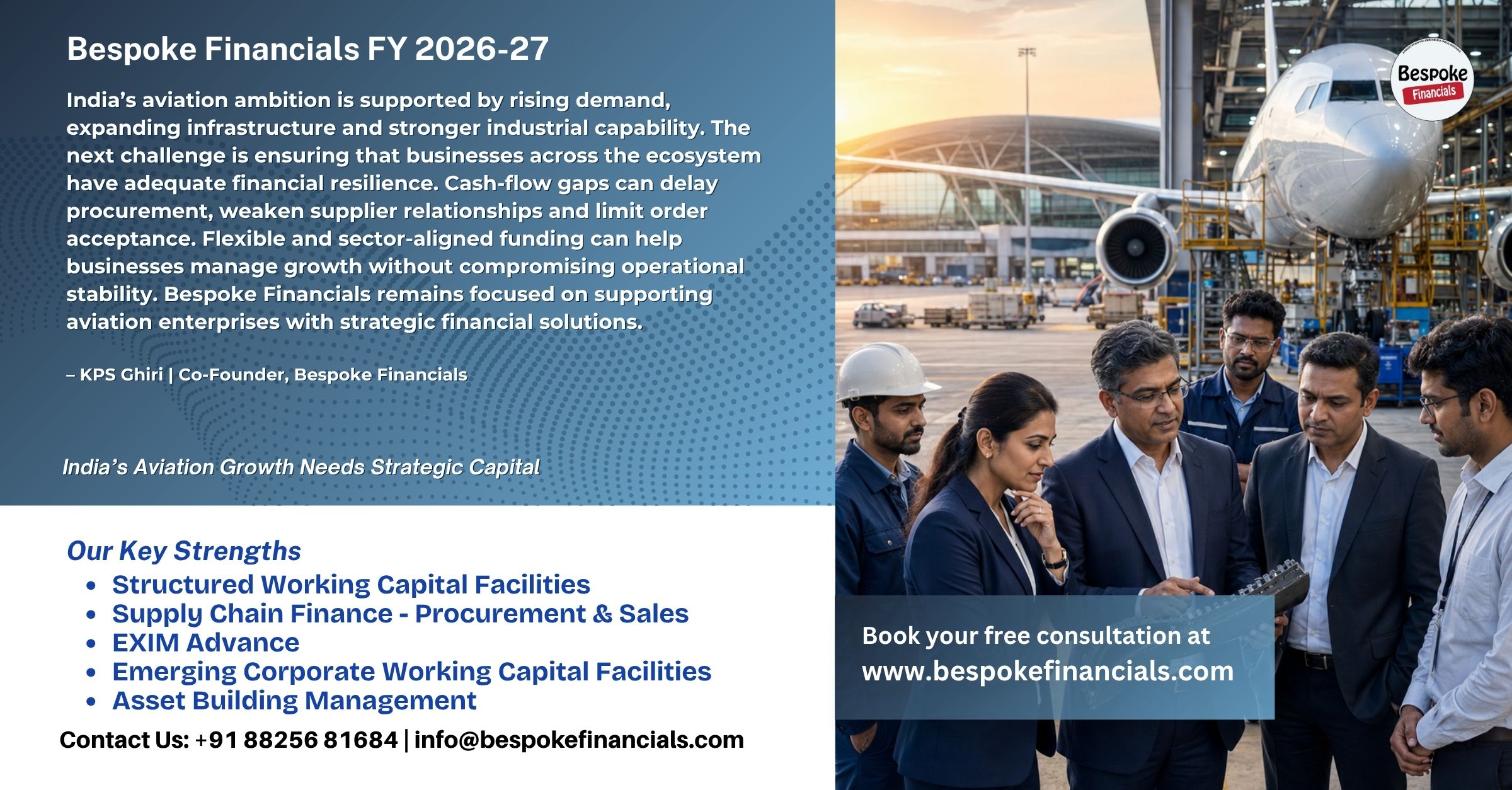
# India’s Aviation Growth Story Needs a Stronger Working-Capital Backbone in FY 2026–27
### After Three Years of Fuel, Forex, Fleet, Supply-Chain and Cash-Flow Pressure, Bespoke Financials Highlights Structured Working-Capital Solutions for India’s Aviation Ecosystem
**Chennai, August 2026:** India’s aviation sector is entering one of the most important phases in its development. Passenger demand is expanding, airlines are building larger fleets, airports are being modernised, regional connectivity is deepening, MRO capacity is gaining strategic importance, and Indian aerospace manufacturers are finding a larger role in global supply chains.
Yet the financial story behind this expansion is considerably more complex.
Aviation remains one of the most capital-intensive and globally exposed industries. Aviation Turbine Fuel (ATF), aircraft leases, imported components, engine maintenance, airport charges, insurance, foreign-exchange movements and long procurement cycles can materially affect operating cash flows. For manufacturers, traders, exporters, MRO companies and other aviation-linked enterprises, even a strong purchase order can require significant funding months before the corresponding receivable is collected.
The experience of the last three financial years—**FY 2023–24, FY 2024–25 and FY 2025–26—demonstrates why working capital has become a strategic requirement for the Indian aviation ecosystem rather than merely a banking facility.**
## FY 2023–24: Passenger Recovery Met Aircraft Groundings and Supply-Chain Disruption
FY 2023–24 represented a period of strong post-pandemic recovery in Indian aviation, but the improvement in passenger traffic did not eliminate financial pressure.
One of the biggest challenges was aircraft availability. Engine failures and global aerospace supply-chain constraints forced airlines to ground significant portions of their fleets. ICRA subsequently noted that **20–22% of the total industry fleet was grounded as of September 30, 2023**, with the situation worsening for some operators as Pratt & Whitney engine-related problems continued. Around 70 IndiGo aircraft were grounded by March 31, 2024, according to ICRA's sector assessment.
An aircraft on the ground creates an unusual working-capital problem: revenue generation stops or reduces, but several costs continue.
Airlines had to manage lease rentals, maintenance expenses, employee costs, airport commitments and replacement capacity. Additional aircraft taken through wet leases or short-term arrangements could also carry higher lease costs and sometimes lower fuel efficiency.
The effect travelled across the aviation supply chain.
MRO companies needed additional spares and components. Equipment suppliers had to hold inventory for longer. Component manufacturers faced uncertain delivery schedules. Ground-handling and airport-service providers had to align manpower and operational costs with changing airline capacity.
For smaller aviation vendors, one of the most difficult issues was that a confirmed order did not necessarily translate into an immediately available bank limit.
Thus, **FY 2023–24 demonstrated the difference between having business demand and having sufficient liquidity to execute that demand.**
## FY 2024–25: Growth Continued, But Scale Increased Funding Requirements
The following financial year brought healthier passenger volumes and a larger aviation ecosystem.
ICRA estimated domestic air passenger traffic at approximately **165.4 million in FY 2024–25, representing growth of about 7.6%**. The demand environment remained supportive and airline pricing power was comparatively steady.
However, higher traffic also required more aircraft, manpower, maintenance, airport services, fuel, inventory and supplier capacity.
ICRA's expanded airline sample subsequently estimated an industry net loss of approximately **₹55 billion, or ₹5,500 crore, for FY 2024–25**. This figure relates to the airline sample analysed by ICRA rather than the entire Indian aviation ecosystem.
Interestingly, average ATF prices during FY 2024–25 were around ₹95,181 per kilolitre, approximately 8% lower year-on-year. But fuel prices alone do not determine aviation profitability. Aircraft leases, maintenance and several other expenses remain linked to international currencies. ICRA estimates that fuel represents roughly **30–40% of airline expenses**, while around **35–50% of operating expenses—including fuel, aircraft leases and significant aircraft and engine maintenance costs—can be dollar-denominated.**
This means rupee depreciation can weaken cash flows even when passenger demand is growing.
For aviation-related MSMEs and emerging companies, FY 2024–25 also exposed another issue: growth itself consumes working capital.
An aerospace manufacturer winning larger orders may need to purchase aluminium, titanium, specialised alloys, electronic systems or certified components in advance.
An MRO supplier may need to maintain high-value inventory despite uncertain consumption dates.
An airport equipment manufacturer may incur fabrication, testing, installation and commissioning expenditure months before receiving its final payment.
An exporter may have to finance production, documentation, freight and shipping before receiving foreign-currency receivables.
Therefore, the stronger order books witnessed across parts of the aviation ecosystem were often accompanied by **larger cash-conversion cycles**.
## FY 2025–26: Slower Traffic Growth, Forex Pressure and Geopolitical Disruption
FY 2025–26 brought a different financial environment.
Domestic passenger growth moderated sharply. According to ICRA's July 2026 update, domestic passenger traffic reached approximately **167.4 million during FY 2025–26, representing only about 1.2% year-on-year growth**, while international passenger traffic carried by Indian airlines grew by about 3.9%.
Meanwhile, airline financial pressure increased materially.
ICRA estimated airline-industry net losses of approximately **₹170–180 billion—₹17,000–18,000 crore—for FY 2025–26**, reflecting slower passenger growth, rising aircraft deliveries, operational disruption and foreign-exchange losses.
The weakening rupee increased the burden of dollar-linked aircraft leases, imported parts, engine maintenance and other international obligations.
The West Asian geopolitical conflict added another dimension toward the end of FY 2025–26. Airspace restrictions affected international operations, leading to cancellations and longer routes in certain markets while increasing fuel consumption and operational expenses. ICRA consequently changed its outlook on the Indian aviation industry from **Stable to Negative in March 2026**.
Supply-chain constraints also continued. ICRA reported that **99 aircraft belonging to select airlines remained grounded as of March 2026**, representing approximately 11–13% of the industry fleet covered by its assessment. Although this was an improvement from the 20–22% level recorded in September 2023, it continued to create leasing, maintenance and operational-cost pressure.
The financial lesson from FY 2025–26 is particularly important:
**Revenue growth cannot substitute for liquidity planning.**
A company can have passengers, orders, contracts, confirmed projects and strong customers—and still experience financial stress when expenditure occurs substantially earlier than cash realisation.
## FY 2026–27: The Working-Capital Challenge Has Not Disappeared
The current financial year has begun with both opportunity and caution.
ICRA estimated domestic passenger traffic of approximately **42.93 million during Q1 FY 2026–27**, an increase of 2.3% year-on-year. However, international traffic of Indian carriers declined sharply during April–May amid West Asian disruptions. ICRA continues to maintain a **Negative outlook** on the industry and, as of July 2026, projected domestic passenger growth of 3–6% for FY 2026–27.
Fuel pressure has also returned. Domestic ATF prices in July 2026 were approximately **18% higher year-on-year**, according to ICRA.
Nevertheless, the long-term aviation opportunity remains significant.
Airbus projects India's commercial aircraft fleet above 100 seats to reach approximately **2,250 aircraft by 2035**, while India's MRO market could expand to approximately **US$9.5 billion**. Passenger traffic is projected to grow at an average annual rate of 8.9% over the period.
The challenge, therefore, is not the absence of growth.
**The challenge is financing growth without allowing the cash-conversion cycle to weaken the business.**
# Where Aviation-Related Companies Are Facing Working-Capital Gaps
Across airlines, aerospace manufacturing, MRO, airport infrastructure, cargo, ground handling, travel commerce and associated suppliers, recurring liquidity requirements include:
* advance procurement of approved raw materials and components;
* imported equipment and foreign-currency purchases;
* aircraft, engine and component maintenance expenditure;
* long OEM qualification and certification cycles;
* inventory dedicated to particular aircraft platforms;
* extended payments from airlines, airports and institutional customers;
* execution of large purchase orders before customer realisation;
* bank guarantees, performance guarantees and security deposits;
* tooling, testing, calibration and technology-upgrade expenses;
* manpower and payroll during project execution;
* export-production and shipment funding;
* logistics, freight and customs expenditure;
* and temporary mismatches between supplier payments and customer collections.
These characteristics are already identified as central financing constraints for aviation manufacturers and suppliers.
This is precisely why traditional collateral-driven finance may not always be sufficient for the sector.
# Bespoke Financials: Working-Capital Solutions for FY 2026–27
Bespoke Financials believes that aviation finance must be structured according to the **commercial cycle, rather than forcing every requirement into a conventional term-loan structure**.
For eligible Indian aviation-related manufacturing, trading, exporting and service enterprises, Bespoke Financials can evaluate and structure a range of working-capital facilities during FY 2026–27.
### 1. Non-Asset-Based Working Capital — Up to ₹20 Crore
Suitable for companies requiring liquidity for raw-material procurement, payroll, inventory, production expenses, project execution and receivable-cycle gaps without depending exclusively on additional property collateral.
This can be particularly relevant for aerospace component manufacturers, aviation equipment suppliers, MRO vendors and companies executing institutional orders.
### 2. Supply Chain Finance — Up to ₹50 Crore Without Collateral
Aviation is an anchor-driven industry.
Suppliers working with established airlines, airport operators, aerospace OEMs, MRO companies and large aviation institutions may possess strong receivables but insufficient collateral.
Supply-chain structures can help convert the strength of the commercial ecosystem into liquidity and reduce pressure created by extended customer-payment cycles.
### 3. Export & Import Finance — Up to US$5 Million
Aviation has significant international exposure.
Facilities can be evaluated for eligible businesses importing machinery, avionics, specialised components, raw materials and technical equipment or exporting aerospace products and engineering services.
The objective is to bridge the period between **procurement, production, shipment and final realisation of overseas receivables**.
### 4. Procurement Finance — BG-Backed Structures Up to 270 Days
Large aviation contracts may require substantial procurement before production or delivery begins.
A procurement structure supported by appropriate bank guarantees can potentially allow businesses to align supplier payments with longer contract cycles rather than immediately consuming internal cash resources.
### 5. Working Capital Against Eligible Negotiable Instruments — Up to ₹20 Crore
For eligible short-duration requirements, liquidity may be structured against acceptable negotiable instruments for periods extending up to approximately 10 months.
This can be useful where delivery has taken place or a defined commercial milestone has been achieved but actual payment remains pending.
### 6. Bullet-Repayment Working Capital
A conventional monthly amortisation schedule may not always suit aviation orders.
Where cash realisation occurs after inspection, certification, installation, export shipment or customer acceptance, suitable non-asset-based structures with **bullet repayment aligned to the underlying business cycle** may be evaluated.
### 7. Emerging Corporate Finance — Up to ₹15 Crore
Growing aviation suppliers can reach a stage where existing banking arrangements are no longer sufficient for their order book.
Structured emerging-corporate finance can support expansion, additional procurement, larger customer contracts and increasing operating requirements.
### 8. Quick and Traditional Capital
Time-sensitive orders sometimes require rapid procurement or operational expenditure.
Subject to eligibility and credit assessment, quick-capital structures can assist businesses facing immediate order-execution, inventory or supplier-payment requirements.
### 9. Equity-Based Working Capital — ₹25 Crore and Above
Companies undertaking substantial capacity expansion, technology investment, strategic scale-up or larger aviation programmes may require capital beyond ordinary short-duration debt.
Equity-linked or equity-based structures can be evaluated for eligible larger requirements.
### 10. Asset Restructuring With Additional Working Capital
Some established businesses possess valuable operating assets but their existing debt structure restricts access to fresh working capital.
For qualifying businesses, restructuring existing obligations together with additional working-capital support can help release liquidity for ongoing operations and future growth.
These facilities and indicative limits form part of the financing framework identified by Bespoke Financials for aviation-connected enterprises.
## Not More Debt—Better-Structured Capital
The central objective should not simply be to increase borrowing.
It should be to ensure that **the tenure, repayment pattern and facility structure correspond with the company's actual operating cycle**.
For example:
An aerospace component manufacturer purchasing certified material today against a receivable expected after six months requires a different facility from an airport retailer with daily digital collections.
An MRO company waiting for technical completion and customer acceptance needs a different cash-flow structure from an exporter receiving payment after shipment.
An equipment manufacturer executing a large airport order may require procurement finance, while an aviation supplier billing a financially strong anchor may benefit more from supply-chain or receivable-linked finance.
This ability to match **capital with the underlying commercial transaction** is becoming increasingly important in FY 2026–27.
# Financial Preparedness Will Determine Who Captures India’s Aviation Opportunity
India does not lack aviation opportunities.
The coming decade will require more aircraft, airports, hangars, MRO capacity, ground-support equipment, components, aerospace manufacturing, cargo infrastructure, technology, engineering services, trained personnel and specialised suppliers.
But every additional aircraft and every new airport connection creates an entire chain of financial obligations before revenue reaches every participant in that ecosystem.
For India's aviation-related MSMEs, suppliers, manufacturers, traders, exporters and emerging corporates, the question for FY 2026–27 is therefore no longer simply:
**“Do we have sufficient orders?”**
The more important question is:
**“Do we have sufficient and appropriately structured working capital to execute those orders profitably?”**
Bespoke Financials works with businesses to understand their procurement cycle, customer profile, receivable position, imports, exports, inventory, existing banking arrangements and growth requirements before identifying an appropriate financing structure. Its approach emphasises financing aligned with procurement, production, receivables and commercial repayment cycles.
As India's aviation ecosystem moves toward significantly greater scale, **financial agility may become as important as operational capability.**
Companies that prepare their working-capital limits before receiving the next major order will be better positioned than companies that begin searching for finance only after their internal liquidity has already been committed.
For FY 2026–27, this preparedness could make the difference between merely participating in India's aviation expansion and successfully scaling with it.
## About Bespoke Financials
Bespoke Financials provides customised working-capital and structured-finance solutions for eligible manufacturing, trading, exporting and emerging corporate businesses across India.
For aviation-related enterprises, the focus is on developing financing structures around procurement, production, supply-chain requirements, imports, exports, receivables, order execution and expansion rather than depending solely on conventional asset-backed lending.
### Connect With Bespoke Financials
Businesses engaged in **aviation components, aerospace manufacturing, MRO, ground-support equipment, airport supplies, aviation cargo, logistics, exports, imports, airport infrastructure and allied aviation services** may connect with Bespoke Financials to evaluate suitable working-capital options for FY 2026–27.