India’s Industrial Fabrics Sector Enters a New Growth Phase Driven by Infrastructure, Exports and Working Capital Readiness
India’s Industrial Fabrics Sector Enters a Growth-Led Transformation Phase as Demand Rises Across Infrastructure, Logistics, Agriculture and Exports
India’s Industrial Fabrics sector is moving into a decisive phase of expansion, supported by rising demand from infrastructure, logistics, agriculture, warehousing, construction, packaging, commodity movement and export markets. Products such as tarpaulins, canvas fabrics, PP woven fabrics, laminated sheets, coated technical textiles, industrial covers, geotextiles, cargo covers and protective packaging fabrics are increasingly becoming essential inputs for India’s industrial and trade ecosystem.
The sector, once viewed mainly as a utility-led textile category, is now gaining strategic relevance as India strengthens its manufacturing, logistics and technical textile capabilities. Industrial fabrics play a critical role in protecting goods, supporting transport, enabling storage, improving packaging efficiency and serving specialized applications across agriculture, infrastructure and exports.
The broader textile industry remains an important pillar of India’s economy. According to government data, India is among the world’s leading textile exporters and the textile sector contributes significantly to GDP, industrial production and exports. The Government of India’s National Technical Textiles Mission has further strengthened the policy environment by focusing on research, market development, exports and skill development in technical textiles, with a stated mission outlay of ₹1,480 crore till 2025–26.
Industrial fabrics are also benefiting from the shift toward performance-based textile applications. Demand is no longer limited to basic coverings or packaging material. Buyers are increasingly seeking UV-resistant tarpaulins, reinforced covers, laminated PP woven fabrics, waterproof sheets, coated canvas, geotextiles, shade nets, protective industrial covers and customized technical textile solutions.
Market observers expect the next 2 to 4 quarters to remain opportunity-led for businesses with strong procurement systems, quality standards, inventory readiness and working capital discipline. Growth is expected from infrastructure execution, warehouse expansion, agricultural storage, export packaging, construction activity, transport movement and institutional buying.
However, the sector continues to face several operational and financial pressures. Manufacturers and traders are exposed to raw material price volatility in polymer granules, PP and HDPE yarn, coating compounds, lamination materials, pigments, packing inputs and freight. Exporters must also manage currency movement, shipping costs, documentation timelines, buyer payment cycles and destination-market compliance requirements.
Global trade realignments are creating both opportunity and risk for Indian exporters. As buyers diversify sourcing beyond single-country dependency, India has an opportunity to position itself as a reliable supplier of durable, cost-effective and customized industrial fabric products. At the same time, tariff shifts, sustainability requirements, route disruptions and freight volatility require exporters to strengthen documentation, product consistency and financial planning.
Working capital is therefore emerging as a critical growth factor for Industrial Fabrics companies. While demand may be available, businesses often require upfront liquidity for raw material procurement, seasonal inventory buildup, production, packing, freight, receivable gaps and export execution. Companies that approach finance only after orders arrive may lose valuable opportunities due to delayed approvals or inadequate structuring.
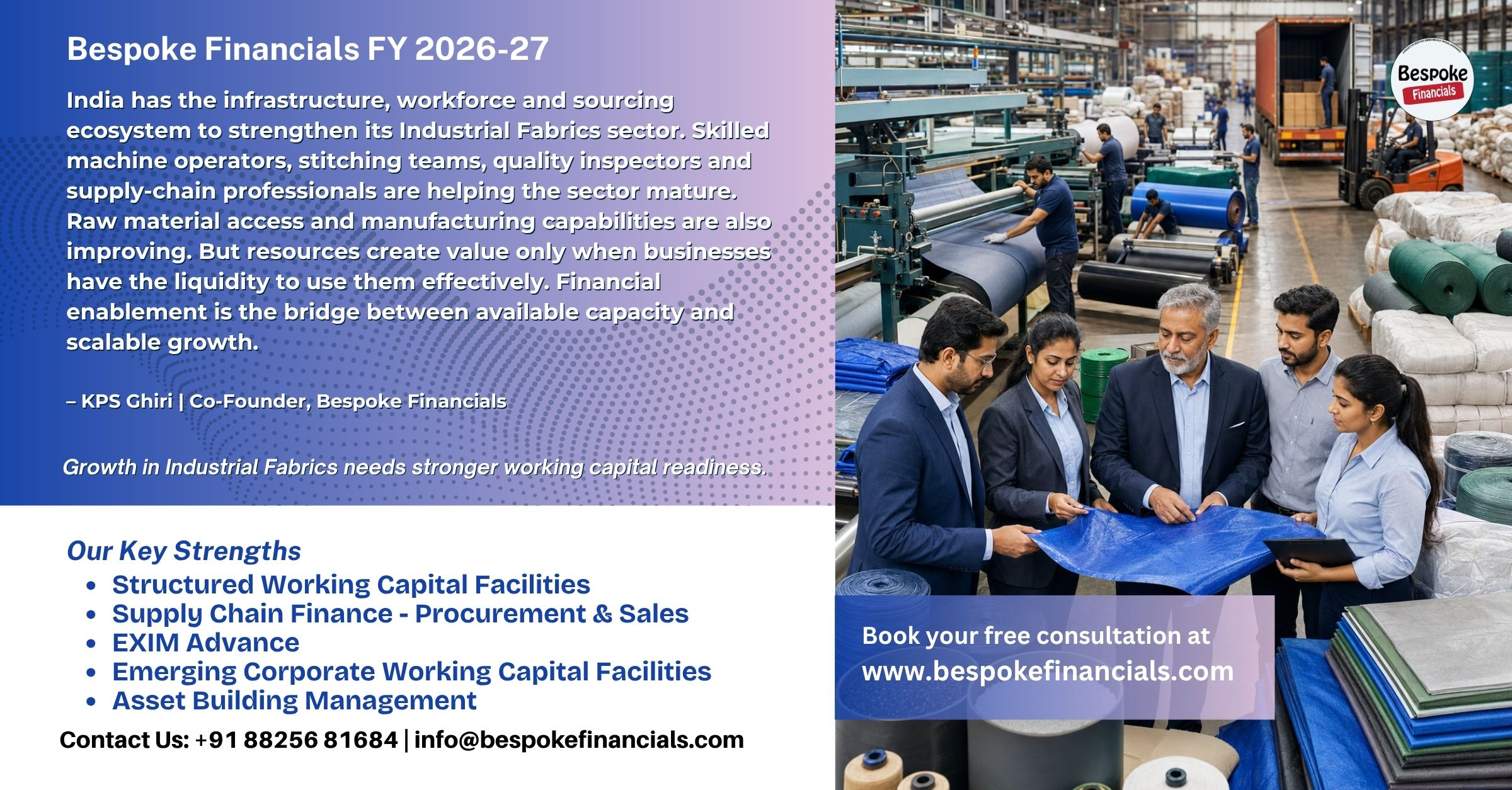
“Industrial Fabrics companies are no longer competing only on price or production capacity. They are competing on financial agility, inventory readiness, quality consistency and the ability to execute orders on time,” said KPS Ghiri, Co-Founder, Bespoke Financials. “For FY 2026–27, working capital should be treated as a strategic business tool, not merely as emergency funding.”
Financial service providers working with manufacturing, trading and exporting companies across India are increasingly focusing on sector-aligned working capital and growth finance solutions. For businesses in the Industrial Fabrics segment, including tarpaulin, canvas, PP woven, coated fabrics, packaging textiles and technical textile products, such solutions may support funding requirements linked to procurement, inventory, receivables, supply chain cycles, export-import transactions and expansion plans.
Relevant financing options in the sector may include working capital facilities, supply chain finance, export and import finance, procurement facilities, working capital against negotiable instruments, traditional or quick capital, emerging corporate finance and asset restructuring with additional working capital facilities, depending on the eligibility and requirements of individual businesses.
Industry examples during FY 2025–26 highlight the practical need for such support. A tarpaulin and coated fabric manufacturer facing seasonal demand required faster procurement of polymer inputs, yarn and coating materials. A PP woven fabric supplier serving institutional buyers faced delayed receivables while supplier payments remained immediate. An exporter of industrial covers and fabric rolls needed liquidity for pre-shipment expenses, freight and documentation. In each case, structured working capital helped improve procurement timing, supplier confidence, order execution and cash flow continuity.
The outlook for India’s Industrial Fabrics sector remains positive, but growth will depend on disciplined execution. Businesses that invest in product quality, organized warehousing, digital inventory systems, export documentation, supplier management and financial preparedness will be better positioned to capture domestic and global opportunities.
As India continues to strengthen its technical textile ecosystem, Industrial Fabrics companies have the opportunity to move from commodity supply to value-added manufacturing. The sector’s future will be shaped by durability, customization, sustainability, export readiness and working capital strength.
Manufacturing, trading and exporting companies in the Industrial Fabrics sector preparing for FY 2026–27 expansion, bulk procurement, export execution, receivable management or capacity enhancement may explore structured financial solutions aligned with their individual business cycles and requirements.