India Takes Community-Led Water Security Message to World Water Week 2026 in Stockholm
India Takes Community-Led Water Security Message to World Water Week 2026 in Stockholm
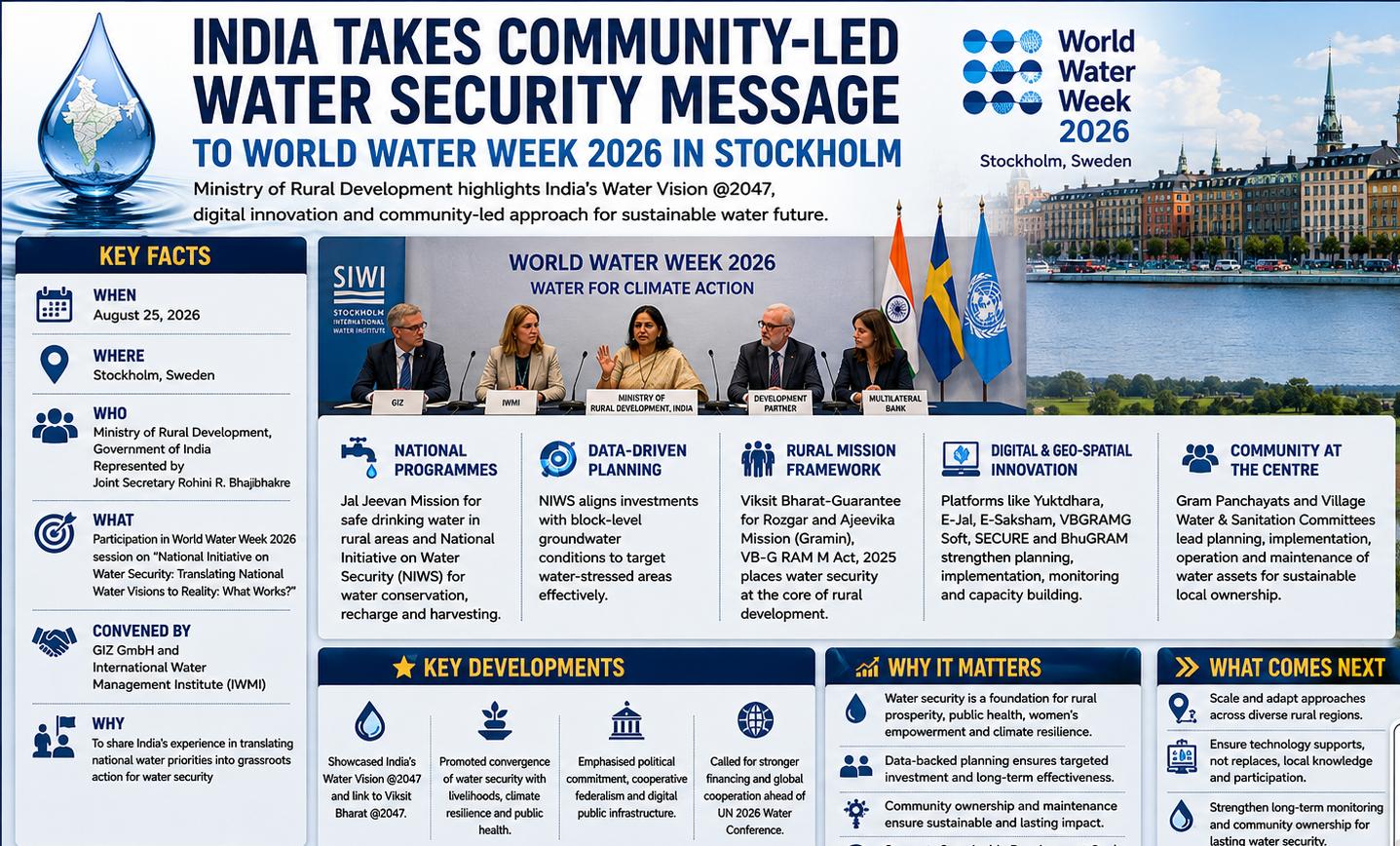
India has placed community participation, technology and data-driven planning at the centre of its global water-security message as the Ministry of Rural Development participated in World Water Week 2026 in Stockholm, Sweden. The participation on August 25 highlighted how India is linking rural development with water conservation, climate resilience, livelihoods and sustainable management of natural resources.
Representing the Ministry, Joint Secretary Rohini R. Bhajibhakre took part in a session titled “National Initiative on Water Security: Translating National Water Visions to Reality: What Works?” The session was convened by the Deutsche Gesellschaft für Internationale Zusammenarbeit (GIZ) GmbH and the International Water Management Institute (IWMI), providing a platform for India to share its experience in translating national water priorities into action at the grassroots level.
India’s Water Security Vision Takes Centre Stage
World Water Week, organised by the Stockholm International Water Institute (SIWI), brings governments, development organisations, researchers and practitioners together to discuss global water challenges and possible solutions. India used the forum to underline its Water Vision @2047, aligned with the broader Viksit Bharat @2047 objective of building resilient, inclusive and sustainable water security.
The Ministry presented water security not simply as a matter of infrastructure, but as an important foundation for rural prosperity, public health, women's empowerment, climate resilience and sustainable development.
India's approach combines national programmes with decentralised planning. The Ministry highlighted the Jal Jeevan Mission, which focuses on access to safe drinking water in rural areas, alongside the National Initiative on Water Security (NIWS), which supports water conservation, groundwater recharge, water harvesting and other water-related assets through scientific planning.
National Initiative Targets Water-Stressed Areas
A significant element of the Indian approach is the way NIWS seeks to align spending with local groundwater conditions. By considering groundwater conditions at the block level, the initiative can help direct water-related investments towards areas facing greater stress.
This data-oriented approach is intended to make public expenditure more targeted and transparent while improving the long-term effectiveness of water-security interventions. It also connects water conservation with wider rural-development objectives rather than treating water management as an isolated activity.
The Ministry also highlighted the Viksit Bharat-Guarantee for Rozgar and Ajeevika Mission (Gramin), or VB-G RAM G Act, 2025, under which water security is among the key areas of rural development intervention. The framework seeks convergence between employment generation, livelihoods, natural-resource management and the creation of durable community assets.
Technology Adds a New Layer to Rural Water Planning
Technology was another major component of India's presentation in Stockholm. The Ministry showcased digital and geospatial tools designed to make rural planning more evidence-based and transparent.
The Yuktdhara Geospatial Planning Platform uses geographic information system technology and remote sensing to support planning for rural development and natural-resource management. Meanwhile, the E-Jal application supports water budgeting at the Gram Panchayat level by bringing together information on water resources, rainfall, groundwater and population.
Digital platforms are also being used to strengthen implementation and capacity building. The E-Saksham Learning Platform supports knowledge development, while systems including VBGRAMG Soft, SECURE and BhuGRAM provide tools for implementation tracking, financial management and monitoring.
The wider objective is to move rural water planning from fragmented decision-making towards a system where local conditions, digital evidence and real-time monitoring can inform public investment.
Communities Remain Central to Water Security
Despite the growing role of technology, the Ministry stressed that successful water management ultimately depends on local participation. Gram Panchayats, Village Water and Sanitation Committees and communities have an important role in planning, implementing, operating and maintaining water-related infrastructure.
This community-led model is particularly significant because infrastructure alone cannot guarantee sustainable water security. Local ownership, social accountability and continued maintenance can determine whether water assets deliver benefits over the long term.
India's message therefore combined digital governance with grassroots participation, placing communities at the centre of decisions that directly affect their water resources.
India Calls for Stronger Financing and Global Cooperation
On August 25, Bhajibhakre also participated in a high-level panel on “Financing Water Resilience and Prosperity: Translating Commitments into Implementation and Sustainable Impact ahead of the UN 2026 Water Conference.”
The discussion brought together ministers, multilateral development banks, climate-finance institutions and development partners to consider ways of strengthening investment in water resilience and advancing the Sustainable Development Goals. India emphasised political commitment, cooperative federalism, digital public infrastructure and community-centred planning as important ingredients for converting financial commitments into lasting outcomes.
What Comes Next for India’s Water Security
India's participation in World Water Week 2026 places its rural water-security strategy within a wider international conversation about climate resilience, sustainable development and financing. The focus on groundwater-based planning, digital tools and community institutions could help strengthen how water investments are identified, implemented and monitored.
The next challenge will be translating these approaches consistently across diverse rural regions while ensuring that technology supports, rather than replaces, local knowledge and participation.
India's Stockholm engagement has therefore projected a clear message: lasting water security requires more than building assets. It depends on better data, smarter investment, strong local institutions and communities that have a meaningful role in managing their own water future.