Nepal Flash Flood Raises Fresh Concerns Over Warming Himalayas and Glacier Instability
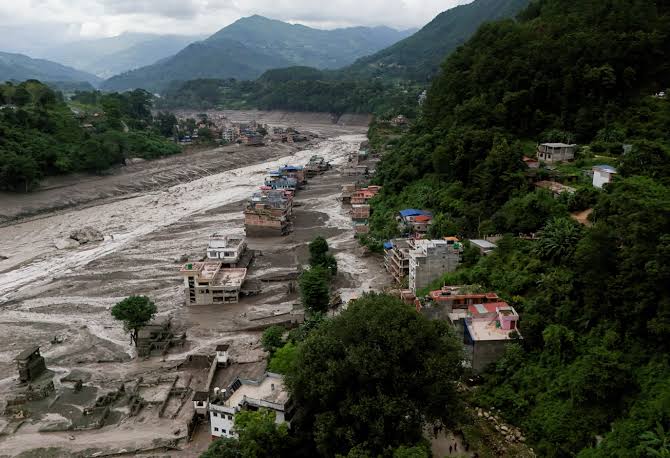
A devastating flash flood in Nepal’s Rasuwa district near the Nepal-Tibet border has brought renewed attention to the growing risks faced by the Himalayan region amid rising temperatures and changing weather patterns.
The massive flood struck the Bhote Koshi River region on Wednesday morning, sending a powerful surge of water, mud, rocks and debris downstream.
The areas of Timure and Syafrubesi were among the worst affected, while the flood also impacted the Trishuli River system and neighbouring areas.
According to reports, the disaster has claimed the lives of more than 157 people, with hundreds still reported missing.
What Triggered The Flood?
The precise sequence of events behind the disaster is still being investigated. Preliminary assessments based on satellite imagery, videos and reports from the affected region suggest that a large amount of ice and rock debris may have entered the Lende Khola, a tributary of the Bhote Koshi River.
The collapse reportedly generated a destructive mixture of meltwater, mud, rocks and debris, which rapidly travelled downstream. At Galchchi, the water level was reported to have risen by nearly nine metres within just 30 minutes, leaving little time for people to react.
Several bridges, roads and hydropower facilities were damaged or washed away.
Are Rising Temperatures Making Himalayan Glaciers More Unstable?
The Nepal disaster has renewed questions about the impact of global warming on the Himalayan cryosphere — the region's glaciers, snow and frozen ground.
Scientists have warned that rising temperatures are accelerating glacier retreat and contributing to the expansion of some glacial lakes.
As glaciers shrink and frozen mountain terrain becomes less stable, the risk of landslides, rockfalls, ice avalanches and glacial lake outburst floods can increase.
A Glacial Lake Outburst Flood (GLOF) occurs when water stored behind a natural glacial barrier is suddenly released. Such floods can send enormous volumes of water and debris into valleys within minutes.
The IPCC has previously reported that rising temperatures are increasing glacier melting in the Hindu Kush-Himalayan region and that the expansion of glacial lakes poses risks to downstream communities.
Why The Himalayas Are Particularly Vulnerable
Nepal's geography makes it highly exposed to mountain-related disasters. Steep slopes, glaciers, unstable terrain and intense monsoon rainfall can combine to create extremely dangerous conditions.
The Himalayan region is also often referred to as the “Third Pole” because its glaciers and snowfields store huge amounts of freshwater. Rivers originating in the Himalayas provide water to millions of people across South Asia.
Climate change is therefore not only a concern for mountain communities. Changes in glaciers, snowmelt and extreme rainfall can have consequences much farther downstream.
Climate Change: A Growing Risk, But Not The Only Factor
Experts caution that individual disasters cannot automatically be attributed entirely to climate change. Floods in the Himalayas can result from a combination of factors, including extreme rainfall, geological instability, landslides, glacier movement and changes in frozen terrain.
However, scientific assessments show that warming is altering the Himalayan environment. The IPCC has documented glacier shrinkage, increasing glacial-lake area and growing risks from glacier-related hazards across parts of Asia.
The Nepal flash flood has therefore become another warning about the vulnerability of communities living in high-risk Himalayan valleys.
As rescue and relief operations continue, scientists and authorities are likely to focus on determining exactly how the flood developed — and whether changing glacier and mountain conditions played a role in turning a natural hazard into a catastrophic disaster.