The 0.4% That Could Quietly Bring Cash Back
UPI MDR Change: What the 0.4% Merchant Fee Could Mean for Payments
“UPI karenge toh charge lagta hai. Cash hai toh cash de dijiye.” If such conversations become more common at checkout counters after October 15, they could signal a change in how some merchants respond to the new UPI Merchant Discount Rate (MDR) framework.
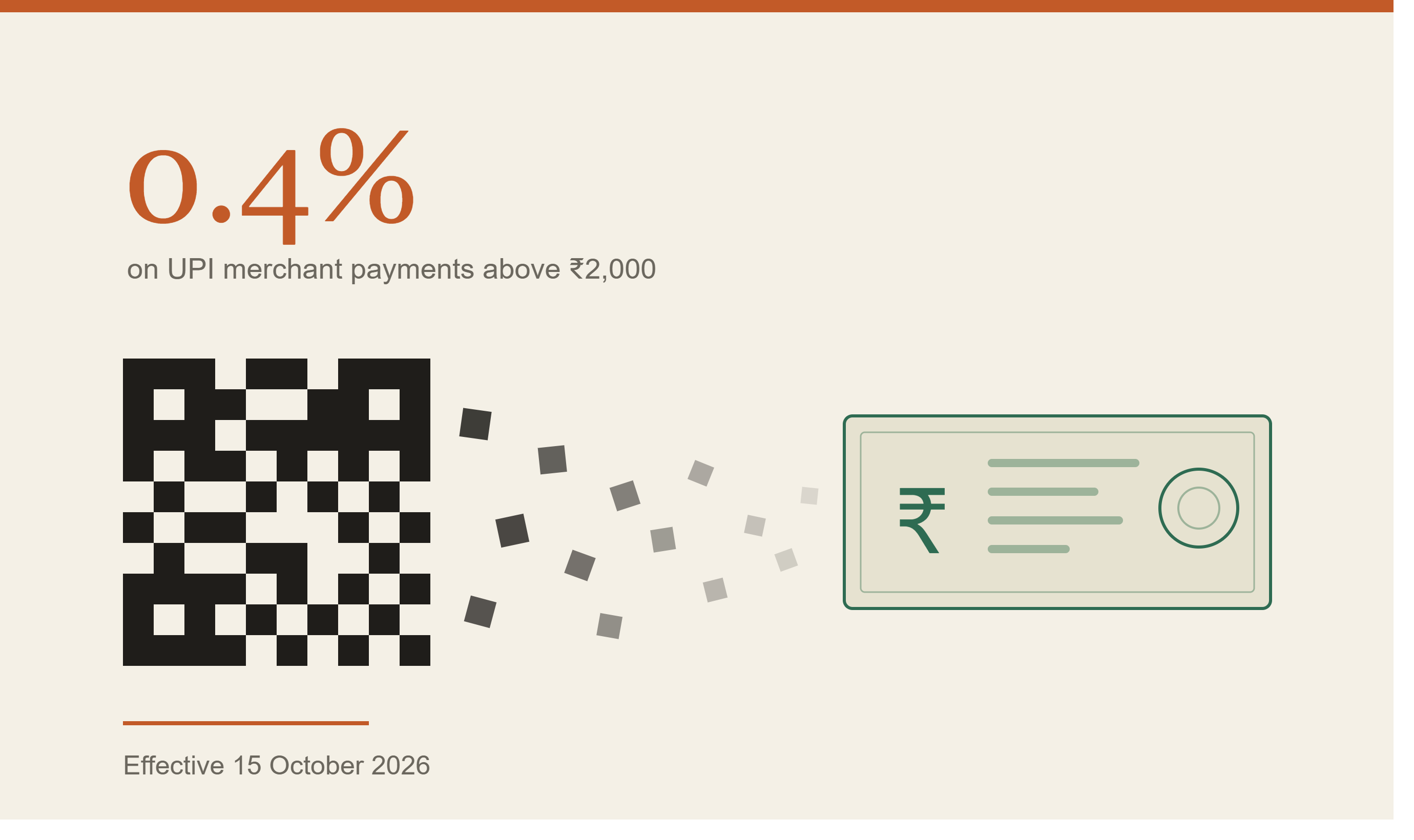
From October 15, 2026, a 0.4% MDR will apply to specified person-to-merchant (P2M) UPI transactions above ₹2,000, with the charge capped at ₹300 for transactions of ₹75,000 or more. The new framework does not apply to person-to-person transfers, which will remain free.
What has changed?
The change is narrower than a blanket UPI charge. Payments up to ₹2,000 remain free, while eligible small merchants receiving up to ₹1 lakh a month through UPI QR are covered by the zero-MDR framework. According to the government, around 96% of P2M transactions will remain unaffected.
Some essential-service categories will also have a lower flat MDR of ₹5 for qualifying transactions above ₹2,000. These include sectors such as railways, telecom, insurance and fuel. Capital-market transactions have a separate rate structure.
Who bears the MDR?
The MDR is a merchant-side charge rather than a fee directly imposed on consumers for making UPI payments. The government has advised banks to ensure that merchants do not pass the newly introduced charge on to customers.
For a ₹10,000 eligible transaction, a 0.4% MDR works out to ₹40. For ₹25,000 it would be ₹100, while a ₹50,000 transaction would attract ₹200. At ₹75,000 and above, the MDR is capped at ₹300.
The effect on individual businesses, however, will depend on their margins, transaction volumes and the way they manage payment-processing costs.
Where could the impact be visible?
Everyday low-value payments such as small grocery purchases, tea and other routine transactions are largely outside the new MDR framework. Transactions above ₹2,000 represent a smaller share of P2M transactions by volume but account for a much larger share of their value.
This means the impact could be more relevant for businesses that regularly handle higher-value UPI payments, including electronics, furniture, jewellery, wholesale trade and certain professional services.
Could merchant behaviour change?
Industry groups have raised concerns that additional payment costs could influence how some businesses accept or encourage different payment methods. Reuters reported that retailer organisations have warned the new MDR could encourage some merchants to consider cash transactions, particularly where profit margins are narrow.
However, the actual response is likely to vary. Some merchants may absorb the cost, while others could adjust payment preferences or pricing decisions within the applicable rules. These behavioural effects will become clearer after the framework takes effect.
The sustainability argument
Authorities have described the MDR framework as part of an effort to create a sustainable commercial model for the UPI ecosystem. The government has said the MDR is distributed among participants in the payments ecosystem rather than collected as a tax by the government or NPCI.
The introduction of MDR therefore changes an important part of the economics surrounding merchant payments, but it does not mean that UPI as a whole has become a paid service.
What to watch after October 15
The key question will be how merchants respond to the additional cost on eligible transactions. Payment preferences, merchant pricing practices and the use of cash or alternative digital payment methods will provide a clearer picture of the policy's practical impact in the months ahead.
For consumers, most everyday UPI payments will continue without a direct charge. For merchants handling higher-value transactions, however, the new MDR introduces a cost that was absent under the earlier zero-MDR framework.