THE ARABIAN SEA FRONT When Warships Collide, Bharat’s Maritime Power Matters
The Arabian Sea Front: What the India-Pakistan Naval Collision Reveals About Maritime Security
By DANDA NITI | The Science of Power
A war can begin with a missile. A crisis can begin with a miscalculation. And sometimes, a collision between two naval vessels can highlight the strategic importance of an entire region.
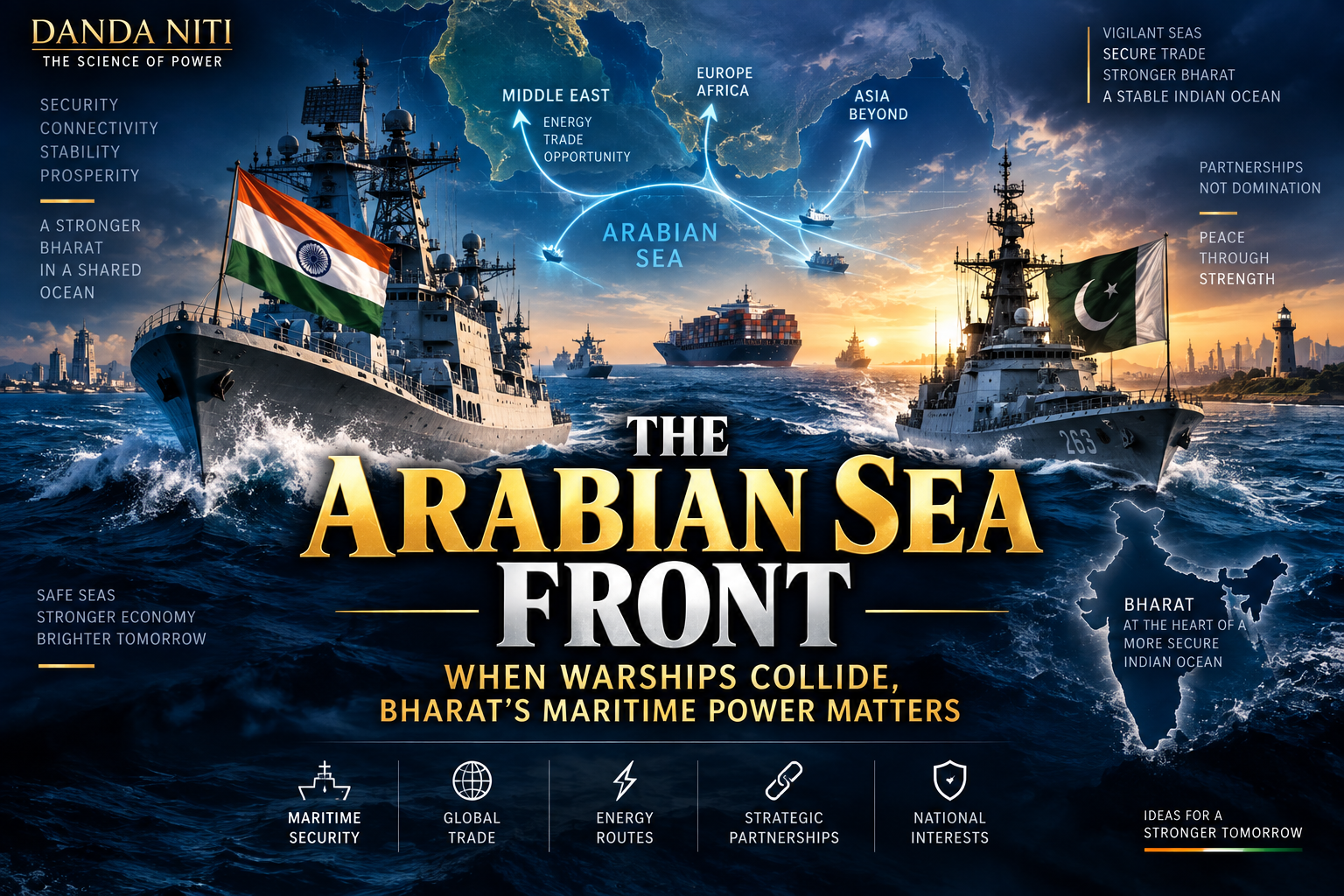
On September 15, 2026, an Indian Navy warship and Pakistan Navy's PNS Hunain were involved in a collision in the North Arabian Sea. Indian officials said the incident occurred in international waters and described the Pakistani vessel's conduct as unsafe and unprofessional. Pakistan disputed India's account and said the incident occurred within its Exclusive Economic Zone during a naval exercise. The responsibility for the collision therefore remains contested. Current reporting
Regardless of the competing accounts, the incident has drawn attention to the strategic importance of the Arabian Sea and the wider Indian Ocean for India.
Geography Is a Strategic Factor
India's location gives it a central position in the Indian Ocean. To the west lies the Arabian Sea, with maritime routes extending toward the Gulf, the Red Sea and connections between Asia, Europe and Africa.
These waters are important for energy supplies, imports, exports and international commerce. Maritime security therefore has implications beyond defence and can also affect economic security.
India has been developing maritime surveillance, naval capabilities, indigenous shipbuilding and cooperation with other Indian Ocean countries as part of its broader maritime-security approach.
The Importance of Maritime Domain Awareness
Modern maritime power depends not only on the number of ships or weapons available, but also on the ability to monitor and understand activity at sea.
Maritime Domain Awareness involves building a clearer picture of vessels, aircraft and other activities across a maritime area. India's Information Fusion Centre–Indian Ocean Region is part of the country's efforts to strengthen information-sharing and maritime awareness.
Better information can provide decision-makers with more time to assess developments and respond to emerging situations.
From Geography to Maritime Partnerships
India's maritime strategy also involves cooperation with other Indian Ocean countries. In 2026, India assumed the chairmanship of the Indian Ocean Naval Symposium (IONS). The second edition of the Indian Ocean Ship (IOS) SAGAR initiative involved naval personnel from 16 IONS countries and focused on training and maritime cooperation. Ministry of Defence
These developments illustrate how maritime security increasingly involves a combination of naval capabilities, coast-guard operations, ports, shipbuilding, surveillance, technology, diplomacy and international partnerships.
Together, these capabilities can contribute to India's broader maritime-security capacity.
The China Factor
The Arabian Sea cannot be viewed only through the India-Pakistan relationship. China also has economic and strategic interests across the Indian Ocean, while Pakistan is an important Chinese partner and Gwadar is located on the Arabian Sea.
Consequently, maritime competition in the region involves more than warships. Ports, logistics, shipping, energy infrastructure, surveillance capabilities, technology and regional partnerships can all influence the strategic environment.
What Could Strengthen India's Maritime Position?
The following points represent the author's analysis rather than announced government policy.
See First
India could continue expanding maritime surveillance and information-sharing capabilities to develop a comprehensive picture of activity across the Indian Ocean.
Respond Effectively
Maintaining the ability to respond rapidly to threats involving Indian interests, citizens or commercial activity can form an important part of maritime preparedness.
Protect Trade
Keeping major sea lanes secure is closely connected with the protection of energy supplies, imports, exports and wider economic activity.
Build Partnerships
Training, information-sharing, disaster response and maritime cooperation can strengthen India's relationships with other Indian Ocean countries.
Control Escalation
Maritime capability also involves preventing accidents and misunderstandings from developing into larger confrontations. Communication, professional conduct and adherence to established procedures are particularly important when naval vessels operate in proximity.
India has referred to the 1991 bilateral agreement with Pakistan, which includes provisions concerning separation between naval vessels operating in international waters. Pakistan disputes India's characterization of the September incident. The competing accounts underline the importance of established maritime procedures and communication between the two sides.
The Larger Maritime Lesson
The September collision does not by itself determine the broader balance of maritime power in the Arabian Sea. However, it highlights the importance of surveillance, professional naval operations, crisis management and regional cooperation.
India already possesses significant geographic advantages and has continued developing naval capabilities, indigenous shipbuilding, maritime surveillance and partnerships across the Indian Ocean.
The strategic challenge, from the perspective presented in this analysis, is to connect these capabilities effectively so that India can monitor its maritime environment, protect commercial interests, cooperate with regional partners and manage crises while limiting unnecessary escalation.
A warship is one component of maritime capability. A wider maritime network can combine ships, surveillance, logistics, technology, trade and partnerships.
The Arabian Sea does not belong to India. But its importance to India's security and economy makes sustained maritime awareness and preparedness strategically significant.
DANDA NITI
The Science of Power