WHAT DOES THE WORLD NEED FROM INDIA?
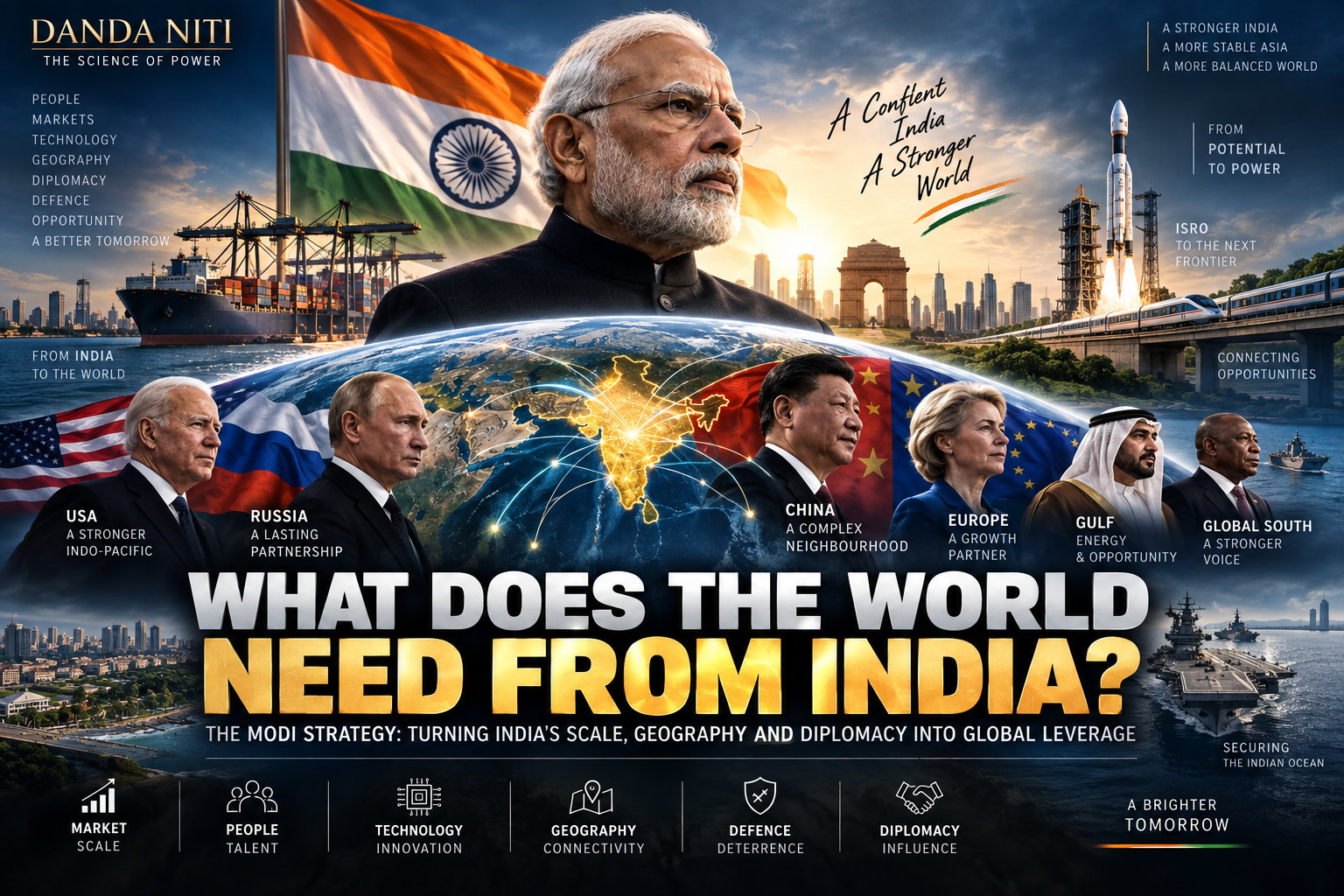
WHAT DOES THE WORLD NEED FROM INDIA?
The Modi Strategy: Turning India’s Scale, Geography and Diplomacy into Global Leverage
America, Russia, China, Europe and the Global South all want something from India. The strategic question is no longer what India can receive from the world—but what India can make the world value.
By DANDA NITI | The Science of Power
For Indian Press Union
There was a time when India's foreign-policy question was largely framed in one direction:
What does India need from the world?
Capital.
Technology.
Energy.
Defence equipment.
Foreign investment.
Markets.
That question was legitimate.
But India in 2026 presents a different strategic picture.
The question is no longer only what India needs.
It is increasingly:
What does the world need from India?
America wants resilient supply chains and a major Indo-Pacific partner.
Europe wants new markets, manufacturing capacity and technology partnerships.
Russia needs major economic relationships outside the Western system.
China cannot ignore the world's most populous country, one of its largest markets and a major power sitting across the Himalayas and the Indian Ocean.
The Gulf needs India's market, workforce and economic partnership.
The Global South increasingly looks to India for a larger voice in international institutions.
And multinational companies are looking at India as one of the places where future manufacturing and technology ecosystems can expand.
The evidence is already visible. In September 2026, US semiconductor-equipment company Applied Materials announced plans to invest $5 billion in India over the next decade, while more than 600 companies from 52 countries participated in SEMICON India.
This is not charity.
It is economics.
And economics, when combined with geography, technology, demographics, military capability and diplomacy, becomes strategic power.
THE FIRST SHIFT: FROM DEPENDENCE TO INTERDEPENDENCE
India does not live in a world where any major country can realistically become completely self-sufficient.
Neither can the United States.
Neither can China.
Neither can Europe.
Modern power is built through networks.
The strategic objective, therefore, should not be:
“India must need nobody.”
That is unrealistic.
The more practical objective is:
India should become important to many countries while remaining critically dependent on none.
That is a very different concept.
It means India should not simply ask:
“What can America give us?”
It should also ask:
“What does America gain by working with India?”
Not:
“What does Russia sell us?”
But:
“What does Russia gain by keeping India close?”
Not:
“What does China export to India?”
But:
“What does China need from the Indian market and from India's wider economic and geopolitical position?”
This is the beginning of strategic leverage.
AMERICA: INDIA IS MORE THAN A PARTNER
The India-US relationship is often described through what America can provide India:
technology, defence cooperation, capital and access to advanced ecosystems.
But there is another side.
India offers the United States:
* a massive consumer market;
* a large technology and engineering workforce;
* an expanding manufacturing base;
* a major Indo-Pacific partner;
* defence and security cooperation;
* supply-chain diversification;
* and a country capable of engaging simultaneously with the Global South and major powers.
Indian and US officials have publicly identified areas of complementarity including technology innovation, high-precision defence, digital data centres, quantum computing and medical devices.
India has also joined the Pax Silica initiative focused on secure semiconductor and advanced-technology supply chains.
The strategic calculation therefore changes.
India should not approach Washington simply as a country asking for technology.
India can negotiate as a country offering scale, talent, market access and strategic geography.
That is a stronger negotiating position.
EUROPE: THE NEXT ECONOMIC EQUATION
Europe is another example.
European companies need:
* new markets;
* reliable manufacturing locations;
* skilled workers;
* technology partnerships;
* resilient supply chains;
* long-term growth opportunities.
India offers all of these to varying degrees.
But India also needs something from Europe:
advanced technology, capital, industrial expertise and access to sophisticated markets.
That is not one-sided dependence.
It is mutual economic leverage.
India's defence establishment has explicitly promoted India as a long-term proposition for foreign industry, highlighting its expanding market, skilled workforce and evolving industrial ecosystem, while inviting co-development and co-production in niche technologies.
The opportunity is therefore not simply:
“Foreign companies manufacture in India.”
The larger ambition is:
“Foreign companies build technology, intellectual property, supply chains and global products with India.”
That difference matters.
RUSSIA: FROM CUSTOMER TO CO-DEVELOPER
India-Russia relations are frequently discussed through oil and defence.
But the relationship is considerably broader.
The two governments currently describe cooperation across:
* defence;
* energy;
* space;
* trade;
* mobility;
* skills;
* industrial cooperation;
* and people-to-people ties.
Russia also has a strong interest in maintaining India as a major economic and strategic partner.
That creates an opportunity for India.
The long-term objective should not simply be:
buy more from Russia.
It should increasingly be:
build with Russia.
Co-development.
Co-production.
Industrial partnerships.
Space.
Energy technology.
Advanced manufacturing.
If India can move from being primarily a customer to becoming a co-developer and co-producer, the relationship becomes more balanced.
That is how strategic autonomy becomes practical.
CHINA: THE MOST COMPLICATED EQUATION
Then comes China.
This is where geopolitics becomes particularly interesting.
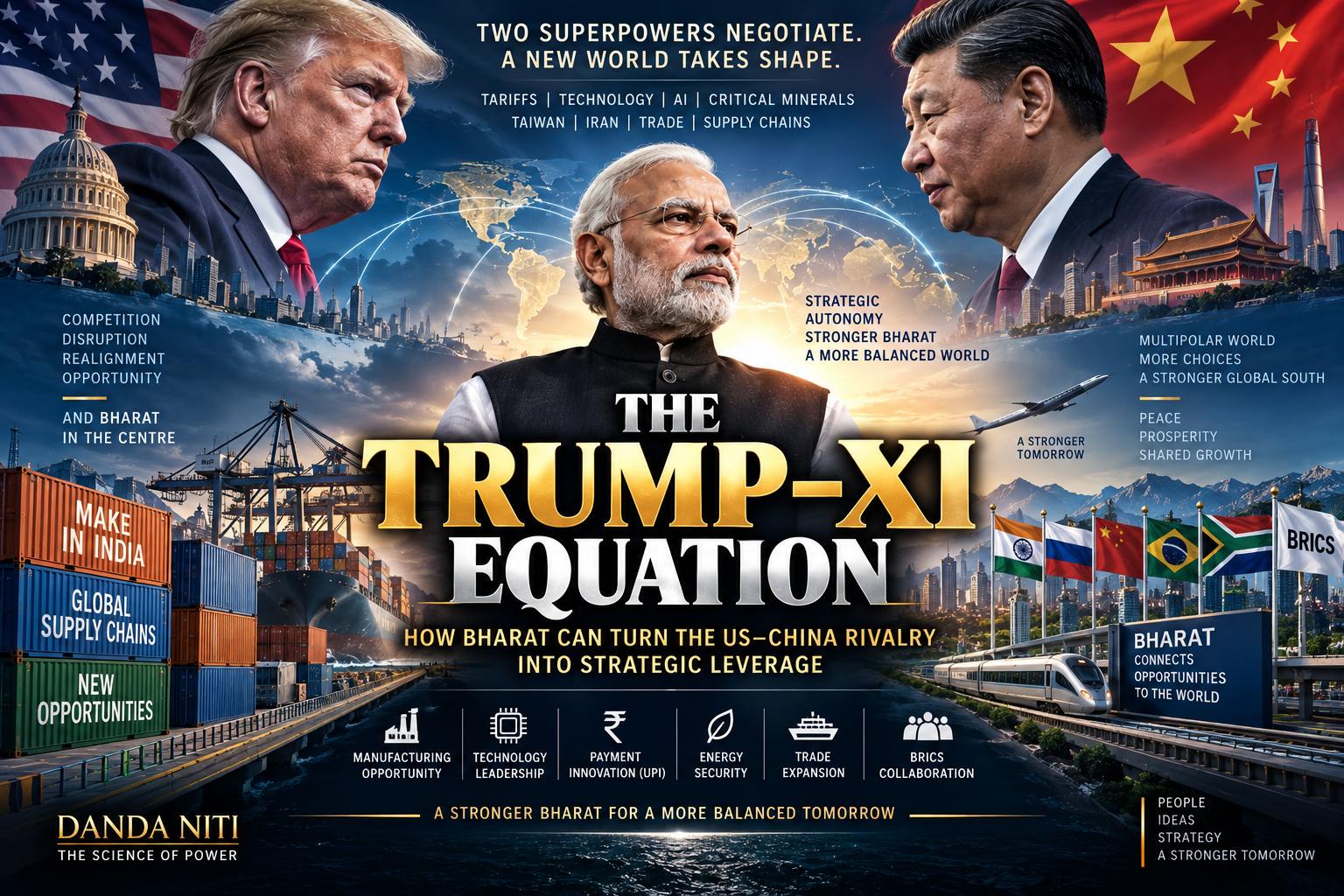
India and China remain strategic competitors.
The border remains unresolved.
The memory of the 2020 Galwan clash remains part of the relationship.
Yet bilateral trade reached approximately $155.6 billion in 2025, according to Reuters, with India's imports from China substantially exceeding its exports.
At the September 2026 BRICS Summit, Modi and Xi discussed border peace, business links, transport, market access, supply chains and the structural trade imbalance.
This creates an extraordinary paradox.
India needs to compete with China.
But China also has reasons to engage India.
Why?
Because India is:
a huge market,
a major economy,
a nuclear-armed state,
a major military power,
a BRICS member,
an important Global South voice,
and
a geographically critical Indian Ocean power.
Therefore, India's objective does not have to be to eliminate China's influence.
It can be more strategic:
Make India too important to ignore.
Competition can continue.
Security vigilance can continue.
But economic and diplomatic engagement can continue where India's interests are served.
That is not weakness.
It is statecraft.
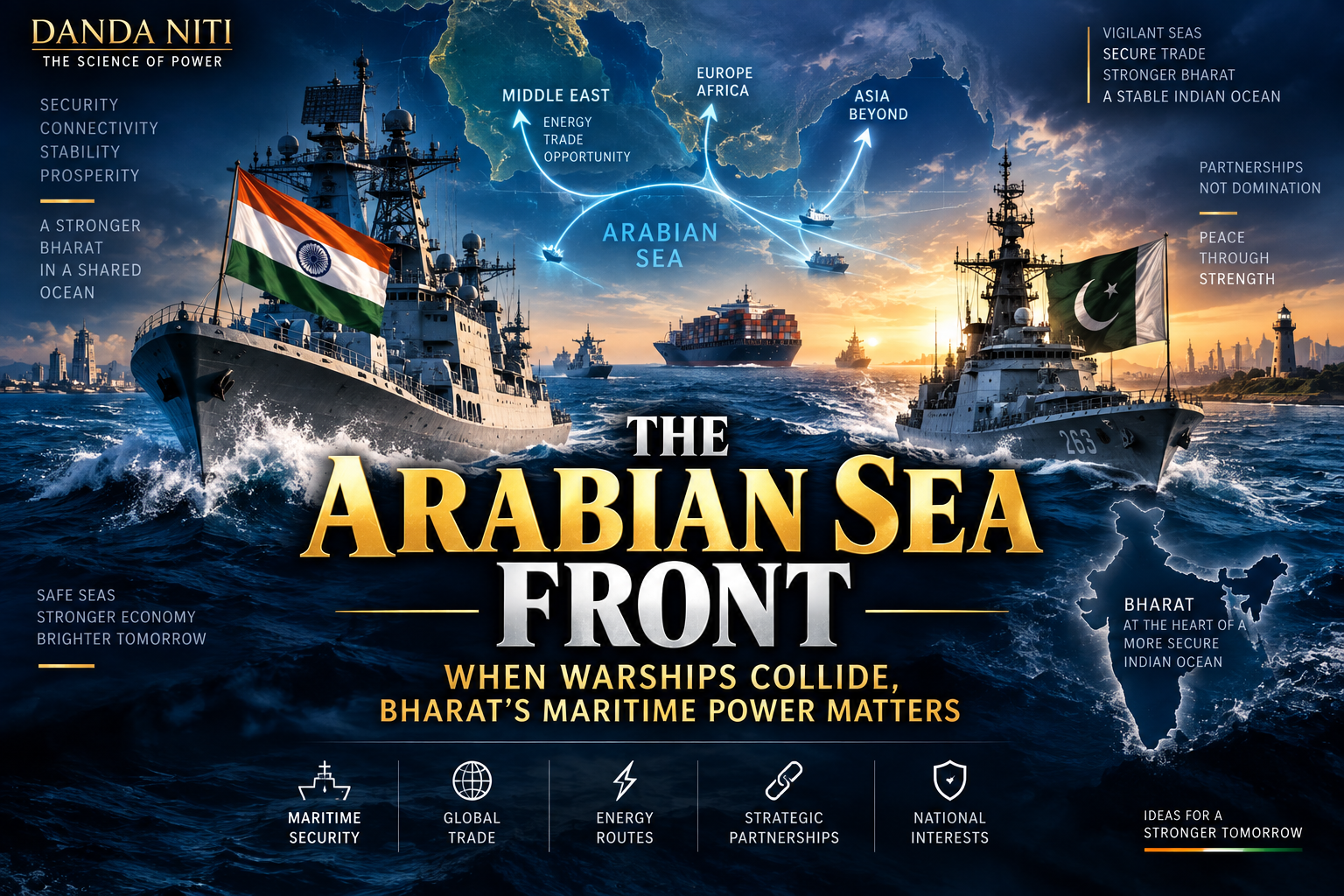
THE INDIAN OCEAN: INDIA'S GEOGRAPHY IS A STRATEGIC ASSET
There is one Indian advantage that no foreign investment can relocate.
Geography.
India sits astride the Indian Ocean, close to some of the world's most important maritime trade and energy routes.
That gives India potential influence over:
* maritime trade;
* logistics;
* ports;
* shipping;
* energy transportation;
* undersea infrastructure;
* regional connectivity;
* and Indo-Pacific security.
India's geography becomes even more valuable when combined with infrastructure.
A port by itself is infrastructure.
A port connected to:
railways + highways + manufacturing + logistics + digital networks + financial services + maritime security
becomes an economic system.
And an economic system becomes leverage.
India's policy institutions are increasingly examining precisely this opportunity: using trade, investment, logistics and digital infrastructure to position India as a hub connecting the wider Indian Ocean region.
The strategic lesson is simple:
Geography gives India an asset. Capability converts that asset into power.
THE GLOBAL SOUTH: INDIA'S DIPLOMATIC CAPITAL
India's influence is not restricted to relations with major powers.
There is another constituency:
the Global South.
During India's 2026 BRICS presidency, New Delhi pushed themes around inclusive global governance, multilateral reform and greater representation for developing countries. The expanded BRICS platform now includes major countries across Asia, Africa, the Middle East and Latin America.
This gives India an opportunity that goes beyond speeches.
India can export:
* digital public infrastructure;
* affordable pharmaceuticals;
* agricultural expertise;
* education;
* skills;
* disaster-response capabilities;
* development partnerships;
* fintech solutions;
* space applications.
If these capabilities are scaled internationally, diplomacy becomes more than summit meetings.
It becomes institution-building.
And institution-building produces durable influence.
THE MODI METHOD
Leadership matters.
One observable characteristic of India's current foreign-policy approach is the simultaneous pursuit of relationships with countries that themselves compete with one another.
Modi meets Putin.
India works with Washington on strategic technologies.
Modi meets Xi.
India participates in the Quad.
India works with Gulf countries.
India engages Iran.
India leads BRICS.
India works with Japan, Australia and Europe.
This is not one alliance replacing another.
It is a network.
The objective is to create multiple strategic options.
And that is where the role of India's foreign-policy establishment becomes important.
Prime Minister Narendra Modi provides leader-level political direction and diplomacy.
External Affairs Minister S. Jaishankar has become a prominent public communicator of India's strategic-autonomy approach.
The diplomatic corps negotiates.
The defence establishment provides military credibility.
Industry provides economic capacity.
Technology institutions provide strategic capability.
Entrepreneurs provide global reach.
In other words:
India's foreign policy is increasingly an ecosystem of state capacity, diplomacy, economics and technology—not simply a series of leader-to-leader meetings.
THE REAL STRATEGY: MAKE INDIA VALUABLE TO EVERYONE
This is where India's strategic opportunity becomes clear.
India does not need every major country to agree with it.
It needs every major country to have a reason to work with it.
America should see India as strategically valuable.
Russia should see India as economically and strategically valuable.
China should see India as too important to marginalise.
Europe should see India as a major economic and technology partner.
The Gulf should see India as a long-term economic partner.
The Global South should see India as a source of technology, development and diplomatic coalition-building.
That is how influence works.
Not through declarations.
Through interdependence.
BUT INDIA MUST BUILD POWER AT HOME
There is an important caution.
India's market alone does not create strategic autonomy.
Population alone does not create power.
Geography alone does not create power.
Diplomacy alone does not create power.
They become power only when converted into capability.
That means India must continue building:
Manufacturing
So that India becomes a producer, not simply a consumer.
Technology
So that India owns more critical intellectual property and value chains.
Defence production
So that military capability is increasingly backed by domestic design and manufacturing.
Energy security
So that external shocks do not become strategic vulnerabilities.
Infrastructure
So that India's geography can be monetised and strategically utilized.
Human capital
So that India's demographic advantage becomes productive capability.
Capital
So that Indian companies can scale globally.
This is why the semiconductor story matters.
Applied Materials' announced $5 billion India investment is significant—but Reuters also noted that India has not yet begun large-scale chip fabrication, showing both the opportunity and the remaining gap.
That is the honest story.
India has enormous capability.
But the next stage is converting capability into ownership of global value chains.
THE FIVE-PART POWER EQUATION
DANDA NITI can frame India's strategic position through five elements:
MARKET
India's scale creates commercial leverage.
GEOGRAPHY
The Indian Ocean gives India strategic location.
PEOPLE
Human capital creates technological and economic capacity.
DIPLOMACY
Multiple partnerships create strategic options.
CAPABILITY
Manufacturing, defence, technology and infrastructure convert potential into actual power.
And above these sits:
LEADERSHIP
Leadership can bring these assets together.
But leadership cannot substitute for national capability.
The two have to work together.
FROM “WHAT CAN INDIA GET?” TO “WHAT CAN INDIA OFFER?”
This is perhaps the most important shift.
The old diplomatic mindset asks:
What technology will they give us?
The new mindset asks:
What technology can we build together?
The old question:
Who will invest in India?
The new question:
What global value chains can India become indispensable to?
The old question:
Which country will support India?
The new question:
Why would that country want to lose India as a partner?
That is the psychology of a rising power.
THE WORLD DOES NOT HAVE TO LOVE INDIA
This is an important distinction.
Great powers do not build influence because everyone loves them.
They build influence because other countries need their participation.
India does not need America to abandon China.
India does not need Russia to abandon its other partners.
India does not need China to accept every Indian position.
India needs something more practical:
A world in which cooperation with India is more valuable than ignoring India.
That is leverage.
THE REAL MODI STRATEGY
If the current approach is viewed through this lens, the strategic objective becomes clearer.
It is not simply:
Choose America.
It is not:
Choose Russia.
It is not:
Confront China.
It is not:
Lead the Global South.
It is something broader:
Build enough relationships, capabilities and economic weight that India retains the freedom to choose.
That is strategic autonomy in practice.
And the next stage is even more ambitious:
Convert India's relationships into mutual dependencies—and convert those dependencies into bargaining power.
THE DANDA NITI CONCLUSION
The world is changing.
Supply chains are being redesigned.
Technology is becoming a strategic weapon.
Energy is becoming a geopolitical instrument.
The Indian Ocean is becoming increasingly important.
The Global South is demanding a larger voice.
And major powers are searching for partners they can trust.
India enters this environment with something rare:
scale.
geography.
human capital.
technology capability.
military weight.
economic potential.
diplomatic reach.
And an increasingly confident foreign-policy establishment.
But potential is not power.
Power is potential converted into capability.
And capability converted into leverage.
That is where India's next chapter will be decided.
America may need India's market.
Russia may need India's economic relationship.
China may need India's market and strategic engagement.
Europe may need India's growth and manufacturing potential.
The Gulf may need India's people, market and economic partnership.
The Global South may need India's voice and technological solutions.
But India's greatest strategic objective should be larger than becoming needed.
It should be becoming capable enough that its choices matter.
Because the strongest country is not the country that has no dependencies.
It is the country that has options.
And the country with options has leverage.
And the country with leverage has strategic autonomy.
That is the real test of India's rise.
Not whether the world applauds India.
Not whether one great power stands beside India.
But whether, when the major powers sit around the table, India's absence becomes impossible to ignore.
That is power.
That is statecraft.
That is DANDA NITI.
The Science of Power