THE TRUMP–XI EQUATION How Bharat Can Turn the US–China Rivalry Into Strategic Leverage
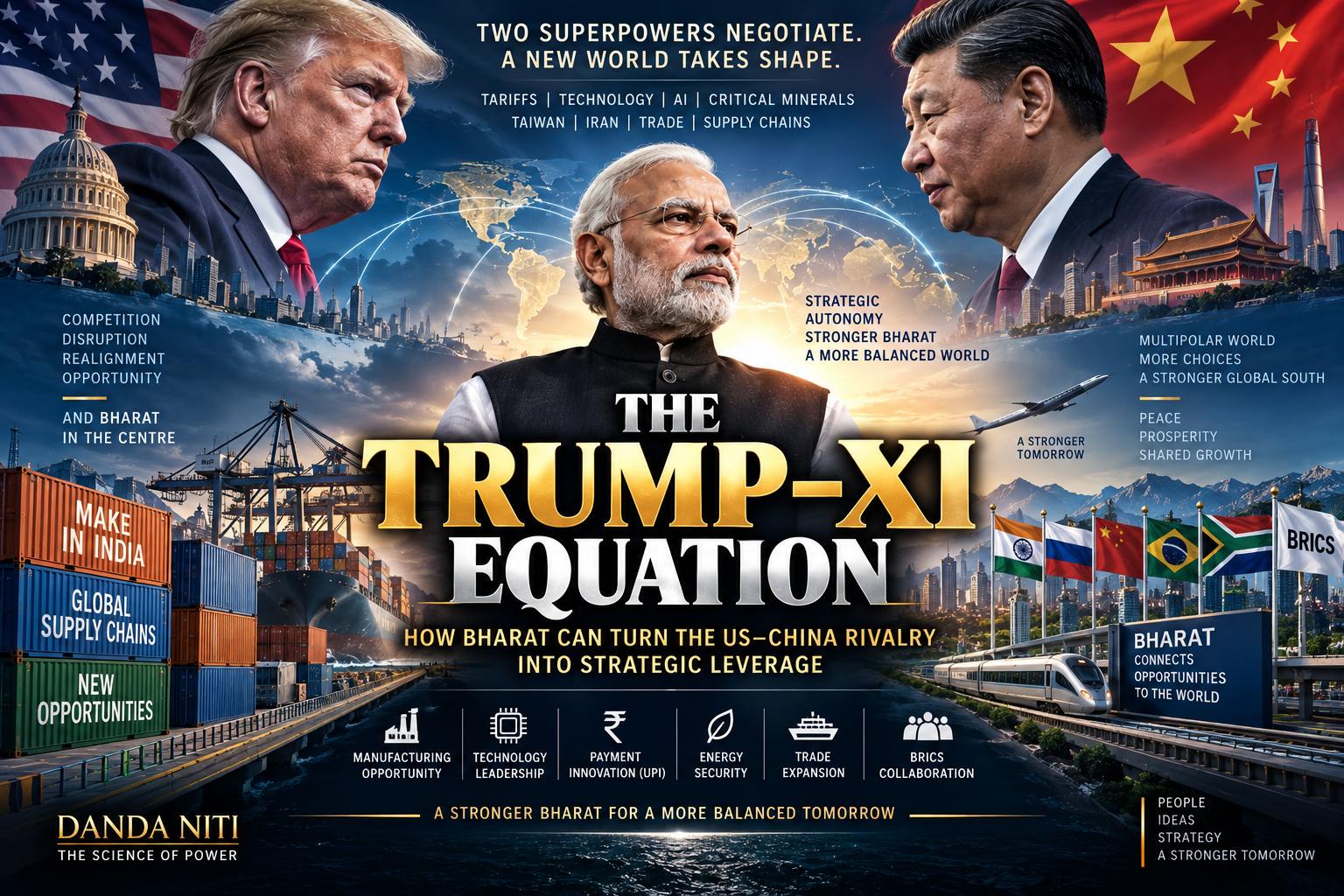
The Trump–Xi Equation: How India Could Use the US–China Rivalry as Strategic Leverage
By DANDA NITI | The Science of Power
On September 24, 2026, US President Donald Trump and Chinese President Xi Jinping are scheduled to meet in Washington. The meeting is expected to draw attention to trade, tariffs, technology, artificial intelligence and other areas of US-China relations. Recent reporting has also highlighted issues including rare-earth exports and AI cooperation.
For India, the significance of the meeting extends beyond the immediate US-China relationship. Changes in trade, technology and supply-chain policies between the world's two largest economies can affect other countries, including India.
India and the Changing Global Power Equation
India maintains relationships with the United States, Russia, China, the Gulf countries, Europe, Japan, Australia, Africa and other members of the Global South. It is also a member of BRICS and has economic, diplomatic and strategic interests across several major regions.
This combination gives India multiple channels through which it can pursue its economic and foreign-policy interests. The extent to which those relationships translate into strategic leverage, however, depends on India's economic capabilities, diplomatic choices and implementation of domestic policies.
The US-China Trade Relationship and India
The United States and China remain significant trading partners despite their strategic competition. According to the US Trade Representative, US goods and services trade with China totalled an estimated $494.6 billion in 2025. US goods imports from China were approximately $308.7 billion during the same year.
At the same time, tariffs, technology restrictions and supply-chain concerns have encouraged companies to examine manufacturing and sourcing alternatives. This creates potential opportunities for countries seeking a larger role in global production.
For India, converting such opportunities into sustained investment would depend on factors including manufacturing capacity, infrastructure, logistics, skilled labour, energy availability, technology and policy predictability.
India-China: Competition Alongside Economic Interdependence
India's relationship with China includes strategic competition, unresolved border issues and a significant bilateral trade relationship. The two countries have also maintained channels for diplomatic engagement aimed at managing tensions.
This means India's engagement with Washington does not automatically eliminate its need to manage relations with Beijing. Similarly, participation in BRICS does not by itself determine India's relationship with the United States or other Western economies.
From the perspective presented in this analysis, maintaining relationships with multiple major powers can provide India with greater diplomatic flexibility. The practical limits of that flexibility depend on specific issues and India's national interests.
Russia and the Wider Strategic Equation
Russia remains an important partner for India in areas including energy and defence. Russia also maintains a close relationship with China. India's relationship with Moscow, however, has its own history and interests and is not identical to China's relationship with Russia.
For India, diversification of energy sources, technology partnerships and trade relationships can reduce dependence on any single external source. The pace and effectiveness of such diversification would depend on economic and geopolitical conditions.
BRICS and the Search for More Economic Options
BRICS has expanded significantly in recent years. According to India's Ministry of External Affairs, the grouping currently represents around 49.5% of the global population and around 40% of global GDP.
BRICS cooperation includes discussions on economic and financial issues as well as wider areas of international cooperation. The grouping could provide additional avenues for trade, financial cooperation, development finance and other forms of economic engagement, although the extent of such integration remains dependent on decisions by individual member countries.
The potential objective for India need not necessarily be the creation of an alternative to the existing international financial system. Another possibility is greater diversification of trade, payment and settlement mechanisms.
India's Digital Payments Advantage
India's Unified Payments Interface has developed into a large-scale real-time payments system. NPCI data show that UPI processed 24.50896 billion transactions worth approximately ₹29.82 lakh crore in August 2026.
The scale of UPI has also generated discussion about its potential role in cross-border payment connectivity. Greater interoperability between national payment systems could, if implemented through appropriate agreements and safeguards, provide additional options for international payments and settlements.
Such developments would not necessarily require the creation of a common BRICS currency. They could instead involve greater use of existing national currencies and payment infrastructures where participating countries agree to such arrangements.
De-Dollarisation and the Dollar's Continuing Role
The growth of alternative payment and settlement mechanisms should not be equated with the collapse of the US dollar's international role.
According to the IMF's latest COFER data, the US dollar accounted for 56.77% of global official foreign-exchange reserves in the fourth quarter of 2025, while the Chinese renminbi accounted for 1.95%.
These figures indicate that diversification of international payments and reserves can occur alongside the continued importance of the dollar. The more measurable possibility is therefore greater diversification rather than an immediate replacement of the dollar.
Possible Areas for India's Five-Year Strategy
The analysis proposes five broad areas in which India could seek to strengthen its strategic capabilities:
- Manufacturing: Expand capacity in electronics, machinery, pharmaceuticals, defence-related production and other advanced manufacturing sectors.
- Technology: Increase domestic capabilities in artificial intelligence, semiconductors, cybersecurity, quantum technologies, space and robotics.
- Payments: Expand international linkages involving UPI and compatible payment systems where bilateral agreements permit.
- Energy: Diversify suppliers while increasing renewable energy, nuclear power, storage and domestic energy capabilities.
- Trade: Deepen commercial relationships with the United States, Europe, Gulf countries, ASEAN, Africa, Russia and other economies.
These measures represent a strategic-policy argument rather than an established government programme. Their effectiveness would depend on implementation, investment, international conditions and domestic economic performance.
What the Equation Could Mean for the United States
A stronger network of economic relationships among BRICS and other emerging economies would not automatically reduce US economic or technological strength. The United States continues to possess major capabilities in technology, capital markets, the dollar-based financial system, higher education, innovation, defence and global business.
However, if countries develop additional options in trade, payments, energy, technology, critical minerals and manufacturing, the distribution of economic influence could gradually become more diversified. The extent of any change would depend on how these systems develop and how countries choose to use them.
India's Strategic Options
The central argument of this analysis is that India can seek to maintain productive relationships with multiple major powers while strengthening its own domestic capabilities.
This approach would involve continued trade and engagement with the United States and Europe, management of relations with China, cooperation with Russia and the Gulf, participation in BRICS and continued development of domestic manufacturing, technology, energy and digital infrastructure.
Such a strategy can be described as an effort to preserve strategic flexibility. Whether it produces greater leverage will depend on India's ability to convert economic and technological capabilities into sustainable national capacity.
The Bharat Equation
The emerging international system is shaped by several overlapping economic, technological, military and diplomatic relationships rather than by a single bilateral equation.
For India, one possible framework is:
Market + Manufacturing + Technology + Energy + Geography + Defence + Digital Infrastructure + Diplomacy = Potential Strategic Leverage
The Trump-Xi meeting therefore matters to India because changes in the US-China relationship can affect trade, supply chains, technology restrictions, energy markets and wider geopolitical calculations.
At the same time, India's future strategic position will depend not only on decisions made in Washington and Beijing but also on its own economic performance, technological development, diplomatic choices and ability to maintain multiple international partnerships.
The objective, from the perspective presented in this analysis, is not to frame international relations simply as a contest in which one country must defeat another. It is to examine how India can expand its available economic and diplomatic options.
DANDA NITI | The Science of Power