THE LAST SALUTE AT HUSSAINIWALA
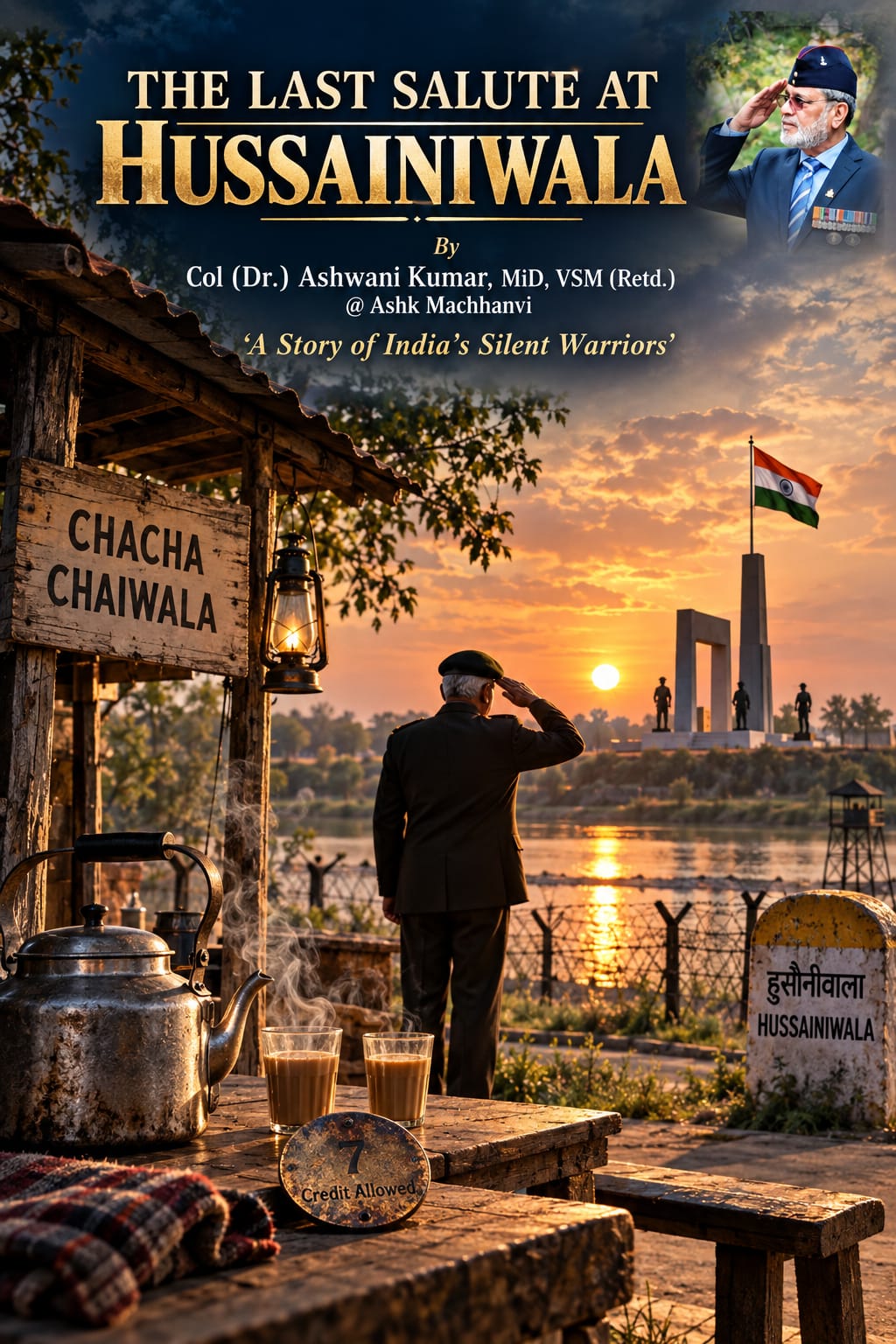
A Story of India's Silent Warriors
The Man Nobody Knew
Editorial Note: This is a narrative feature based on the account provided by the author. Specific claims concerning intelligence operations, individuals, awards and national-security activities should be independently verified before being presented as established facts.
In intelligence work, success is rarely celebrated publicly. Operations that prevent conflicts, expose espionage networks, disrupt militant activities and save lives may remain hidden from public view. This story is dedicated to those silent warriors whose greatest achievement was that nobody knew what they had done.
The winter sun was slowly descending over the fields of Hussainiwala. The border retreat ceremony had ended. Tourists had dispersed, and vehicles were returning towards Ferozepur.
A white SUV slowed near a deserted patch of land along the old road near the bridge.
“Stop here,” said the elderly officer seated in the rear seat.
The driver looked surprised. There was nothing remarkable about the place.
Only a crumbling platform, a few broken bricks and the remains of what had once been a small roadside structure were visible. The officer stepped out slowly. Age had bent his shoulders slightly, but his eyes remained sharp.
For several moments, he stood silently looking at the abandoned site. Then he straightened himself, raised his right hand and saluted.
The young Major accompanying him was stunned.
“Sir, what is this place?”
The old officer did not reply immediately. Finally, he smiled.
“Son, forty years ago this was one of the most important tea shops in Punjab.”
“A tea shop, Sir?”
“Yes,” the old officer replied. “A tea shop that, according to this account, helped support a war nobody knew was being fought.”
His mind then travelled back several decades.
A Simple Tea Stall
According to the story, Punjab was passing through one of the most difficult periods in its history during the early 1990s. The border districts were facing serious security challenges, with weapons, explosives and militant networks reportedly operating through secret routes.
Amid this atmosphere, a simple tea stall appeared near a busy road frequented by villagers, truck drivers, farmers, policemen, soldiers and travellers.
The owner was a middle-aged man known simply as “Chacha Chaiwala.” Nobody knew much about where he had come from or about his family. Few people questioned it.
His tea was popular, his manner was friendly and his honesty was widely trusted. Within months, his tea stall had become a familiar landmark in the area.
People would say, “Turn left from Chacha’s tea stall,” or “Ask Chacha, he knows everyone.”
Beside the tea stall stood a small cycle-repair shop run by Ramu. Both men appeared ordinary and attracted little attention.
That, according to the story, was precisely the point.
Information Behind the Tea Counter
Every morning, Chacha arrived before sunrise. He swept the courtyard, lit the stove, prepared fresh tea and switched on his old radio.
The melodies of Mohammed Rafi, Mukesh, Lata Mangeshkar and Kishore Kumar drifted across the road. Between the songs came national, international and regional news, weather reports and political developments.
Chacha listened carefully—far more carefully than anyone realised.
Visitors sometimes joked that he knew more news than senior officials. He simply smiled and continued working.
People thought he loved the radio. According to the story, he loved information.
An orphan boy named Sonu also worked at the stall. Ramu maintained an old notebook containing credit accounts for many local customers. The accounts were reportedly accurate, and Chacha's willingness to help people strengthened the trust placed in him.
That trust became an important part of his public image.
The Hidden Identity
The account describes Chacha as a highly trained individual with knowledge of surveillance, counter-surveillance, source handling, Human Intelligence, behavioural analysis, operational security and counter-intelligence. It further states that he could speak multiple dialects and had an exceptional memory.
However, these details are presented as part of the author's account and have not been independently verified in the material provided.
According to the story, Chacha deliberately allowed people to believe that he was an ordinary tea seller. This simple identity allegedly provided him with an effective cover while allowing him to interact freely with people in the area.
An Invisible Information Network
The story describes a network in which farmers, truck drivers, villagers, shopkeepers and labourers could provide small pieces of information about unusual movements or suspicious activities.
Each piece of information might appear insignificant on its own. According to the account, however, information was analysed, verified, correlated and passed through an intelligence network.
The story attributes several security successes to this network, including the identification of alleged intelligence contacts, interception of militant couriers, recovery of weapons caches and disruption of cross-border smuggling routes.
These are significant national-security claims and should be independently verified before being treated as documented historical facts.
Major Kumar and Chacha Chaiwala
The central revelation of the story comes when the elderly officer tells the young Major that the man known locally as Chacha Chaiwala was allegedly Major Kumar.
According to the narrative, by day he served tea, listened to conversations and built relationships. By night, he analysed reports, met sources, coordinated activities and briefed senior officials.
The account states that only his immediate senior officer, identified as Colonel Shamsher Singh, knew his real identity. This detail too remains subject to independent verification.
The Day the Tea Stall Disappeared
According to the story, one winter morning in 1995, the tea stall did not open. Initially, people assumed that Chacha was unwell. By evening, the locked shop had become a subject of concern.
A small handwritten note was reportedly found on the door:
“Take care of each other. Chacha.”
Inside, the stove had been cleaned, the utensils were neatly arranged and the accounts register had reportedly been settled.
Afterwards, different versions of Chacha's disappearance began circulating. Some believed that he had been kidnapped or killed, while others believed that hostile intelligence elements had discovered his identity.
The truth, according to the story, was different.
A Mission That Continued
The account states that Major Kumar quietly moved to Jammu and Kashmir for another assignment. It further describes subsequent service in desert, mountain and other sensitive areas, as well as responsibilities related to different forms of intelligence work.
The story also claims that Major Kumar received two Presidential decorations for distinguished service connected with national security and espionage-related work. No supporting official documentation for these awards is included in the material provided, so this claim requires independent verification.
The Salute to Silent Warriors
Years later, the elderly officer returns to the abandoned site with the young Major. Looking towards the ruins, he explains that the salute is not for one man alone but for all those who served without seeking recognition.
“This salute is not for one man,” he says in the story. “It is for all those silent warriors whose names will never appear in books.”
The young officer stands to attention and joins him in the salute.
Among the broken bricks, the elderly officer finds an old tea token. The object becomes another symbolic reminder of the ordinary life associated with Chacha Chaiwala.
The Legacy of an Unseen Service
The story concludes with the idea that successful intelligence work is often measured not by publicity but by the events that are prevented or quietly contained.
Chacha Chaiwala remains, within this narrative, a symbol of the unseen individuals who may work behind ordinary identities while serving larger responsibilities.
At the same time, the specific identities, operations, arrests, awards and security achievements described in the story should not be treated as independently established facts unless supported by reliable official or documentary sources.
For the finest intelligence operatives, the greatest recognition may sometimes be the peace left behind rather than the publicity received.
That is why some heroes never become famous. They become legends.
Author: Col. (Dr.) Ashwani Kumar, MiD, VSM (Retd.)
Date: 14 September 2026