When Democracy Meets Barricades: Why Are India's Students Being Treated Like Criminals?
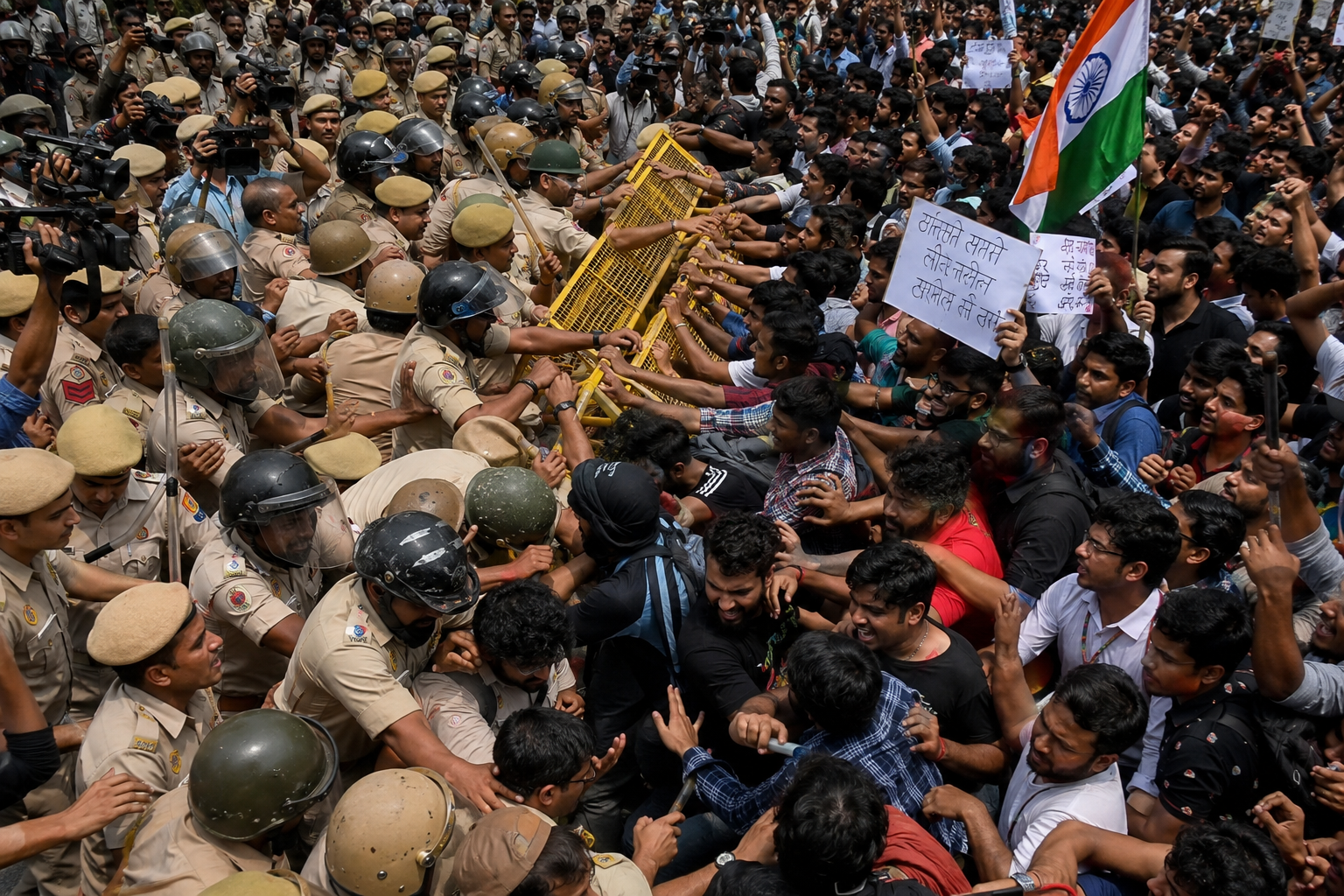
India has always called its youth the future of the nation. Governments of every political party have repeatedly said that students are the country's greatest strength. But when those very students stepped onto the streets of New Delhi demanding accountability over repeated examination failures and paper leak controversies, many found themselves surrounded by barricades, tear gas, heavy police deployment, and detentions instead of dialogue.
The question every Indian must ask is not political.
It is constitutional.
Who Does the Police Serve?
The Delhi Police is not the police force of any political party.
It is not the police of the ruling government.
It is not the police of any minister.
It is the police of the Republic of India.
Every police officer takes an oath to uphold the Constitution and the law. Their duty is to maintain public order while protecting the constitutional rights of citizens, including the right to peaceful assembly and expression, subject to reasonable restrictions.
If thousands of students gather demanding justice, transparency, and accountability, their first response should not automatically be force. It should begin with communication, negotiation, and protection of public safety.
Students Are Asking One Question: "Who Will Protect Our Future?"
The current protests did not emerge overnight.
They are the result of years of frustration over repeated examination controversies, uncertainty, and a growing feeling among many young people that their future is being compromised. Protesters have demanded accountability, reforms in the examination system, and the resignation of the Education Minister over the handling of these issues.
Many protesters travelled hundreds of kilometres.
Many were first-generation college students.
Many came carrying only one demand:
"Give us justice."
They were not asking for privilege.
They were asking for fairness.
Why Is Every Dissenter Called "Anti-National"?
Perhaps the most disturbing aspect of recent public discourse is how quickly critics of the government are branded as "anti-national" or even "terrorists."
Such labels are serious. In a democracy governed by the rule of law, they should not be used against citizens merely because they criticize public policy or participate in peaceful protest. Genuine terrorism is a grave crime, and equating peaceful dissent with terrorism risks diluting the meaning of both.
Questioning a government is not the same as questioning India.
Governments change.
Political parties change.
India remains.
The Constitution gives citizens the right to question those in power. Exercising that right peacefully is part of democratic life.
Sonam Wangchuk: A Voice That Refused to Stay Silent
When engineer, education reformer, and Ramon Magsaysay Award recipient Sonam Wangchuk joined the movement, the issue gained national attention.
He undertook a prolonged hunger strike, saying that accountability was necessary to restore trust in India's institutions. After his health deteriorated, authorities moved him to a hospital. Police said this was done on medical advice and under court directions, while supporters criticised the move as forcible, illustrating the sharp disagreement over how the protests were handled.
Whether one agrees with his methods or not, his protest remained rooted in non-violent civil resistance.
Force Cannot Replace Dialogue
Reports from multiple news organisations described extensive security arrangements during the "Chalo Sansad" march, including barricades, tear gas, and baton charges after protesters attempted to move toward Parliament despite restrictions on public gatherings. Police have also rejected some viral allegations of assaults circulating on social media and urged people not to spread misinformation.
This demonstrates why transparency and independent scrutiny are essential whenever there are conflicting accounts of events.
This Is Bigger Than Politics
This movement is no longer only about examinations.
It is about trust.
Trust in institutions.
Trust in accountability.
Trust that ordinary citizens can speak without being dismissed.
India's freedom struggle was built by people who questioned authority through peaceful means. The Constitution that emerged from that struggle protects the right of citizens to express dissent.
A democracy does not become weaker because people ask difficult questions.
It becomes weaker when citizens begin to fear asking them.
A Message to the Government
Students are not your enemies.
Young people demanding accountability are not enemies of the nation.
Criticism is not sedition.
Dissent is not terrorism.
Peaceful protest is not a crime.
The measure of a democracy is not how loudly it celebrates those who agree with it. It is how fairly it treats those who disagree.
If India's youth believe that their future has been jeopardized, they deserve to be heard with respect and answered with transparency.
Because governments are temporary.
Political leaders are temporary.
But the dreams of India's students and the Constitution that protects them must endure.