Every year, thousands of retail businesses develop detailed plans that include sales targets, marketing calendars, inventory forecasts, staffing schedules, and promotional campaigns. Yet many of these businesses struggle to achieve their desired results.
This raises an important question: If the planning is sound, why do the results often fall short?
Drawing on more than sixteen years of experience in the retail industry, from frontline sales roles to operational leadership positions, I have observed a recurring pattern. In many cases, retail businesses do not struggle because of poor planning; they struggle because of inconsistent execution.
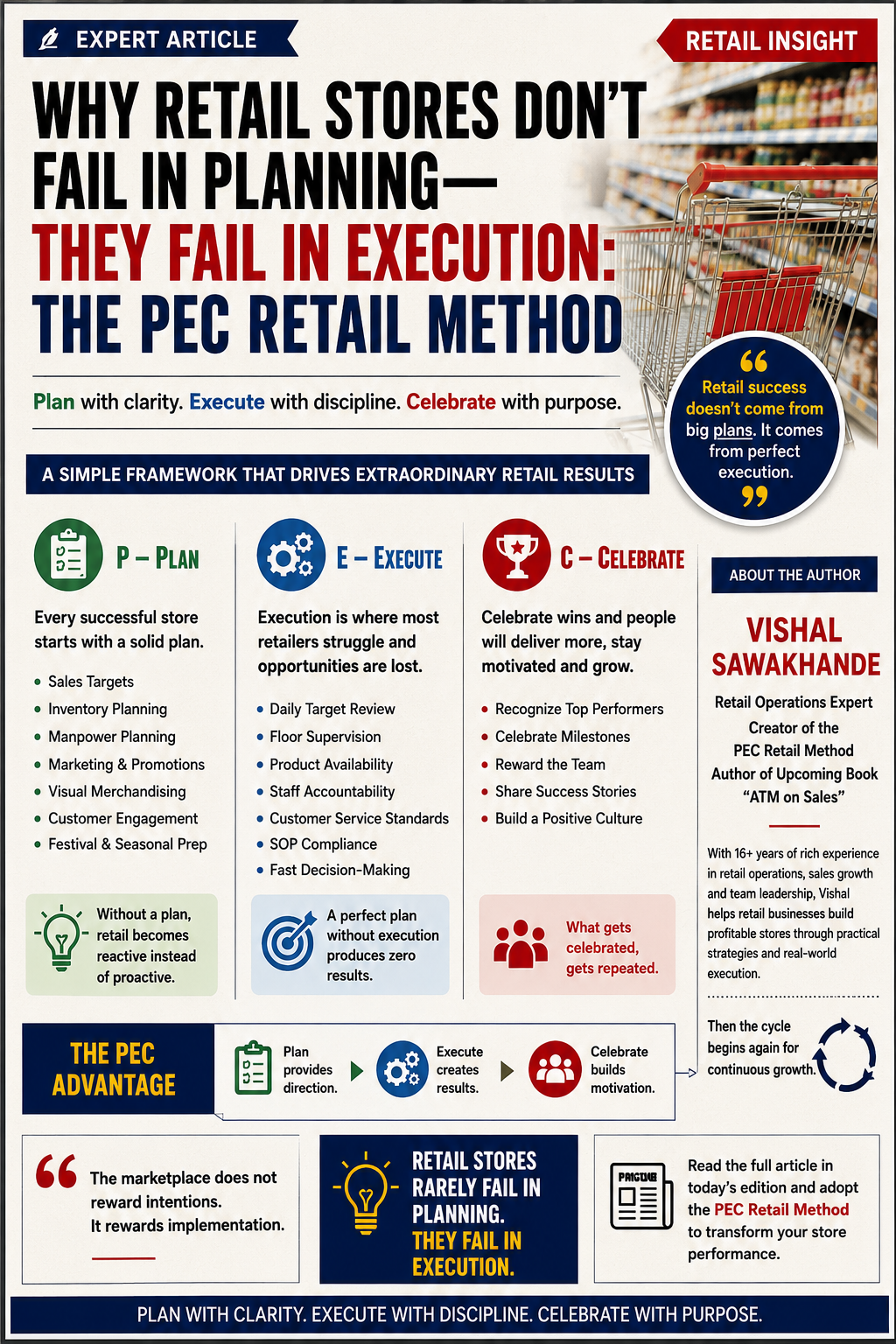
This observation led to the development of the PEC Retail Method, a framework built around three interconnected pillars:
Plan. Execute. Celebrate.
P – Plan
Planning forms the foundation of every successful retail operation.
A comprehensive retail plan typically includes:
- Sales targets
- Inventory requirements
- Staffing strategies
- Marketing activities
- Visual merchandising plans
- Customer engagement initiatives
- Seasonal and festival preparations
Most retail organizations are comfortable with planning. Meetings are conducted, targets are announced, and strategies are discussed in detail.
However, planning alone does not generate results.
A blueprint can guide the construction of a building, but it cannot build the structure by itself. Similarly, a retail plan must be implemented effectively to deliver meaningful outcomes.
E – Execute
Execution is often the deciding factor between success and underperformance.
Many organizations assume that once instructions are communicated, implementation naturally follows. In practice, effective execution requires continuous attention and monitoring.
Key elements of execution include:
- Daily performance reviews
- Floor supervision
- Product availability checks
- Staff accountability
- Customer service monitoring
- SOP compliance
- Timely decision-making
Consider a retail store preparing for a major festival season. Even with a strong strategy in place, opportunities may be lost if shelves remain understocked, promotional displays are incomplete, employees are not adequately prepared, or supply chains face delays.
Customers ultimately respond to the experience they receive, not the plans created behind the scenes.
Retail success is built through consistent daily actions rather than occasional strategic discussions.
Stores that consistently outperform competitors are often those that execute fundamental retail disciplines with discipline and consistency.
C – Celebrate
The third pillar of the PEC Retail Method is frequently overlooked.
Retail is fundamentally a people-driven business. Every sale, customer interaction, and operational improvement is supported by employees who represent the brand and contribute to business outcomes.
When achievements go unrecognized, motivation can decline. When contributions are acknowledged, engagement and performance often improve.
Recognition can take many forms, including:
- Appreciating top performers
- Recognizing team achievements
- Celebrating sales milestones
- Sharing success stories
- Acknowledging operational improvements
Positive reinforcement helps encourage behaviors that contribute to organizational success.
Organizations that foster a culture of appreciation often benefit from stronger teamwork, improved morale, and higher levels of employee engagement.
The PEC Advantage
The PEC Retail Method creates a continuous cycle:
Plan provides direction.
Execute drives results.
Celebrate strengthens motivation.
The cycle then begins again.
Many retail leaders devote substantial energy to planning while spending comparatively less time monitoring execution. In practice, successful implementation often requires sustained focus on day-to-day operational excellence.
Markets do not reward intentions alone; they reward effective implementation.
Final Thoughts
In today’s competitive retail environment, long-term success depends on an organization’s ability to consistently convert plans into measurable actions.
When sales targets are missed, it is important not only to evaluate the strategy but also to assess how effectively it was implemented.
For many retail businesses, the challenge is not creating a plan—it is ensuring disciplined execution.
The PEC Retail Method seeks to address this challenge by combining clear planning, consistent execution, and meaningful recognition into a single performance framework.
Plan with clarity. Execute with discipline. Celebrate with purpose.
Disclaimer: The views expressed in this article are those of the author.