Xiaomi’s sub-brand officially disrupted the Indian mobile landscape on June 16, 2026, with the highly anticipated launch of the Redmi Turbo 5. Developed to serve power users who demand uncompromising processing velocities alongside relentless battery stamina, this smartphone marks the regional debut of the company’s performance-centric Turbo lineup. Offering an industry-leading silicon-carbon power cell and elite thermal systems, the handset aims to establish a brand-new sub-flagship standard. Scheduled to hit virtual store shelves via Amazon India, Mi.com, and retail networks on June 19, this heavy-hitter represents a calculated attempt to capture dominance in India’s highly competitive upper mid-range tier.
A Strategic Move to Dominate the Performance Tier
The introduction of the Redmi Turbo 5 underlines a significant shift in the brand’s localized market approach. Historically, the brand relied on its Note series to capture mid-tier volume, leaving premium performance metrics exclusively to top-tier flagship offerings. The arrival of the Turbo family fundamentally rewrites this division by presenting users with standard-shattering speed metrics and extreme durability without forcing a step up to steep flagship price brackets.
Furthermore, this launch lands at a critical moment when high-end mobile esports and prolonged resource-heavy tasks drive customer purchasing choices. By offering structural reinforcement alongside high-efficiency components, the company addresses the core frustrations of modern consumers who are tired of performance throttling, rapid battery degradation, and fragile build quality during intensive extended usage cycles.
Elite Internal Architecture and Industrial Design
Driving the capabilities of the smartphone is the upper mid-range MediaTek Dimensity 8500 Ultra processor, a top-tier 4nm chipset capable of executing demanding algorithmic workflows with ease. This powerful architecture operates alongside up to 12GB of LPDDR5X Ultra RAM and up to 512GB of swift UFS 4.1 flash storage, producing seamless app execution and minimal UI lag. To ensure sustained output, a massive 5,300mm² stainless steel IceLoop vapor cooling layout provides up to three times better thermal management compared to traditional configurations.
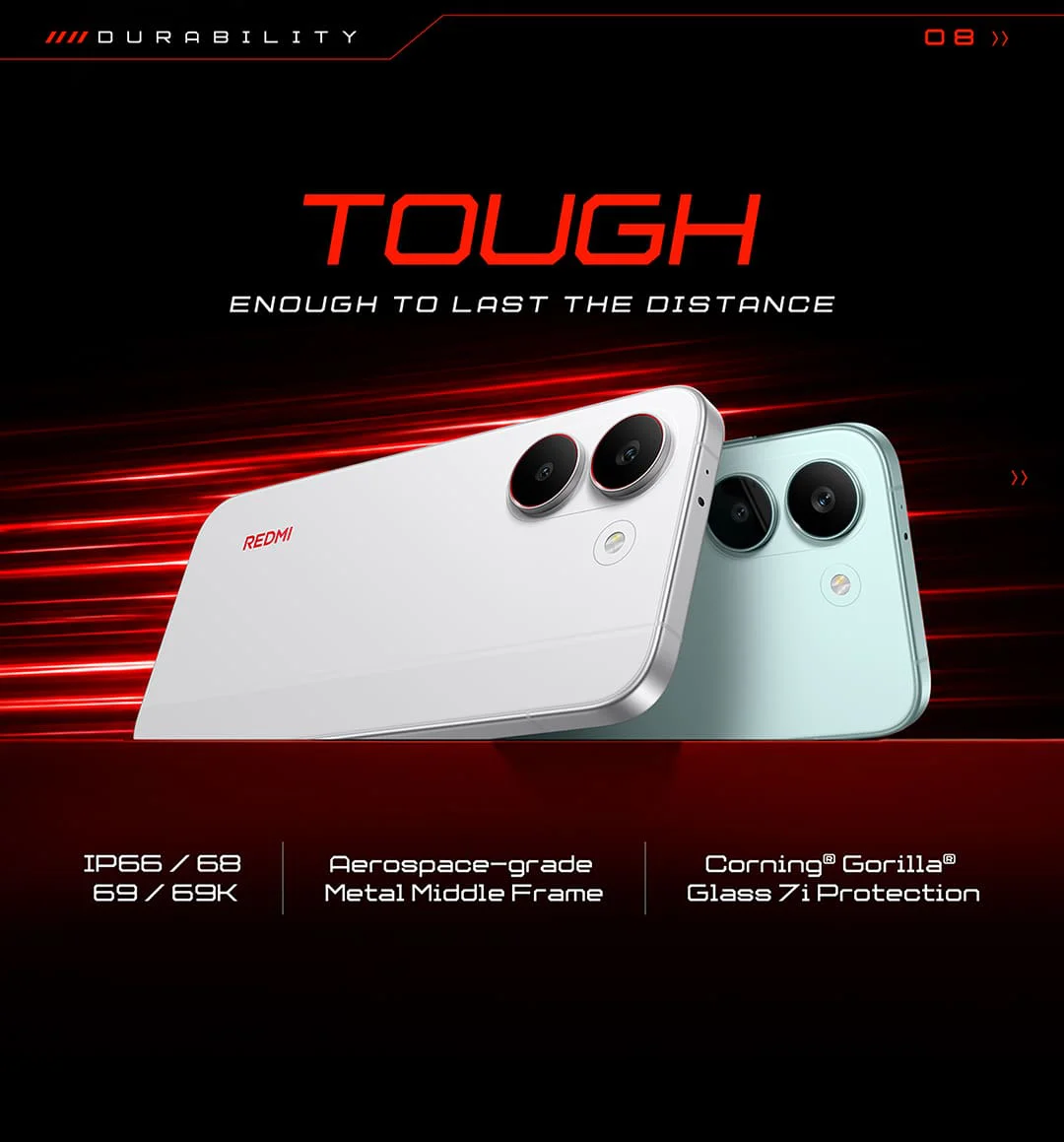
Visuals are handled gracefully by a flat 6.59-inch 1.5K AMOLED panel boasting a smooth 120Hz refresh rate and a peak brightness rating of 3,500 nits. The premium display incorporates professional 3,840Hz high-frequency dimming and Dolby Vision support, shielded externally by Corning Gorilla Glass 7i. The underlying chassis is fully armored, securing multi-tier IP66, IP68, IP69, and IP69K ratings for ultimate resilience against dust, complete water submersion, and aggressive high-temperature steam pressure.
On the rear, a unique Pixel Matrix ring light configuration illuminates dynamically in tandem with system alerts, flanking an optimized dual-camera layout. This imaging array features a 50MP Sony IMX882 primary camera with optical stabilization paired with an 8MP ultra-wide sensor, complemented by a 20MP front selfie shooter. The headlining feature is a mammoth 7,540mAh battery utilizing state-of-the-art silicon-carbon technology, paired with 100W HyperCharge support that tops up the huge cell efficiently. The software layer relies on Android 16-based HyperOS 3, preloaded with comprehensive Gemini integration and productivity features.
Reshaping Competitive Dynamics and Market Expectations
The smartphone introduces a highly aggressive pricing structure for Indian consumers, positioning it as a distinct market disruptor. The base variant featuring 8GB RAM and 256GB storage enters the market at an official price of ₹37,999, while the top-tier 12GB RAM and 256GB option carries a price tag of ₹40,999. To ensure deep penetration right from the launch date, the manufacturer is implementing a standard introductory discount of ₹2,000, bringing effective acquisition costs down to ₹35,999 and ₹38,899 respectively.
This smart positioning places significant pressure on established mid-premium competitors that often compromise on basic environmental protection ratings or settle for modest battery capacities to balance their budgets. By packaging absolute structural resilience, extreme battery longevity, and sub-flagship speed under the forty-thousand-rupee threshold, the handset establishes an uncompromising benchmark that alters what consumers can expect from reasonably priced hardware.
## Pushing the Boundaries of Value Engineering
As retail availability formally registers on June 19, the wider implications of this launch point toward a shifting trend focused on heavy hardware utility and longevity. With long-term software update support and elite components, the device proves that performance hardware no longer requires excessive premium investments. Moving forward, this product introduction highlights a strong commitment to leverage structural advancements to constantly redefine consumer experiences.
Conclusion
The Redmi Turbo 5 successfully balances elite 4nm computing performance, standard-setting build protection, and a massive battery array at an unmatchable price point. It represents a major leap forward for value-conscious buyers looking for uncompromising sub-flagship longevity.