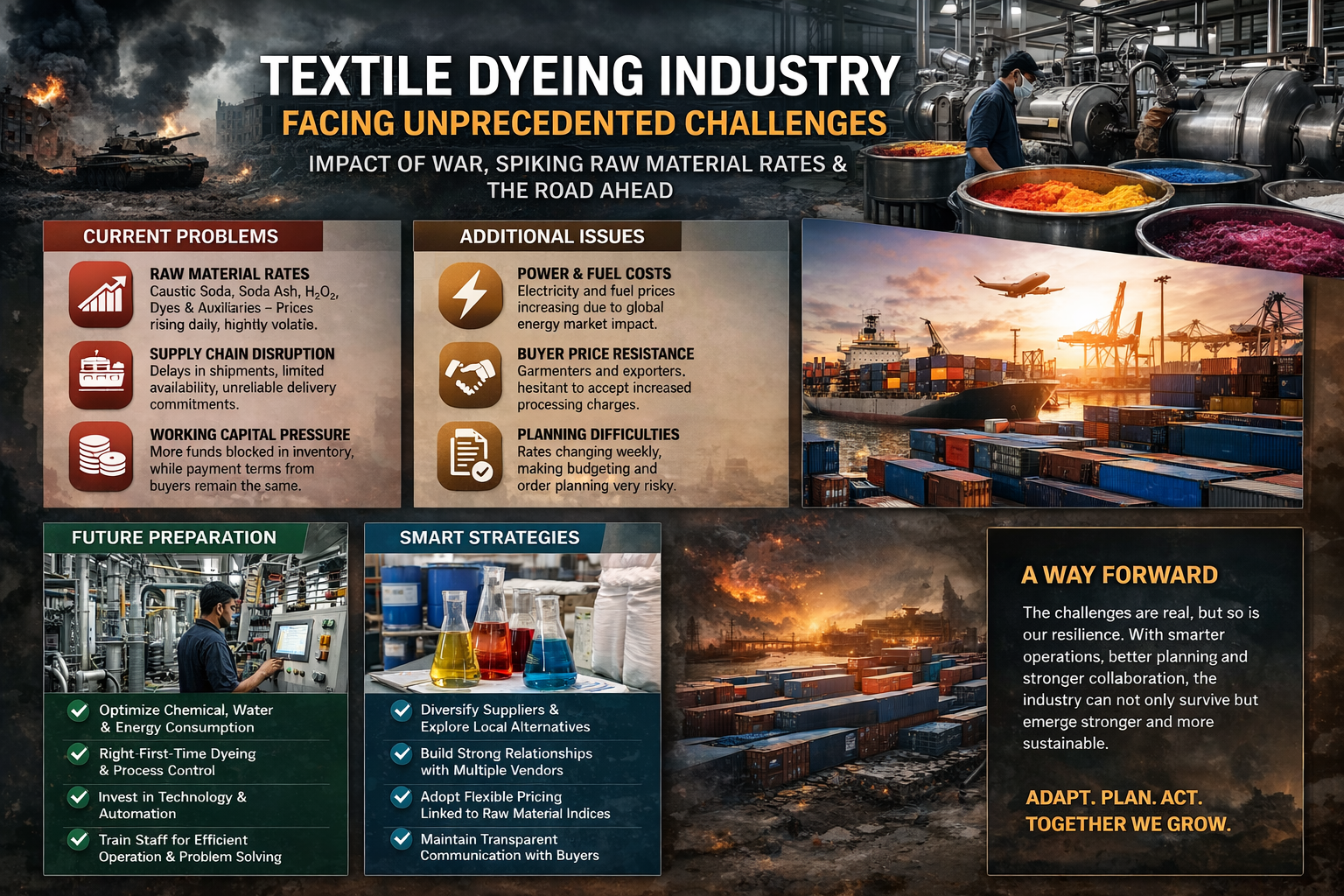
India’s textile dyeing industry is witnessing a fresh wave of cost pressures as global geopolitical tensions disrupt supply chains and push up the prices of key chemical inputs.
According to industry participants, prices of several widely used dyeing chemicals — including reactive dyes, caustic soda, sodium sulphate, and auxiliary agents such as fixing agents and softeners — have risen by 20–35% over the past quarter. The increase is largely linked to volatility in crude oil derivatives, supply constraints, and elevated international freight rates.
“Most textile chemicals are either petrochemical-based or imported in part. Any global disruption immediately reflects in our input costs,” said a dyeing unit owner operating in the eastern textile belt. “In the last few months, we have seen continuous upward revisions with no stability in pricing.”
In addition to chemicals, energy costs have also surged, further tightening operating margins. Dyeing is an energy-intensive process requiring steam, electricity, and water treatment, all of which have become more expensive. Industry estimates suggest that overall processing costs for dyeing units have increased by 15–25% compared to earlier levels.
Smaller and mid-sized dyeing units are particularly vulnerable. Unlike large integrated mills, these units have limited capacity to absorb cost shocks or hedge against price fluctuations. Many are now facing a difficult choice between increasing processing charges or reducing operational volumes.
“There is a clear mismatch between rising input costs and what the market is willing to pay,” said a chemical trader supplying to textile clusters. “Buyers are cautious, and price pass-through is not immediate, which is squeezing margins across the value chain.”
Export-oriented units may also feel the impact if the trend continues. Higher processing costs can reduce competitiveness in global markets, especially against countries with relatively stable input pricing.
To cope with the situation, several dyeing houses are adopting cost-control measures such as optimizing chemical dosing, switching to alternative auxiliaries, and improving process efficiency. Some units are also diversifying supplier bases to reduce dependency on specific regions.
Despite ongoing challenges, industry stakeholders remain cautiously hopeful. A stabilization in global logistics and raw material availability could help ease price pressures in the coming months. However, until then, the sector is expected to operate under constrained margins and heightened uncertainty.