Step onto any busy road in India and a familiar pattern often emerges—honking, sudden lane changes, signal violations, and vehicles parked in unsuitable locations.
In such situations, many people quickly conclude that the system alone is responsible for traffic problems. However, an equally important question is worth asking: what role do individual road users play?
The Reality on Our Roads
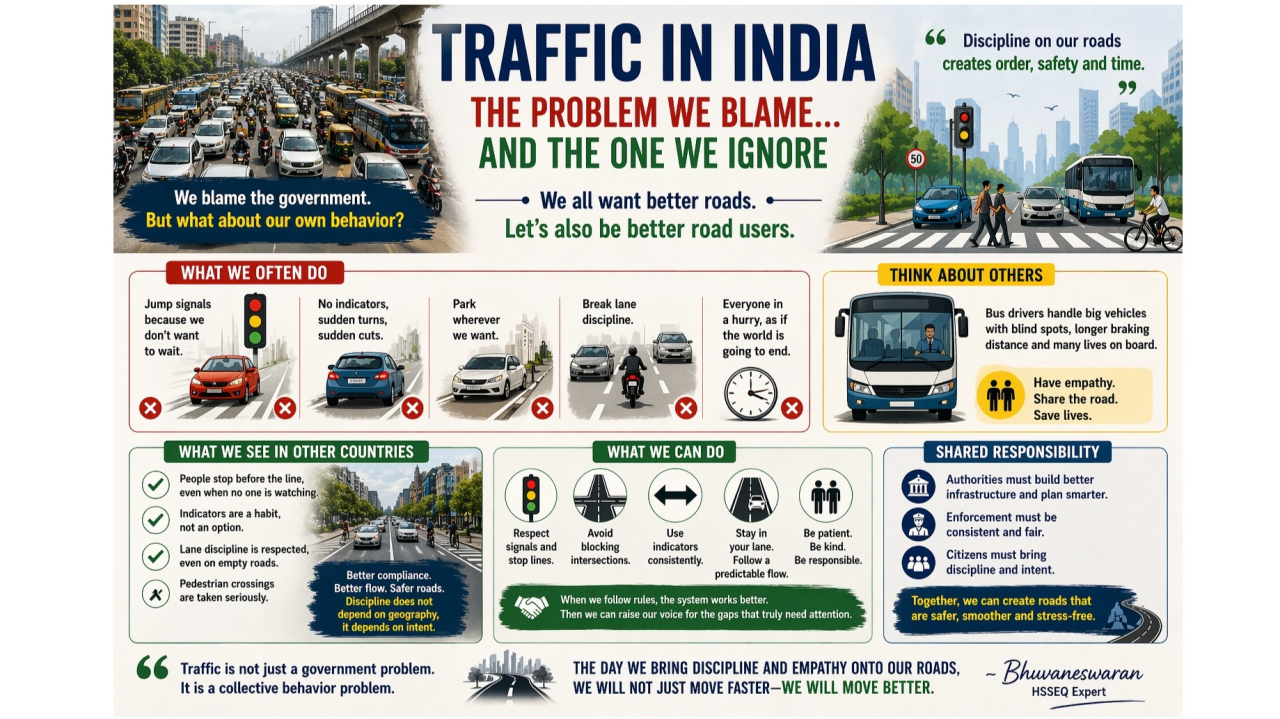
A few minutes at a busy intersection may reveal vehicles crossing stop lines, drivers changing lanes without indicators, and intersections becoming blocked during peak traffic hours. Two-wheelers often navigate through narrow gaps, while motorists who follow traffic rules can sometimes find themselves under pressure from impatient drivers.
These challenges are not only linked to infrastructure and traffic volume. They are also influenced by road-user behaviour.
The Rush Without Reason
Many commuters face time pressures and crowded roads every day. In that rush, road discipline can sometimes take a back seat.
Bus drivers, for example, operate large vehicles carrying dozens of passengers and require greater stopping distances and maneuvering space. Similarly, pedestrians, cyclists, and other motorists all depend on predictable and responsible behaviour from one another.
Road safety is not only about following rules—it is also about understanding how our actions affect others.
A Shared Challenge
In many cities, even short journeys can take significantly longer than expected due to congestion. While urban growth and increasing vehicle numbers contribute to the problem, traffic flow is also affected by driving habits, lane discipline, and adherence to signals.
Learning from Good Practices
Around the world, smoother traffic movement is often supported by a combination of infrastructure, enforcement, and public compliance with traffic rules.
Practices such as respecting stop lines, using indicators, maintaining lane discipline, and giving way to pedestrians can contribute to safer and more efficient roads regardless of location.
The Way Forward
Simple measures can make a meaningful difference:
- Respect traffic signals and stop lines
- Avoid blocking intersections
- Use indicators consistently
- Follow lane discipline wherever possible
- Show consideration toward fellow road users
At the same time, authorities must continue improving infrastructure, enforcement, and traffic management systems.
This is not about assigning blame. It is about recognising that safer and smoother roads require shared responsibility.
Final Thought
Before questioning the system alone, it may also be useful to reflect on individual road habits. Traffic congestion and road safety are influenced by both infrastructure and human behaviour.
Greater discipline, patience, and empathy on the roads can help create a safer and more efficient travel experience for everyone.