Twelve Years of New India: How Growth, Governance and Global Confidence Repositioned India on the World Stage
Twelve Years That Changed the National Mood
There are periods in a nation’s life when progress is not measured merely in numbers, but in the change of confidence, ambition and direction. For India, the past 12 years have been one such period.
From 2014 to 2026, India has not simply grown; it has repositioned itself. It has moved from being described as an emerging market to being watched as a decisive global power. It has gone from being a country of promise to a country of delivery. It has transformed the grammar of governance from intent to implementation, from schemes to saturation, from policy announcements to measurable outcomes.
At the centre of this transition has been Prime Minister Narendra Modi’s leadership — a leadership style defined by scale, speed, direct communication, national aspiration and an unmistakable belief that India must not merely participate in the 21st century, but shape it.
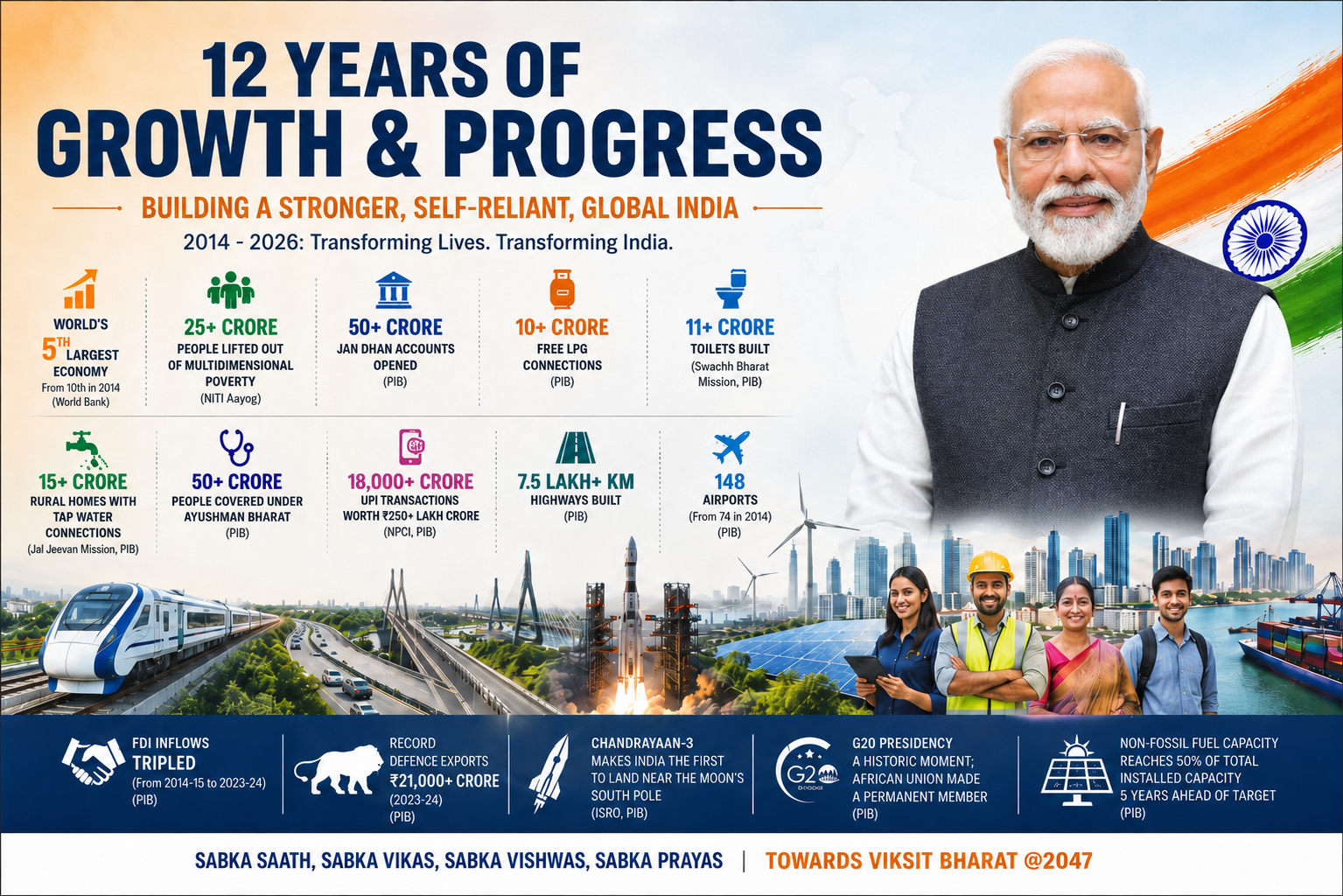
The India of today is more connected, more digital, more financially included, more infrastructure-driven, more welfare-secure and more globally visible than it was a decade ago. Highways have expanded, airports have multiplied, digital payments have become a daily habit, welfare benefits now reach citizens directly, startups have moved from the margins to the mainstream, defence exports have risen sharply, and India’s diplomatic voice has grown louder across multilateral platforms.
This is the story of a country that found administrative discipline and national imagination at the same time.
From Policy Paralysis to Performance Politics
Before 2014, India was often spoken of in terms of potential. It had the demographic advantage, the entrepreneurial energy, the consumer market and the civilisational depth. What it lacked was a governance architecture that could turn these strengths into coordinated national momentum.
The Modi years changed that equation.
The defining feature of the past 12 years has been execution at scale. Whether it was bank accounts, toilets, tap water connections, LPG cylinders, digital payments, highway corridors, health coverage or startup recognition, the government’s model has been built around measurable delivery. It has brought a private-sector sense of targets into public governance.
The phrase “last-mile delivery” became more than bureaucratic language. It became a political and administrative promise. The state began to reach citizens not only through local offices, but through bank accounts, mobile phones, digital identities, dashboards and direct benefit transfers.
This has been one of the most important shifts of the Modi era: governance became visible. Citizens could see roads being built, airports being opened, bank accounts being credited, toilets being constructed, water taps being installed and digital payments being accepted even by the smallest street vendor.
In a country as large and complex as India, visibility of governance matters. It creates trust. It creates participation. It creates the belief that the system can work.
The Economy: From Fragile Confidence to Global Momentum
India’s economic journey over the past 12 years has been marked by resilience and acceleration. Despite global shocks such as the pandemic, supply-chain disruptions, geopolitical tensions and inflationary pressures, India has remained among the fastest-growing major economies in the world.
The broader economic story is not just about GDP growth. It is about the emergence of a more formal, better-connected and increasingly investment-friendly economy. The introduction of GST created a common national market. The Insolvency and Bankruptcy Code strengthened credit discipline. Digital payments formalised transactions at a pace few countries have matched. Infrastructure spending created demand while improving long-term productivity.
The government’s economic approach has combined welfare, infrastructure and enterprise. This is important because India cannot grow by focusing only on elite consumption or only on subsidies. It needs roads and railways, but also food security. It needs startups and foreign investment, but also toilets, water, housing and healthcare. It needs manufacturing, but also digital public infrastructure.
That mix has become the defining economic architecture of New India.
India today stands among the world’s largest economies and continues to be seen as one of the most important engines of global growth. Global institutions have repeatedly noted India’s growth momentum, driven by domestic demand, investment, services strength and reforms. The significance of this cannot be overstated. At a time when many advanced economies are struggling with slow growth, ageing populations and strategic uncertainty, India offers scale, stability and aspiration.
The Modi government’s greatest economic contribution may be that it has made ambition respectable again. A $5 trillion economy, Viksit Bharat by 2047, self-reliance in critical sectors, global manufacturing ambitions, digital leadership — these are no longer slogans outside the realm of policy. They are now organising principles of governance.
Infrastructure: The Visible Face of New India
If one had to choose the most visible marker of India’s transformation, it would be infrastructure.
Over the past 12 years, India has built at a pace that has changed both mobility and mindset. National highways have expanded significantly. Expressways have redefined travel between major economic centres. Rural roads have connected habitations to markets, schools and hospitals. Airports have moved beyond metropolitan privilege and entered smaller cities. Metro rail networks have grown. Railway modernisation has become a major public conversation. Ports, logistics corridors and multimodal planning have become central to economic strategy.
This infrastructure push is not only about convenience. It is about competitiveness.
For decades, India’s growth was constrained by high logistics costs, slow freight movement, poor last-mile connectivity and uneven regional development. By investing in highways, corridors, airports, railways and logistics platforms, the government has attempted to address the physical bottlenecks that held India back.
The larger strategic idea is clear: infrastructure is not expenditure; it is national capacity.
A highway reduces travel time, but it also expands market access. An airport improves mobility, but it also brings tourism, investment and jobs. A railway station is not just a transport node; it can become a local economic multiplier. A rural road is not merely a strip of asphalt; it is a bridge between aspiration and opportunity.
This is why the infrastructure story of the past 12 years deserves to be read as a development story, not merely a construction story.
Digital India: The Quiet Revolution That Became a Global Case Study
Perhaps no transformation has touched everyday India as deeply as the digital revolution.
A decade ago, digital governance was often discussed as an urban convenience. Today, it is the backbone of India’s welfare, commerce, payments and identity systems. The Jan Dhan-Aadhaar-Mobile trinity created the foundation. UPI turned mobile payments into a mass habit. Direct Benefit Transfer changed the way subsidies and welfare benefits reached citizens. DigiLocker, CoWIN, FASTag, GeM, Aadhaar-enabled services and other digital public platforms helped create a governance ecosystem that is now studied globally.
UPI, in particular, has become a symbol of India’s technological self-confidence. It has democratised digital payments in a way that few systems in the world have achieved. From large businesses to small vendors, from metropolitan malls to roadside tea stalls, digital payments have become part of India’s daily economic culture.
The genius of India’s digital public infrastructure is that it did not remain confined to the privileged. It scaled downward and outward. It reached the small merchant, the rural beneficiary, the pensioner, the student, the farmer and the migrant worker.
This is where the Modi government’s governance model has shown its sharpest edge: technology was used not merely to modernise the state, but to make the state more direct, more transparent and more accountable.
In the old welfare system, leakages were accepted as inevitable. In the new system, technology made leakage harder to defend. Money could move directly into bank accounts. Beneficiaries could be authenticated. Payments could be tracked. The invisible citizen became visible to the state.
That is a profound administrative shift.
Welfare as Empowerment, Not Patronage:
The past 12 years have also redefined welfare in India.
Historically, welfare in India was often seen through the lens of political patronage. The Modi government reframed it as dignity, access and empowerment. The focus shifted to basic household-level transformation: a bank account, a toilet, a gas connection, a tap water connection, a house, health cover, free foodgrains and direct transfers.
This approach matters because poverty is not only lack of income. Poverty is also lack of access — to sanitation, banking, cooking fuel, healthcare, housing, drinking water and state support. By addressing these deprivations simultaneously, the government created a wider architecture of social protection.
The reduction in multidimensional poverty is one of the most significant outcomes of this period. Crores of Indians moved out of deprivation as basic services expanded. Swachh Bharat brought sanitation into the centre of public life. Jal Jeevan Mission took piped water from a distant aspiration to a household-level reality for millions. Ujjwala changed the everyday lives of women who had long depended on firewood and smoke-filled kitchens. Ayushman Bharat gave health security to vulnerable families. PM Garib Kalyan Anna Yojana provided food security at massive scale.
The political importance of these schemes is obvious. But their social significance is even greater.
They gave citizens the sense that development was not an abstract national statistic. It was entering the home.
The Rise of the Aspirational Indian:
One of the most under-discussed achievements of the past 12 years is psychological: the rise of the aspirational Indian.
Aspirational India is not limited to the metropolitan middle class. It lives in Tier-2 cities, small towns, villages, startup hubs, coaching centres, self-help groups, digital creator communities and among first-generation entrepreneurs. It is a young India that does not want to be managed by poverty politics. It wants opportunity, recognition and mobility.
The government’s youth-focused initiatives — Startup India, Skill India, Digital India, Atal Innovation Mission and the broader push for entrepreneurship — have contributed to this change. The startup ecosystem has grown dramatically, creating jobs, innovation and new business models. India now has one of the world’s largest startup ecosystems, with entrepreneurship no longer confined to a few elite institutions or metro cities.
This is a major cultural shift.
For decades, the safest aspiration in India was a government job. That aspiration still exists and remains important. But alongside it, a new aspiration has emerged: to build, create, innovate, export, scale and compete globally.
That change in mindset is central to the story of New India.
Make in India and the Return of Manufacturing Ambition:
India’s development challenge has always included one uncomfortable question: can a country of India’s size become prosperous without deep manufacturing strength?
The Modi government answered by placing manufacturing back at the heart of national strategy. Make in India, Production Linked Incentive schemes, reforms in FDI policy, electronics manufacturing, defence production, semiconductor ambitions and the larger call for Aatmanirbhar Bharat all belong to this broader push.
The results are visible in sectors such as electronics and mobile manufacturing. India has moved from being heavily import-dependent in mobile phones to becoming one of the world’s major mobile manufacturing centres. Mobile phone exports have risen sharply. Electronics production has expanded. Global firms are increasingly looking at India as part of their China-plus-one strategy.
Defence is another important example. For years, India was one of the world’s largest defence importers. Over the past decade, the push for indigenous defence production and exports has created a new narrative: India is not only buying defence equipment; it is increasingly building and exporting it.
This is more than industrial policy. It is strategic policy.
A country that manufactures more has greater economic resilience. A country that produces defence equipment has greater strategic autonomy. A country that attracts investment into manufacturing creates jobs, develops supply chains and strengthens its global bargaining power.
Aatmanirbhar Bharat, therefore, should not be misunderstood as isolation. It is better understood as confident interdependence — India engaging the world from a position of greater domestic capability.
Clean Energy and Climate Leadership:
India’s growth story has also carried a strong clean energy dimension.
At a time when climate action is often framed as a burden on developing countries, India has attempted to show that development and sustainability can move together. Renewable energy capacity has expanded significantly. Solar power has grown from a relatively small base to a major pillar of India’s energy transition. India has achieved a major non-fossil fuel capacity milestone ahead of its 2030 commitment timeline.
Prime Minister Modi’s leadership in launching and promoting the International Solar Alliance also gave India a distinctive global role in climate diplomacy. Instead of being a passive participant in climate negotiations, India positioned itself as a voice for climate justice, affordable energy access and solar cooperation among developing nations.
This matters because India’s climate position is not merely environmental; it is civilisational and developmental. India has consistently argued that the Global South cannot be denied growth, but growth must be cleaner, smarter and more sustainable.
That is a balanced and necessary position.
India on the Global Stage: From Listener to Agenda-Setter
The most striking foreign policy shift of the past 12 years has been India’s movement from cautious participation to confident agenda-setting.
Under Prime Minister Modi, India’s global posture has become more assertive, more visible and more rooted in national interest. The country has strengthened relations with major powers while maintaining strategic autonomy. It has engaged the United States, Russia, Europe, Japan, the Gulf, Africa, ASEAN and the Global South without reducing itself to any one camp.
This ability to engage multiple poles of power is one of India’s greatest diplomatic strengths today.
The G20 Presidency was a defining moment in this journey. India did not treat it as a routine diplomatic event. It turned it into a national showcase and a global statement. The inclusion of the African Union as a permanent member of the G20 during India’s Presidency was a major diplomatic achievement and reinforced India’s claim to be a voice of the Global South.
The message was clear: India’s rise is not only about India. It is also about giving greater representation to countries historically left at the margins of global decision-making.
India’s space achievements have added another layer to this global image. Chandrayaan-3’s successful soft landing near the Moon’s south pole was not merely a scientific achievement. It was a civilisational moment of confidence. It told the world that India could deliver complex, high-technology missions with precision and cost-effectiveness.
From yoga diplomacy to solar diplomacy, from vaccine outreach to digital public infrastructure, from the G20 to space exploration, India has projected itself as a country that can offer ideas, systems and leadership.
That is the essence of global stature.
Modi’s Leadership: The Politics of Scale and Self-Belief
Every government builds policies. Few governments change the national mood.
Prime Minister Narendra Modi’s most consequential contribution has been the restoration of national self-belief. His politics has consistently communicated that India should think bigger, move faster and demand more from itself.
This style has not been without criticism, and no democracy is without debate. But from a development perspective, the Modi era has clearly shifted the scale of national ambition. The language of governance has changed from incremental improvement to transformational targets. The public expectation from government has also changed. Citizens now expect delivery, dashboards, deadlines and direct communication.
Modi’s leadership has also brought a strong narrative dimension to governance. Schemes are not presented as isolated administrative programmes; they are woven into a larger story of national resurgence. Swachh Bharat was not just about toilets; it was about dignity. Ujjwala was not just about LPG; it was about women’s health and time. Digital India was not just about technology; it was about empowerment. Make in India was not just about factories; it was about confidence. Viksit Bharat is not just an economic target; it is a generational mission.
This ability to connect policy with public emotion is central to Modi’s political appeal.
The Road to Viksit Bharat:
The next phase of India’s journey will be even more demanding.
India must create millions of quality jobs, deepen manufacturing, improve learning outcomes, strengthen healthcare capacity, manage urbanisation, modernise agriculture, reduce judicial delays, expand exports and sustain social harmony. It must ensure that growth is not only fast, but also broad-based. It must make sure that infrastructure is matched by institutional strength. It must turn demographic advantage into productive capacity.
But the foundation built over the past 12 years gives India a stronger platform than before.
A country with digital public infrastructure, expanding highways, rising startups, improved welfare delivery, stronger foreign exchange confidence, growing manufacturing ambition, clean energy momentum and a more assertive diplomatic voice is better placed to take the next leap.
The story of the past 12 years is not that India has solved every problem. No serious editorial should claim that. The real story is that India has changed the direction, scale and confidence with which it approaches its problems.
That is why this period matters.
Conclusion: From New India to Developed India
The past 12 years have been years of growth and progress, but more importantly, they have been years of national repositioning.
India has built more. Delivered more. Digitised more. Included more. Exported more. Innovated more. Spoken louder. Stood firmer. Dreamed bigger.
Under Prime Minister Narendra Modi, India has moved from the margins of global conversations to the centre of many of them. It has shown that democracy and scale can coexist, that welfare and growth can move together, that technology can empower the poor, that infrastructure can unlock aspiration, and that national confidence can become a development force.
The India of 2026 is not the India of hesitation. It is the India of highways and digital payments, startups and satellites, welfare and world diplomacy, manufacturing and moon missions.
The journey is far from complete. But the direction is unmistakable.
The past 12 years have not merely been a chapter in India’s development story. They have been the making of a new national temperament — ambitious, assertive, modern, rooted and ready for the world.
That is the real legacy of this era. And that is the promise with which India now walks toward Viksit Bharat.